








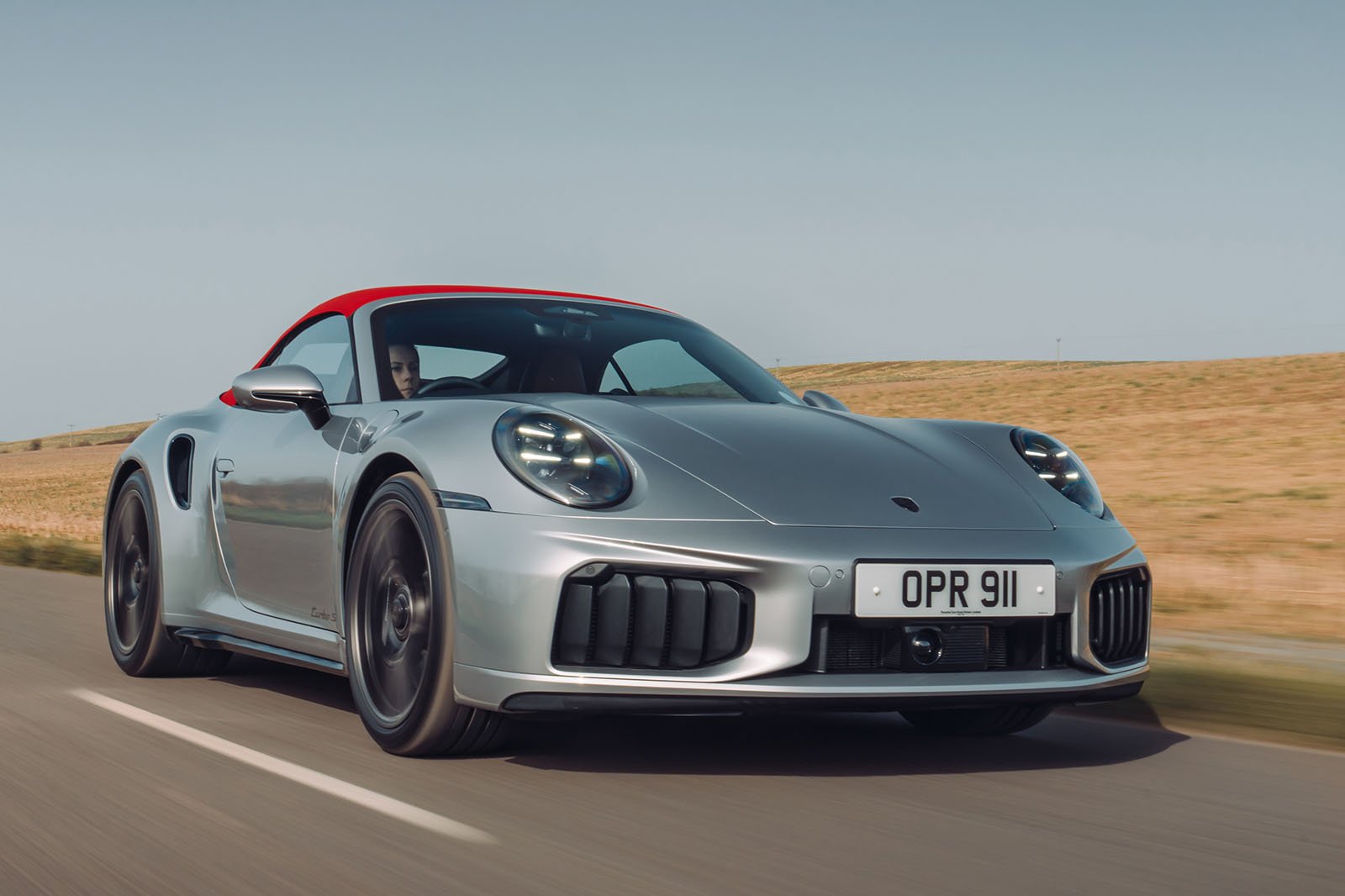
It rode really well, too. And in respect of its handling, you wouldn’t have known the active rear steer was doing its thing (Porsche does such systems better than anyone), and I could imagine commuting in it in summer or putting on a set of winter tyres and heading to the Alps in winter.
On circuit, some people have previously found the Turbo S a little cold, a little too perfect. Not a bit of it; not this time.
In its more tightly suspended drive modes, body control is impeccable. Some roll and pitch is allowed to lean reassuringly against, and there’s a hint of understeer that can be quelled with power or trailed braking; but it really moves around if you want it to.
It feels like there’s tremendous integrity too. This being a Porsche, I drove the car off the road, straight onto the circuit and ragged the bejesus out of it, with no drama, no fires, just some monitoring of the tyre pressures.
On UK roads, meanwhile, the Turbo S Cabriolet had excellent evident chassis integrity, too. It felt entirely natural and intuitive in its steering and handling; and had a way of tackling faster corners that spoke of 95 per cent stability and accuracy, with just a hint of vivid animation available if you were prepared to look hard, and carry plenty of speed, to unearth it.
Most abidingly, however, it felt taut, flat, reigned in and secure. Terser with its body control, and a little less yielding, supple and communicative in its inclinations perhaps, than some of its forebears. But certainly like a car whose chassis has really stepped up; no doubt in response to a powertrain that’s become even more potent than ever – but leading, arguably, to a bit of a character change for what was once considered Porsche’s wild child model.


