







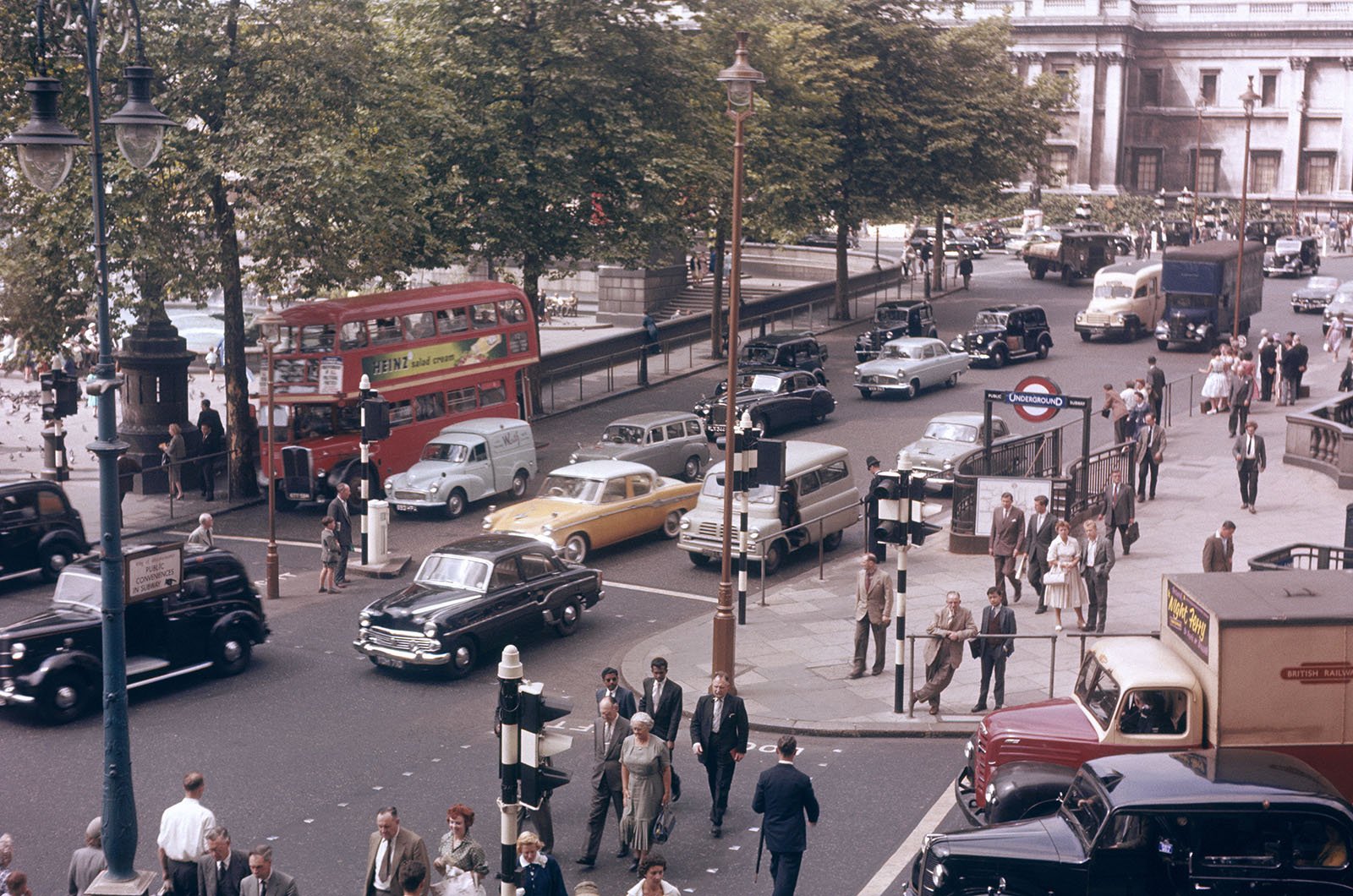
“A little flip of the trafficator means ‘I should like to get over to the left’ or ‘a bit farther on I’m going off to the left, though not yet’.” Coppers even had a ‘hurry up’ gesture.
Another complication was knowing where you were going. Today any driver can use sat-nav, but then they had to plan carefully before setting off, as landmarks and signage would usually be obscured by a mass of surrounding traffic. Indeed, we noted, “the regular’ is so crafty at dodging the more famous and more choked spots that he may rarely see Eros, the Law Courts or Nelson on his column”.
In a happy coincidence, British Pathé was also observing London traffic in 1952, immortalising this milieu. Its footage is fascinating to watch, reminiscent of modern-day Rome in its organised, functional chaos.
This is largely due to how much was left to drivers’ discretion, the road markings and infrastructure being strikingly minimal to modern eyes. Aside from the lack of white lines to demarcate lanes, there were no painted turn arrows, yellow or double-yellow lines (these would be introduced from 1960), hatched box junctions (1964) or similar clutter.
There were no speed cameras in fact, no cameras of any distinction, because there were no bus lanes, no congestion charge or ultra low emission zones. Traffic lights were less common and less prominent too (the modern standard design dates from 1968), traffic flow at busy junctions instead being dictated by policemen standing in the road. (This duty was obsolete by the mid-1970s, when the number of traffic light sets in London reached 1000.)
Yes, it was chaotic, daunting for outsiders and much less safe, but it was also pure – which in some way seems less stressful than what motorists experience in London today.


