







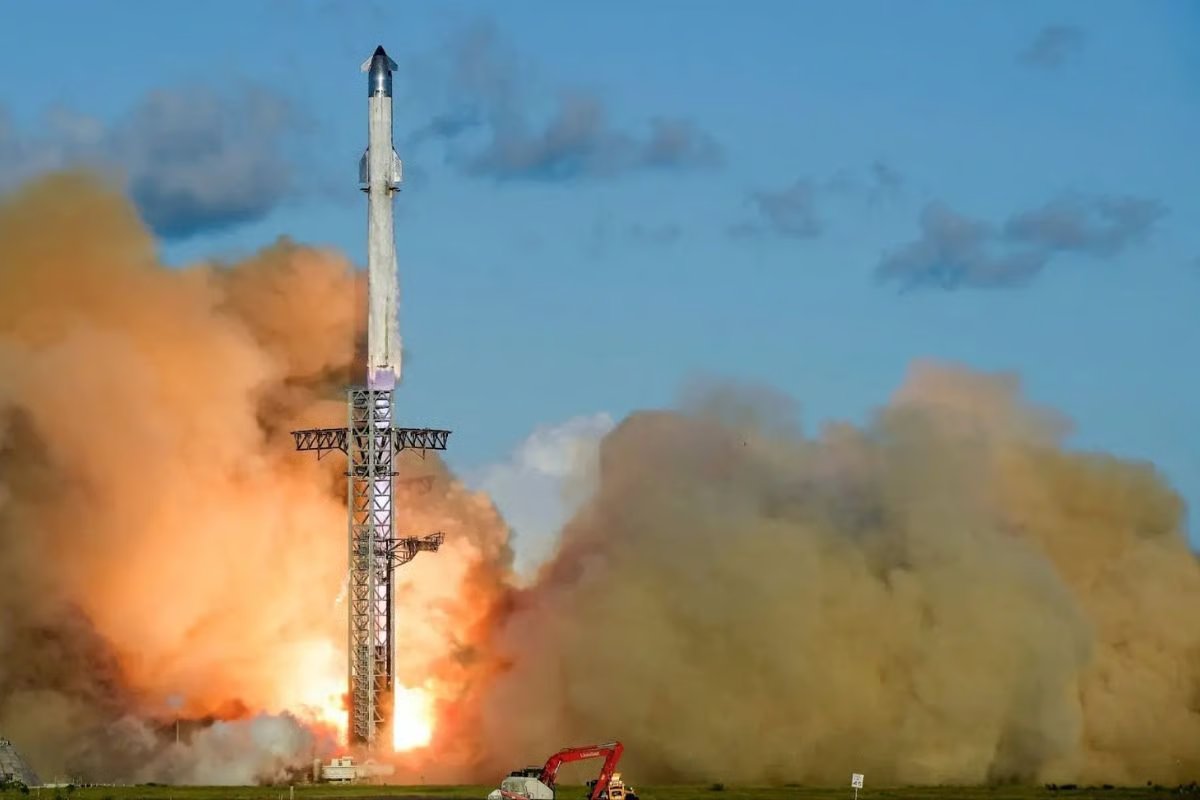
SpaceX is planning its first Starship launch since the aerospace company’s merger with Elon Musk’s AI venture xAI. It will also be the first test of the upgraded third-generation prototype, aimed at moving the rocket closer to operational capability.
The company outlined a broad 18-month timeline at the Mobile World Congress in Barcelona this week. This includes an operational Starship launch in early 2027 and a new Starlink satellite constellation by mid-2027.
The 12th test, due to take place in “four to six weeks” according to a comment by SpaceX president Gwynne Shotwell to the Financial Times, follows a successful October flight. Starship flew for about an hour, delivered a simulator payload, then re-entered and landed in the Indian Ocean.
There is a strong sense that this next launch will be critical to Starship’s timeline, which Musk sees as central to the company’s mission of making lunar and Mars missions more affordable.
At 120 metres tall, Starship is the largest rocket ever built and is designed to carry up to 250 metric tonnes of cargo. NASA has selected it as the lunar lander for the Artemis programme, and Musk believes it will eventually ferry people and cargo to Mars.
Since the last launch, SpaceX and xAI have merged. The tie-up has created a $1.25 trillion behemoth that is reportedly targeting a public listing next year, assuming Starship development proceeds smoothly.
Data centers in space
The merger has prompted Musk to outline potential synergies between the two businesses. One of the most eye-catching ideas is data centers in space, with SpaceX launching the infrastructure and xAI benefiting from what Musk argues would be more efficient and cost-effective AI training and inference.
For now, the financial case looks weak, as experts and rivals have both said the cost of deploying, operating, and maintaining data centers in orbit far exceeds running them on Earth. That is before accounting for the challenges of power generation, heat management in a vacuum, and shielding electronics from radiation.
Musk remains undeterred, recently suggesting on a podcast that space-based data centers could become viable within two to three years and may be the cheapest place to train AI. It would not be the first time he has set an ambitious timeline in an effort to accelerate development, and SpaceX is arguably in the strongest technical position to attempt it.
The Starlink expansion
Between Starship reaching operational status and any potential move into space-based data centers, SpaceX is focused on expanding Starlink’s capacity to reach millions more customers.
Michael Nicolls, senior vice-president of Starlink at SpaceX, said at MWC that the service had reached 10 million monthly users in February. The target is 25 million by the end of the year, driven by residential sales and partnerships with networks such as T-Mobile US and Virgin Media O2 in the UK.
SpaceX had previously considered spinning out Starlink as a separate company, positioning it as a steadier IPO candidate given its more predictable cash flow. Following the integration of xAI, that timeline appears to have shifted, with Starlink expected to remain a subsidiary within the broader group.
Also read: Starlink’s scale-up comes as Amazon’s Kuiper satellite expansion gets fresh FCC approval to add 4,500 more satellites.


