










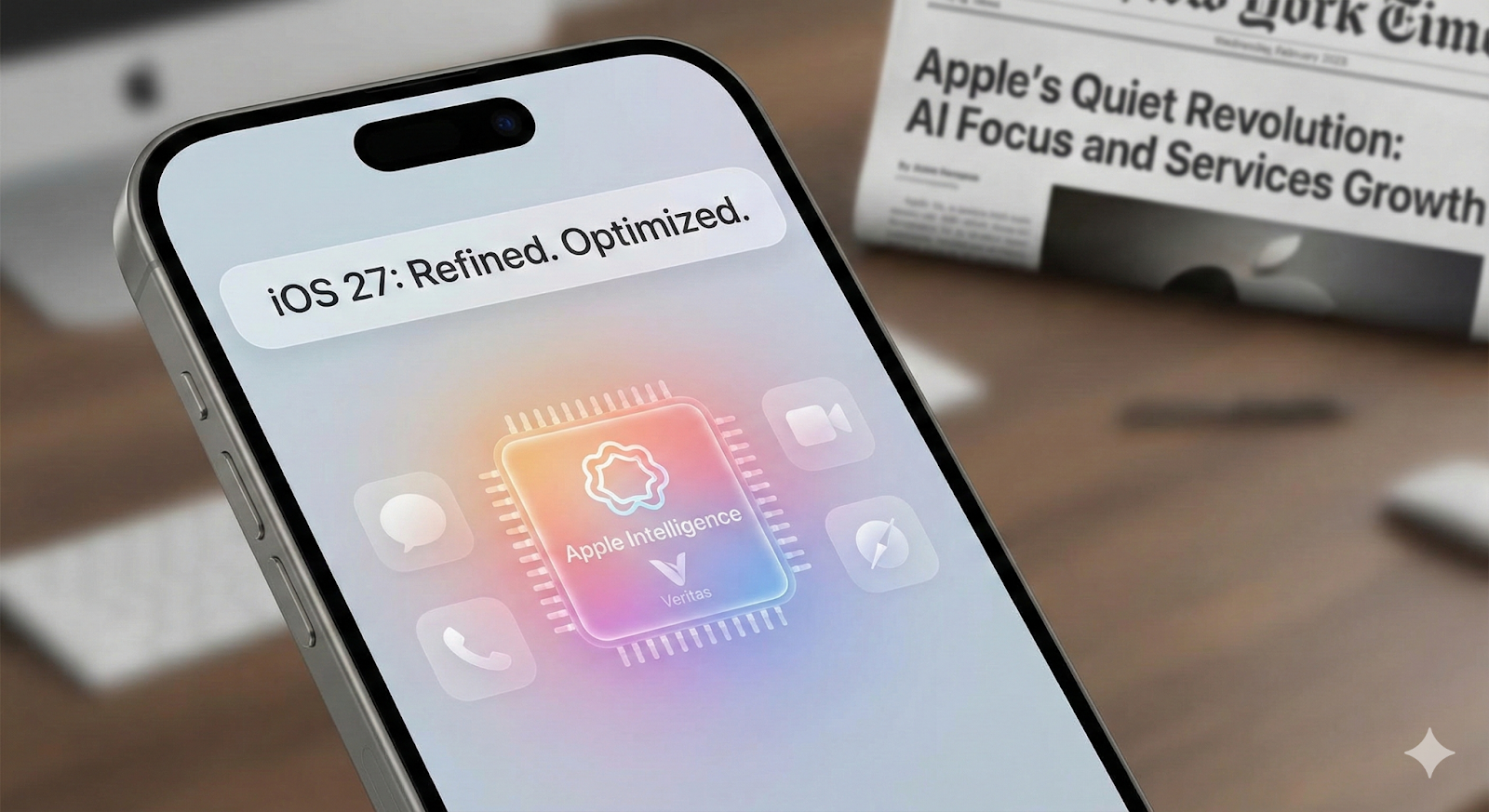
Anyone hoping for Apple to unleash fireworks at the next WWDC may be disappointed, with early signs pointing to a quieter, refinement-led iOS 27 launch.
Echoing the release cycle of OS X Snow Leopard in 2009, which followed the major OS X Leopard overhaul, Apple has reportedly shifted most of its focus to optimising and decluttering the iOS experience. This comes after the significant updates in iOS 26, led by the new unified design language, Liquid Glass.
This was first reported by Apple insider Mark Gurman, who said the company is not planning to launch any new features beyond improvements to the Apple Intelligence system.
iOS 26 delivered a wide range of changes alongside Liquid Glass, including widgets on the home and lock screens, battery optimisation tools, and expanded accessibility options. It is regarded as Apple’s most significant design update since the introduction of the frosted-glass UI in iOS 7, which replaced the skeuomorphic design present in the first six versions of iOS.
Focus on AI
While Apple can afford to take its foot off the design wheel for a few years, AI is a far more treacherous market.
The iPhone maker is keenly aware that it is behind leading-edge companies such as Google. As a result, Apple is pouring resources into improving its internal models. At present, Apple relies on OpenAI’s ChatGPT for more complex tasks, including broad general knowledge queries and modelling that exceeds the capabilities of the device’s local model.
Apple has reportedly been testing its own chatbot, known internally as Veritas, which could rival ChatGPT and Gemini. It is also building an AI agent for Apple Health, which would be available to subscribers.
A top-to-bottom update to Siri may also be on the horizon, with Apple planning to rebuild the virtual assistant’s architecture entirely on a large language model engine. The company has reportedly explored partnerships with Google Gemini, OpenAI, and Anthropic for this, which could result in a multi-billion-dollar agreement with whichever partner is selected. Apple has already enhanced Siri with a ChatGPT integration, but this may be a stopgap ahead of a full rework.
If a partnership doesn’t work out, Apple CEO Tim Cook has signalled the company is open to an acquisition that aligns with its roadmap and strengthens its position in the AI market. Given the enormous valuations on some of the premier AI operators, however, it may be too rich for Apple’s blood, with the company’s largest acquisition still of Beats Electronics for $3 billion in 2014.
Services surpassing hardware
While the latest crop of iPhones has been a hit with consumers, it may be partly due to a good replacement cycle more than anything else. Cycles are getting longer each generation, with customers increasingly comfortable holding onto their devices for more than two years. To offset that trend, Apple is investing heavily in expanding its services portfolio, with AI offering new avenues for subscription sales.
It is not clear whether Apple plans to use this strategy for the revamped Siri or its standalone chatbot, but there is clearly a market opportunity. OpenAI recently reported a revenue run rate of around $ 20 billion, with a substantial share coming from ChatGPT subscribers.
Apple’s services division accounted for 28% of total revenue in the latest financial quarter, generating more than the iPad, Mac, and Wearables categories combined. On top of that, the services division operates at a gross margin of roughly 70% to 72%, far higher than Apple’s hardware segments. That makes the division significantly more lucrative, provided Apple can keep users buying in-app items, subscribing to its services, and viewing ads on its mobile advertising platform.
Earlier in Apple’s AI push, an internal ChatGPT-style Veritas chatbot for testing Siri upgrades on iPhones was used to help the company trial a more capable assistant before it ships.


