


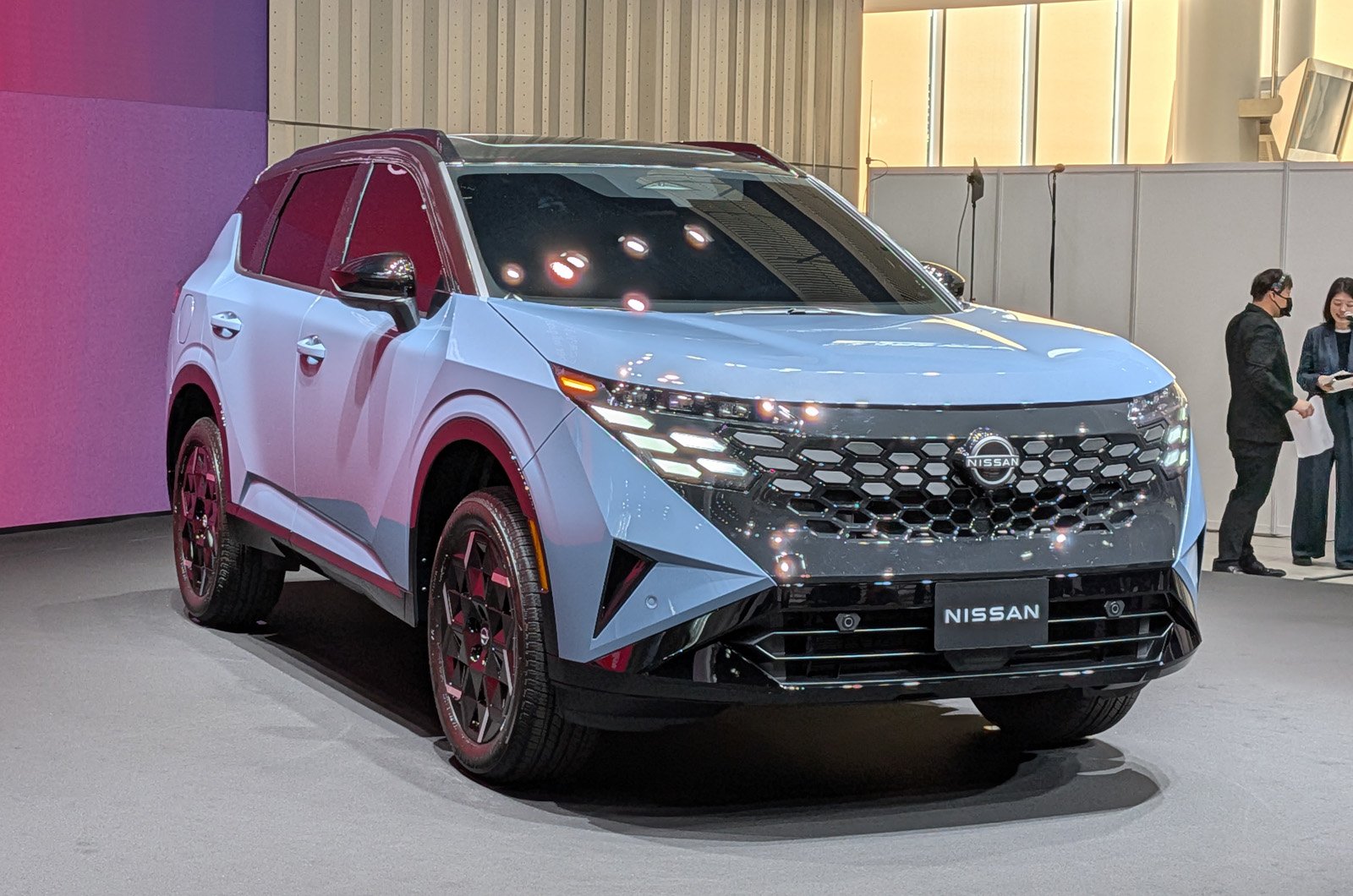
Nissan has revealed the new X-Trail SUV as part of a wide-reaching overview of the company’s future strategy, design language and model line-up.
Revealed alongside the new electric Nissan Juke in an event at the company’s Yokohama headquarters in Japan, the new X-Trail E-Power is due next year as a rival to the Skoda Kodiaq, Kia Sorento and Peugeot 5008.
Nissan has shown only the exterior of the car so far and offered no technical details, but the E-Power badging confirms it will feature a version of the company’s full-hybrid powertrain.
This system differs from conventional parallel hybrid technology in that the petrol engine is used purely as a generator to charge a small battery, which then powers the electric motor driving the wheels.
The X-Trail is already offered in E-Power form but is expected to receive the significantly upgraded system that recently made its debut in the smaller Qashqai, for increased power, refinement and efficiency.
The new car is expected to be closely related under the skin to the current X-Trail, which was itself recently restyled and tweaked as part of a mid-life facelift.
With a targeted launch date of 2027 for the new X-Trail and the current X-Trail having come to the UK only four years ago, it’s unclear when the new car will come here.
It’s possible that it could go on sale in the US as the Rogue first, before coming to Europe later, as was the case previously.
While the new X-Trail is expected to retain the modular CMF-CD platform used by the current car, it has been extensively redesigned in line with Nissan’s new design hallmarks.
It has a bold new front end, dominated by a distinctive trapezoidal grille and angular LED lighting signatures, while the sides are more heavily creased and the back end has been made more angular and chunky too.
It was revealed as Nissan outlined details of the final year of its ‘Re:Nissan’ recovery plan, designed to take the company back to growth following a turbulent few years of falling sales and financial woes.
Central to the strategy is a ‘streamlined’ global product portfolio of 45 models, down from 56 today, with a greater focus on the “clarity of role” for each product.
That means Nissan will axe low-performing models and channel investment into its most successful lines, as part of a push to deliver “a competitive cost base, improved capacity utilisation and strong new‑product momentum that lays the groundwork for future growth”.
