









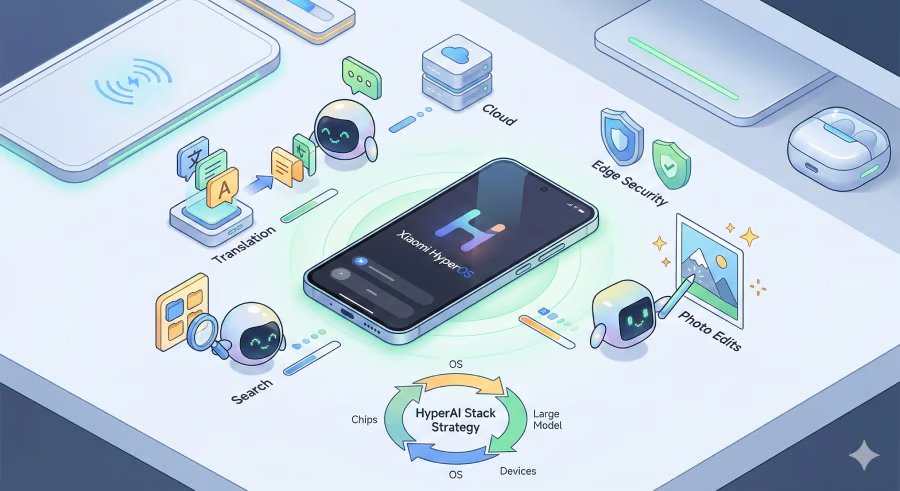
Smartphone AI is moving away from flashy demos and toward the things people do every day: writing tools, translation, search, photo edits, and system shortcuts. The companies that win this phase won’t necessarily have the most talkative assistant. They’ll have the most consistent integration.
Xiaomi is taking that approach with HyperOS, pitching AI as a built-in layer across the operating system rather than a standalone destination. If it works, it’s less about talking to your phone and more about removing friction from routine actions.
What Xiaomi says HyperAI is (and what it isn’t)
On its Xiaomi HyperAI page, Xiaomi describes HyperAI as embedded with Google’s “deeply customized AI assistant” and powered by Xiaomi’s multimodal capabilities across text, sound, and image. The positioning suggests compatibility with Google services, not a clean break or a direct replacement.
In practice, OS-level AI tends to show up as small, repeatable assists: rewriting a paragraph in an email draft, translating text on-screen without switching apps, summarizing a long message thread, extracting dates and locations into a calendar entry, or turning a screenshot into editable text. Those are not “voice assistant” moments — they’re workflow moments, and they live inside the OS.
Xiaomi also leans heavily on privacy framing in its public messaging. Its HyperOS materials emphasize “edge-to-cloud AI data security,” including on-device privacy storage and secure transmission. That does not mean every AI feature runs entirely on-device, and Xiaomi does not claim that it does. The safer read is that Xiaomi is trying to reassure users about how data is handled across the device and the cloud — and to signal that AI features can be deployed with clearer guardrails than a default “send it all to the cloud” approach.
Why Xiaomi’s ‘stack’ strategy matters
The broader context is Xiaomi’s long-term push to control more of its technology stack. According to Gasgoo, Xiaomi CEO Lei Jun said the company will commit 200 billion yuan to R&D over the next five years and aims for a 2026 “grand convergence” that brings its in-house chip, in-house OS, and in-house large AI model together in a single device.
For users, stack control can translate into fewer seams: tighter performance tuning, clearer permissions, more predictable background behavior, and OS hooks that make AI features feel native instead of bolted on. The tradeoff is that deeper OS integration raises the bar on transparency and controls, because OS-level AI can touch more of what the phone sees and does.
In the near term, the test is simple: will HyperOS AI feel cohesive and predictable, or like a bundle of AI toggles competing for attention? Xiaomi’s bet is that OS-level integration and privacy positioning will make AI feel useful in real workflows, not just in demos.
Also read: Samsung’s Galaxy S26 rollout shows how quickly mobile AI is turning into a platform battle in its Unpacked 2026 launch.


