


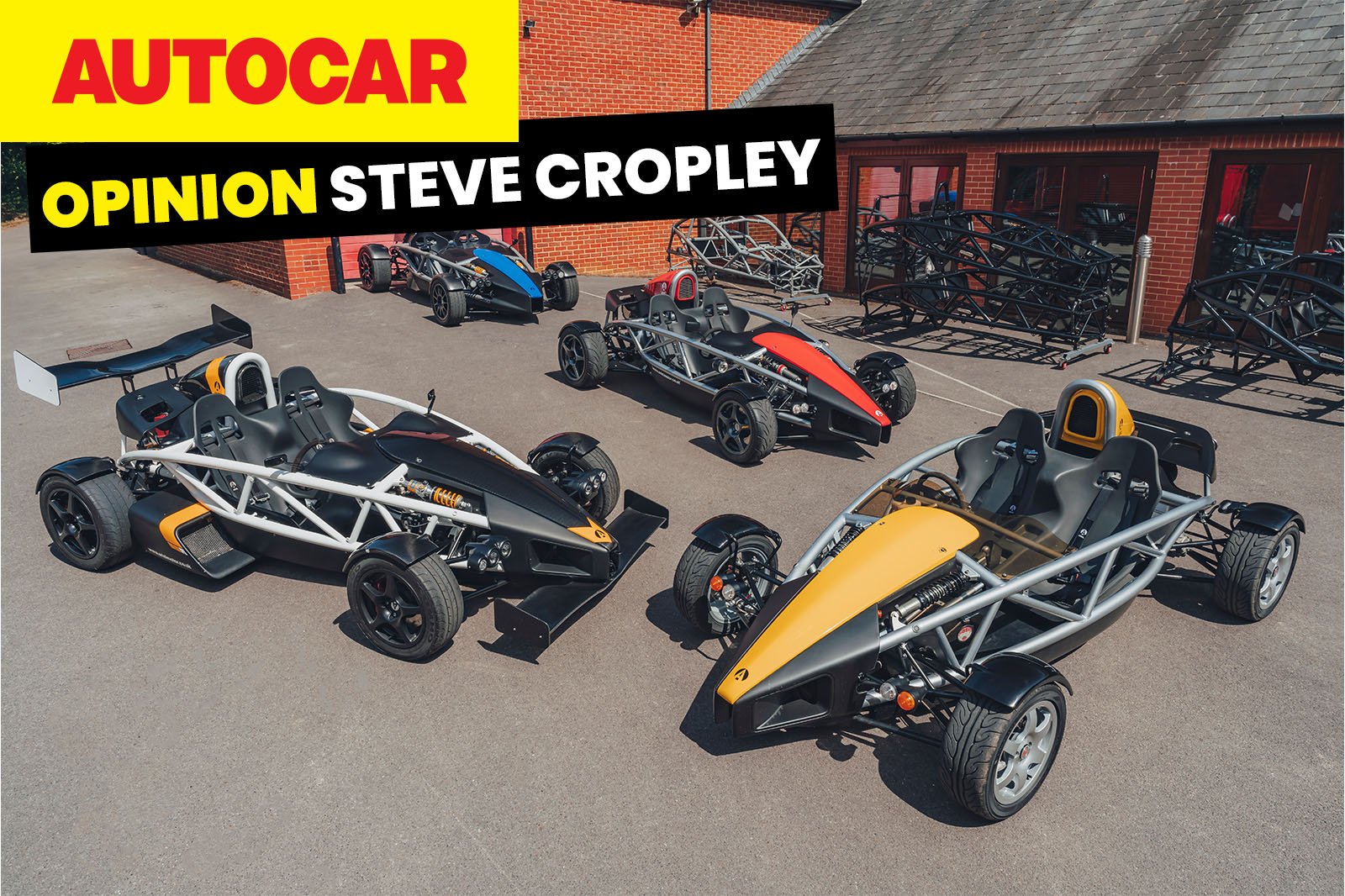
People think the main thing about starting a car company is coming up with a special machine that people will want to buy – but that’s only part of it.
A key part, for sure, but almost certainly not the biggest part. And the reason I love Ariel so much is because its founder and owner, the creator of its cars and the bloke who still makes all the big decisions, Simon Saunders, understood all these things from the beginning.
The Atom, the basis of Ariel’s success over four generations, had its beginnings 25 years ago in a design competition run by Saunders (with Autocar participation) during his time as a senior lecturer at Coventry University’s transport design school.
Already a proven designer of mainstream cars, motorcycles and supercars, Saunders was continuing to run a solus design consultancy while attempting (out of the goodness of his heart) to help students learn the invaluable lessons from industry you don’t find in books.
The simple, skeletal Atom, designed in the mid-1990s by student Niki Smart, stood out from the rest as having the potential for production.
Saunders set about forming the business that would be needed to make it – refining the design to make it practical for real, live buyers, acquiring rights to the age-old name of a once-famous British firm that made cars and bikes, visualising how and where the new cars could be made, negotiating with potential parts suppliers, raising finance, designing an efficient build process, deciding how the cars would be sold (direct from the factory), understanding the implications of providing a service and repair facility, and seeing the beauty of controlling the second-hand market.
Born in Coventry as the LSC (Lightweight Sports Car) in 1996, the car went on sale in 1999 as the Ariel Atom – the name suggested back in the day by your humble author. The original base was a couple of converted barns at Saunders’ own home in Crewkerne, Somerset, but as the business grew, it moved to roomier premises a few miles out of town.
Over time, the Atom was joined by a radically designed motorbike (powered by a 1200cc Honda V4) called Ace, then by a much-praised off-road buggy called Nomad (also Honda-powered). Annual production of all three combined has never totalled much more than 200 (Saunders has always seen the beauty of simplicity and a small size for his company), and the waiting list for cars and bikes has frequently exceeded a year, even through the Covid lockdowns.
However, the growing service and secondhand business, and Saunders’ urge to have more space for a “proper” museum and for bigger workshops to build the cars that he’s always developing in secret (such as the 1180bhp Hipercar EV), means Ariel will move over the next year or two into new, purpose-built headquarters near Yeovil, which will make it possible for more vehicles to be produced and for the waiting list to be shorter.
But in usual car company terms, Ariel will never be bigger than tiny, and it will always shun mainstream vehicles in favour of the most radical designs. This and the wise, self-made nature of Ariel’s formation is why I love it.
