







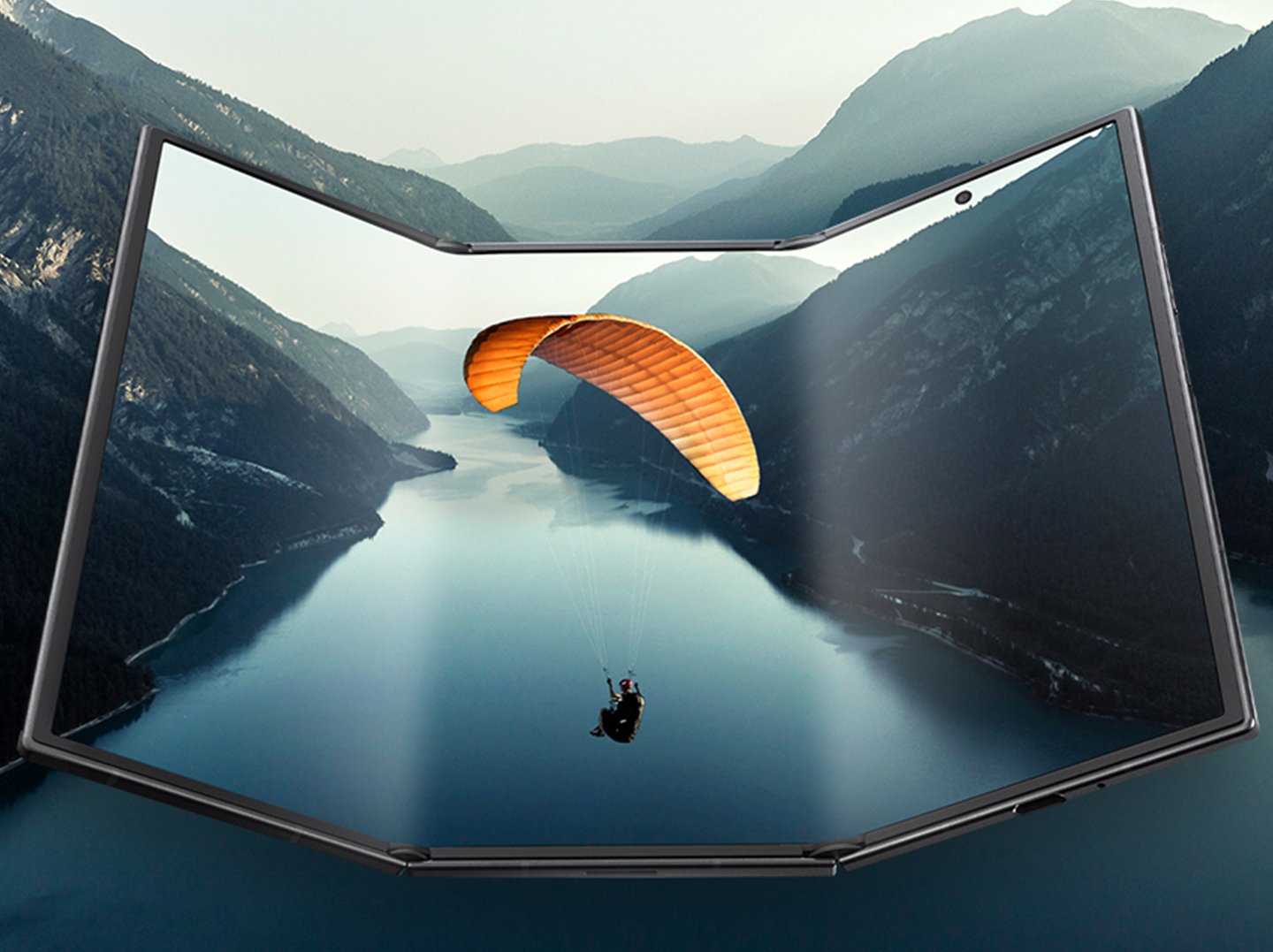
Samsung Electronics has unveiled, or perhaps unfurled, the Galaxy Z TriFold, a device the company calls its most ambitious foldable phone yet.
The TriFold expands on a decade of Samsung foldable research, offering a twice-folding design that transforms from a standard smartphone into a 10-inch tablet-like workspace.
It arrives at a moment when smartphone makers are competing to integrate large displays, enhanced multitasking, and new AI-enhanced productivity features without compromising portability.
Productivity and portability
According to Samsung, the Galaxy Z TriFold folds twice using an inward-folding mechanism that protects its expansive main display. When fully opened, the device becomes a 10-inch screen capable of running multiple apps simultaneously. When folded, it becomes a slim, pocketable smartphone that’s 3.9 mm at its thinnest point. Samsung has positioned the device as the answer to a long-standing industry challenge: delivering tablet-level utility in a form factor that remains practical for everyday carry.
This approach reflects broader industry trends. As hybrid work habits solidify and mobile users demand more flexible computing, tech companies are blending smartphones, tablets, and laptops into multifunctional devices. Samsung’s design suggests that the company aims to capture users who want to replace multiple devices with one versatile product.
The phone is powered by Qualcomm’s customized Snapdragon 8 Elite Mobile Platform for Galaxy and features a 200-megapixel camera, signaling that Samsung intends the TriFold to deliver not only productivity features but also flagship-level performance across content creation and imaging. Its 5,600 mAh three-cell battery system spans each folding panel to ensure balanced power delivery, a structural approach that could influence future foldable engineering across the industry.
Display and durability
Samsung emphasized that the TriFold required significant reengineering of hinge, display, and materials technology. The device uses two differently sized Armor FlexHinges working in tandem, allowing the display panels to meet with minimal gaps. This reduces dust exposure and improves long-term reliability, both key concerns for consumers who may be wary of early-generation foldables.
The display incorporates a shock-absorbing layer and reinforced overcoat, and the exterior uses titanium hinge housing and a frame built from Advanced Armor Aluminum. Samsung also highlighted new quality-control measures such as CT-scanning flexible circuit boards and laser-scanning component alignment. These insights suggest that durability—a major point of scrutiny for foldables—remains a central priority.
AI experiences
Beyond hardware, Samsung is using the TriFold to expand its ecosystem of AI-enabled experiences. Many of its Galaxy AI features, including Photo Assist, Generative Edit, and Sketch to Image, adapt automatically to the large display. This scaling capability matters because the industry is entering an AI-first phase in which hardware must support faster multimodal processing, larger on-screen workloads, and real-time assistance.
The device introduces standalone Samsung DeX for the first time on a phone, enabling up to four separate workspaces that can each run multiple apps. This effectively turns the TriFold into a portable workstation. Such features hint at the growing overlap between smartphones and PCs, potentially reshaping expectations for mobile productivity tools.
The inclusion of Gemini Live support, Google’s multimodal AI assistant, further ties Samsung’s devices into cross-platform AI ecosystems. Users can point the camera at a room, a store listing, or design materials and receive contextual suggestions. This feature highlights how major tech firms are now using AI to integrate visual analysis, language models, and real-time processing directly into handheld devices.
That’s entertainment
Samsung is also promoting the TriFold as a new type of entertainment device. The 10-inch Dynamic AMOLED 2X screen delivers up to 1,600 nits of brightness, while the outer cover display reaches 2,600 nits. Minimized creasing is intended to improve video viewing and reading, addressing one of the most frequent complaints about earlier foldables.
In the TV and display market, these design choices indicate the company’s intent to bring premium visual technology to mobile screens as streaming and mobile video consumption continue to rise.
Global rollout
The Galaxy Z TriFold will launch first in South Korea on Dec. 12, 2025, followed by China, Taiwan, Singapore, and the UAE. A U.S. release is slated for the first quarter of 2026. Samsung is bundling incentives, including six months of Google AI Pro and a one-time 50 percent discount on display repairs.
As competitors such as Huawei, Xiaomi, and Google advance their own foldable portfolios, the TriFold reinforces Samsung’s effort to remain at the forefront of premium mobile hardware. The device’s introduction may accelerate industry momentum toward multi-folding form factors, marking a significant shift in how mobile devices are designed and used.
Last month, Samsung’s Vision AI Companion officially launched across the company’s entire 2025 lineup, turning ordinary televisions into conversational AI assistants that actually understand what they are seeing.


