


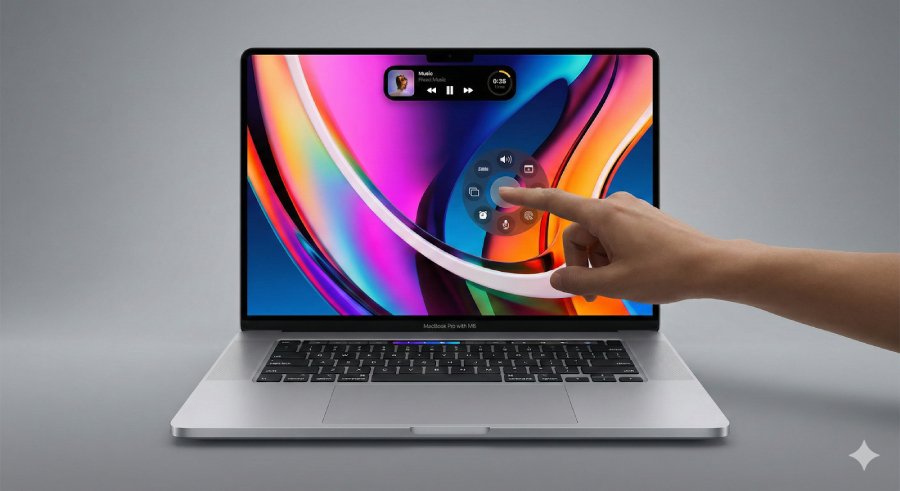
Apple’s MacBook Pro may be about to get its biggest makeover in years.
According to a new Bloomberg report, Apple is preparing to launch its first touchscreen MacBook Pro, powered by the upcoming M6 chip, with major changes to both hardware and software. The overhaul is expected toward the end of 2026 and will mark a significant shift for a company that long resisted touch-enabled laptops.
Bloomberg’s Mark Gurman reports that Apple’s redesigned 14-inch and 16-inch MacBook Pro models, internally code-named K114 and K116, will introduce OLED displays with touch support. This will be the first time Apple uses OLED technology in a MacBook. OLED is already used in iPhones and offers deeper blacks, improved contrast, and better color accuracy compared to traditional LCD panels.
The touchscreen feature won’t replace the keyboard and trackpad. Instead, Bloomberg says Apple intends to blend touch with the existing point-and-click experience. The MacBook Pro will continue to look largely like current models, complete with a full keyboard and large trackpad.
Dynamic Island coming to Mac
One of the most eye-catching additions is the Dynamic Island, a feature introduced with the iPhone 14 Pro lineup in 2022.
On the new MacBook Pro, the Dynamic Island will sit at the top center of the display, built around a smaller hole-punch cutout for the camera. It will replace the current notch design found on existing MacBook Pro models.
Bloomberg reports that the Dynamic Island will function similarly to its iPhone counterpart, displaying alerts, media controls, and live activities. It will also support third-party app integrations. The hole-punch cutout is said to be smaller than the pill-shaped cutout currently used on iPhones.
macOS is getting a touch-friendly overhaul
The touchscreen addition is not just about hardware. Apple is also redesigning parts of macOS to better support touch input.
According to Bloomberg, the system will feature a dynamic interface that adapts based on how users interact with the device. If someone taps a button or control, the interface will display a new menu around their finger, offering touch-optimized options.
If a user taps items in the menu bar at the top of the screen, controls will enlarge to make them easier to select. Other features, such as the emoji picker, will also receive touch-optimized updates.
The display will support familiar iPhone and iPad gestures like fast scrolling and pinch-to-zoom for images and PDFs. However, Apple is not positioning the MacBook Pro as a touch-first device or an iPad replacement. Instead, the touchscreen will complement traditional input methods rather than replace them.
Eating their words?
For over a decade, Apple executives have famously trashed the idea of a touchscreen laptop. Steve Jobs once called the concept “ergonomically terrible,” arguing that users’ arms would get tired from poking a vertical screen.
Even as recently as 2021, Apple’s hardware chief John Ternus told the Wall Street Journal that the company already makes the “best touch computer” with the iPad and that they hadn’t “really felt a reason to change that.”
However, with Windows competitors offering touch as a standard feature and Apple’s own software becoming more unified across devices, the company appears ready to evolve. The aim is to give users more choices without forcing them to abandon the traditional point-and-click precision they expect from a Pro machine.
While new MacBook Pro models powered by updated M5 chips are expected soon, Bloomberg notes that the touchscreen OLED version will not be part of that immediate rollout. Instead, the M6-powered MacBook Pro models with touchscreen are currently slated for launch closer to the end of 2026.
Also read: A broader MacBook Pro overhaul is already taking shape for 2026.
