









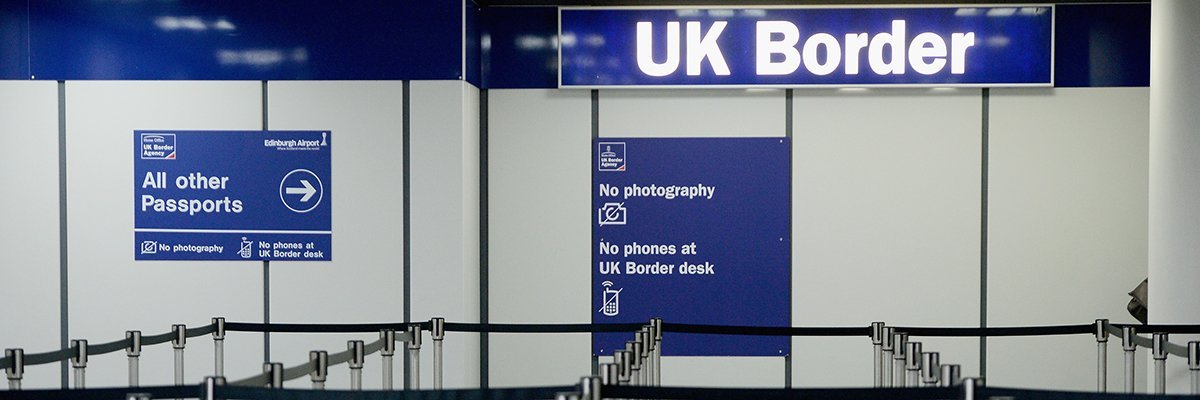
Police do not have to give a lawyer who was stopped, questioned and had his work mobile phone seized for forensic examination reasons for their actions, the UK’s high court has ruled.
The decision means that lawyers can be subject to counter-terrorism powers and have their privileged communications extracted and examined by the state, without having the right to know the case against them, said advocacy group Cage.
Fahad Ansari, who acts for Hamas in a legal appeal to have its proscribed status in the UK overturned, was stopped by police under Schedule 7 of the terrorist act while returning from holiday with his family last year.
The case is believed to be the first targeted use of Schedule 7 powers, which allow police to stop and question people and seize their electronic devices without the need for suspicion, against a practising solicitor.
The high court ruled on 4 March that police may present evidence about the reasons stopping Ansari in a closed court in front of a special advocate without Ansari or his lawyers being present – preventing Ansari or his legal team from learning the reasons why he was stopped.
Lawyers for Ansari argued the lawyer was entitled to be given a sufficient “gist” of the police’s case against him to enable him to disprove the police’s case, even if doing so would be damaging to national security.
Privileged material
Hugh Southey KC told the court in October 2025 that Ansari’s work phone contained data going back 15 years, including privileged material relating to his clients, and that any data extracted by the police should be deleted.
Ansari, an Irish citizen, argues that he was unlawfully stopped, detained and questioned under Schedule 7 of the Terrorism Act when he disembarked from a ferry with his family at Holyhead after visiting relatives in Ireland in August 2025.
The court was told last year that the phone contains details of at least 3,000 contacts, voice notes, memos, case papers, search terms and metadata, the overwhelming proportion of which is likely to be legally protected.
Justice Chamberlian found in a judgment published today the question was not whether any allegations made against Ansari by police in closed hearings were true, but whether police had a lawful basis for stopping and searching the lawyer at the time the search was carried out.
He found in a 15-page ruling that the use of Schedule 7 powers against Ansari to question him and seize his phone does not require any allegation to have been made against him, and that the seizure and retention of his personal information does not affect Ansari’s legal position.
The judge found that there were “substantial protections” in place to protect the integrity of legally privileged information, and that even if legally privileged material could be used against third parties, which it could not, they would enjoy the “full panoply of procedural rights”.
Ansari said he handed over the password to his phone after police warned him that to fail to do so would be an arrestable offence. He said that police also questioned him about Palestine Action, a direct action protest group that was proscribed under the Terrorism Act 2000, though Ansari has no connection with the group.
South Wales Police, which is responsible for counter-terrorism in Wales, has denied that Ansari was stopped because of his political views, and maintains that asking him questions about proscribed organisations is not unlawful.
Ansari, a registered freelance solicitor, became consultant at Duncan Lewis Solicitors, where he specialises in national security and complex human rights cases, after training at Fisher Meredith LLP and Birnberg Peirce.
Speaking after the judgement, Ansari said he would challenge the judge’s order that the police should not disclose their reasons for stopping him in open court.
“Seven months on, I remain in the dark about why counter-terrorism police detained and interrogated me and continue to examine the contents of my work phone,” he added. “I am exploring all options to challenge this dangerous precedent.”
Commenting on the case, Anas Mustapha, head of public advocacy at Cage, said that allowing secret evidence was a “thin end of the wedge” that could undermine justice. “Once courts accept that the state can accuse someone without revealing the accusation, the foundations of justice begin to collapse,” he added.
“The legal profession now faces a serious question: whether it will continue to accommodate secret courts through mechanisms like the special advocate system, or whether it will begin the difficult work of rolling back a process that has steadily eroded open justice for more than two decades,” said Mustapha.


