










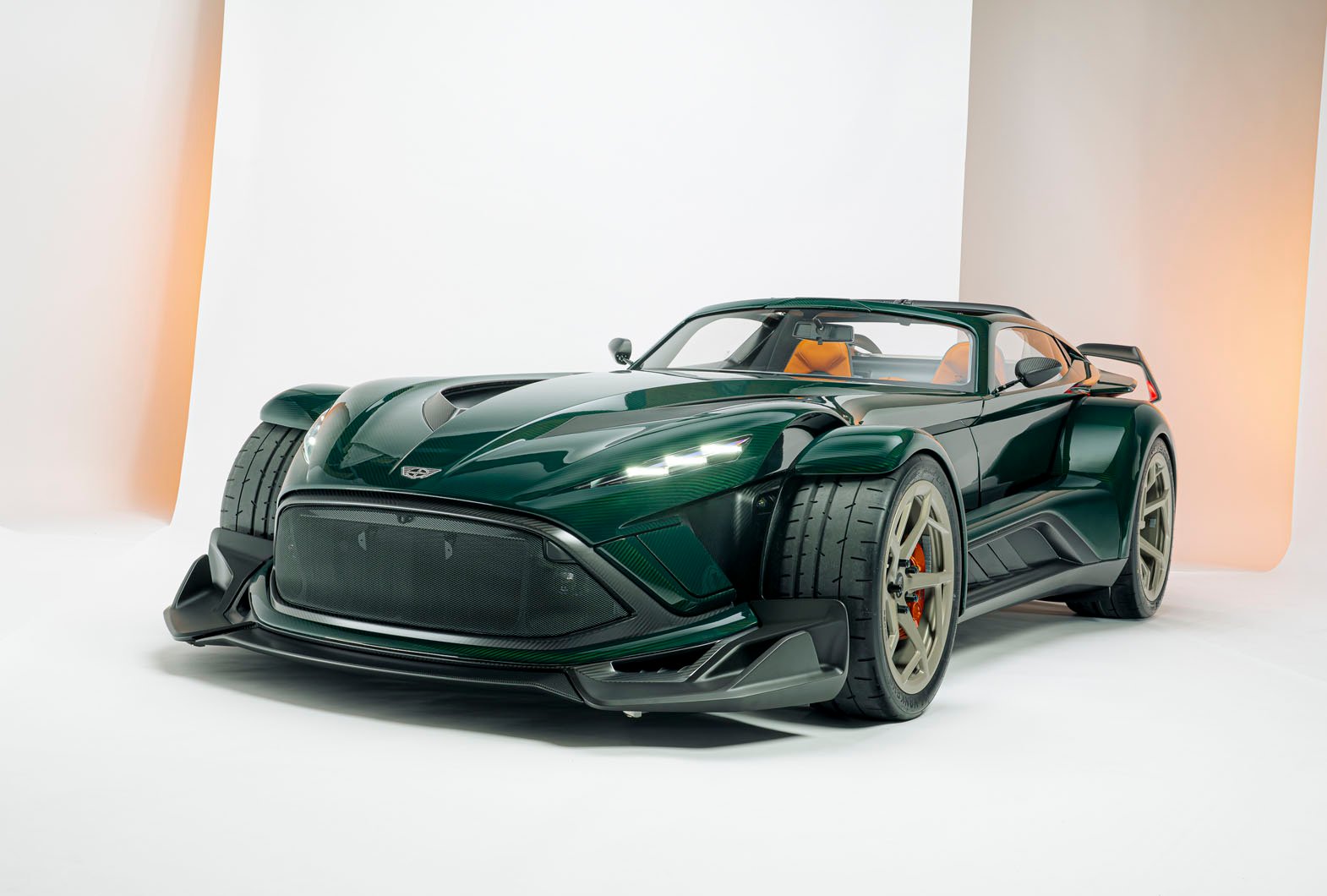
Aided by extensive use of carbonfibre throughout, especially in the chassis (which, like most of the car’s components, has been created by the maker’s Ex-Core Technologies arm), the two-seater offers a power-to-weight ratio of 758bhp per tonne – and Denis Donkervoort said: “That’s the part I’m most proud of.”
The engine is the first V6 to be used in a production Donkervoort. Because it is more compact than the Audi five-pot, it can be positioned more centrally in the car, enabling a better weight distribution. It also means a lighter five-speed gearbox – one that happens to have longer ratios – can be fitted.
Speaking about how different the Donkervoort is with a V6 supplying the power, Denis Donkervoort said: “We are still learning a lot. Every mile you drive, you gain experience. To make it simpler, in the GTO (of 2011-2021), and F22 we had our [Audi] five cylinder. The difference [with this V6] is 80hp, but this 80hp meant a different turbo, a different intercooler, different software, and already, between those models, the character of the engine is huge. It’s a new heart. It has its own character.
“What I really like about [our] V6 is that we have put so much effort in throttle response and having no turbo lag, and that’s, of course, on a car that has a weight of 780kg kilos and 600hp is essential.”


