


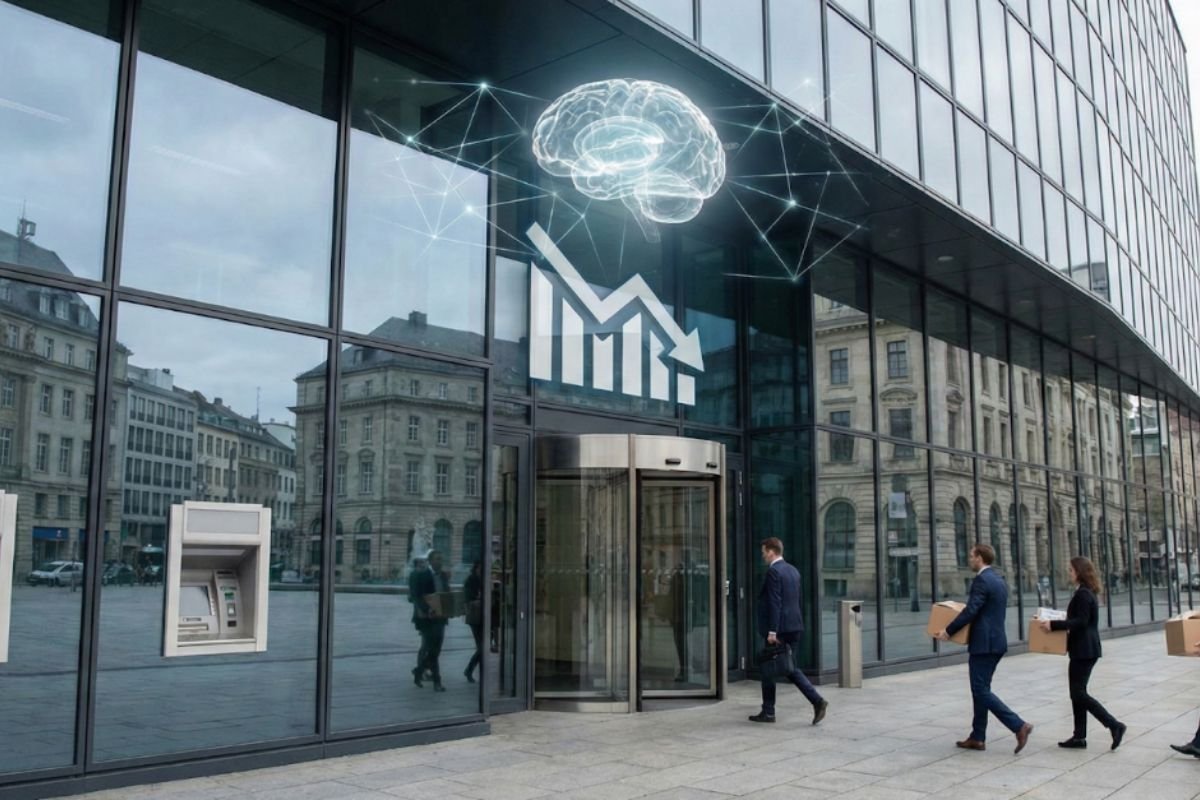
More than 200,000 banking jobs in Europe could be eliminated by the end of the decade as lenders accelerate their adoption of artificial intelligence and reduce the number of physical branches.
The warning comes from analysts at Morgan Stanley and was first reported by the Financial Times.
According to the analysis, Europe’s banks could reduce their workforce by about 10% by 2030. The estimate is based on a review of 35 major lenders that together employ around 2.12 million people. A cut of that size would translate to roughly 212,000 roles disappearing over the next five years.
The job losses are not expected to hit all areas equally. Morgan Stanley says the biggest impact will be felt in so-called “central services” teams. These include back-office and middle-office roles, as well as positions in risk management and compliance.
Banks believe these functions are especially suited to automation as AI tools become better at handling routine processes, data checks, and reporting tasks that have traditionally relied on large human teams.
“Many banks have quoted efficiency gains coming from AI and further digitalisation to the tune of 30 per cent,” Morgan Stanley said, as reported by the Financial Times.
Investor pressure fuels the push
Behind the drive to automate is growing pressure from investors. European lenders have long struggled to match the profitability of their US counterparts, particularly in terms of returns on equity. With past cost-cutting efforts losing momentum, AI is increasingly seen as the next major lever to pull.
Morgan Stanley’s analysts said the technology offers a fresh chance to improve banks’ cost-to-income ratios — a key efficiency metric closely watched by investors — at a time when traditional cost-cutting has “run out of steam,” according to the Financial Times report.
Caution from inside the industry
Despite the rush to deploy AI, some senior bankers are urging restraint. Conor Hillery, JPMorgan Chase’s co-chief executive for Europe, the Middle East, and Africa, warned against moving too fast.
“The one thing we have to be very careful about — in this rush and excitement about AI in our world of banking — is that people don’t lose an understanding of the basics and fundamentals,” Hillery said, according to the Financial Times.
He further cautioned that without a balance between AI speed and human training, “Otherwise, we’re storing up a big problem for the future,” Hillery said.
Beyond Europe
The shift isn’t just a European phenomenon. Across the Atlantic, Goldman Sachs spent much of late 2025 implementing its “OneGS 3.0” strategy — a multi-year overhaul designed to rewire the bank’s operations using AI.
While the firm signaled a hiring slowdown and targeted job cuts through the close of 2025, analysts are watching closely to see how these efficiency gains manifest in 2026. Goldman’s leadership has maintained that while some roles in client onboarding and regulatory reporting are being automated, the long-term goal is to reinvest those gains into higher-level advisory work.
For the 2.12 million people currently working in Europe’s major banks, the next four to five years will be a period of significant retraining or, for many, a transition out of the industry entirely as the algorithm era takes full command.
Also read: Bezos and Jassy say attitude can be a hiring red flag as AI reshapes the job market.
