









Humanoid robots have long been staples of research labs and flashy conference demos, but falling hardware costs and advances in AI are finally pushing them into real-world deployments.
Prices have plunged from hundreds of thousands of dollars to just a few thousand, with consumer-facing quadrupeds starting as low as $1,600 and laundry-folding robots like Weave Robotics’ Isaac 0 debuting at around $7,999.
But for enterprise IT leaders, the biggest shift won’t be the sticker price of the robots themselves. It will be the massive operational infrastructure required to support fleets of autonomous, steel-and-motor machines roaming through your physical office or warehouse environments.
During a recent live demonstration on the Neuron Live podcast, a Unitree humanoid robot — a model from one of the leading next-gen Chinese robotics manufacturers powered by software from Zurich-based AI startup Flexion Robotics — navigated an office hallway, autonomously located a ladder, picked up a box, and successfully opened a door.
The demonstration reflected a broader shift across the industry: hardware is becoming commoditized and affordable, while the software brain that enables autonomy is becoming the true differentiator.

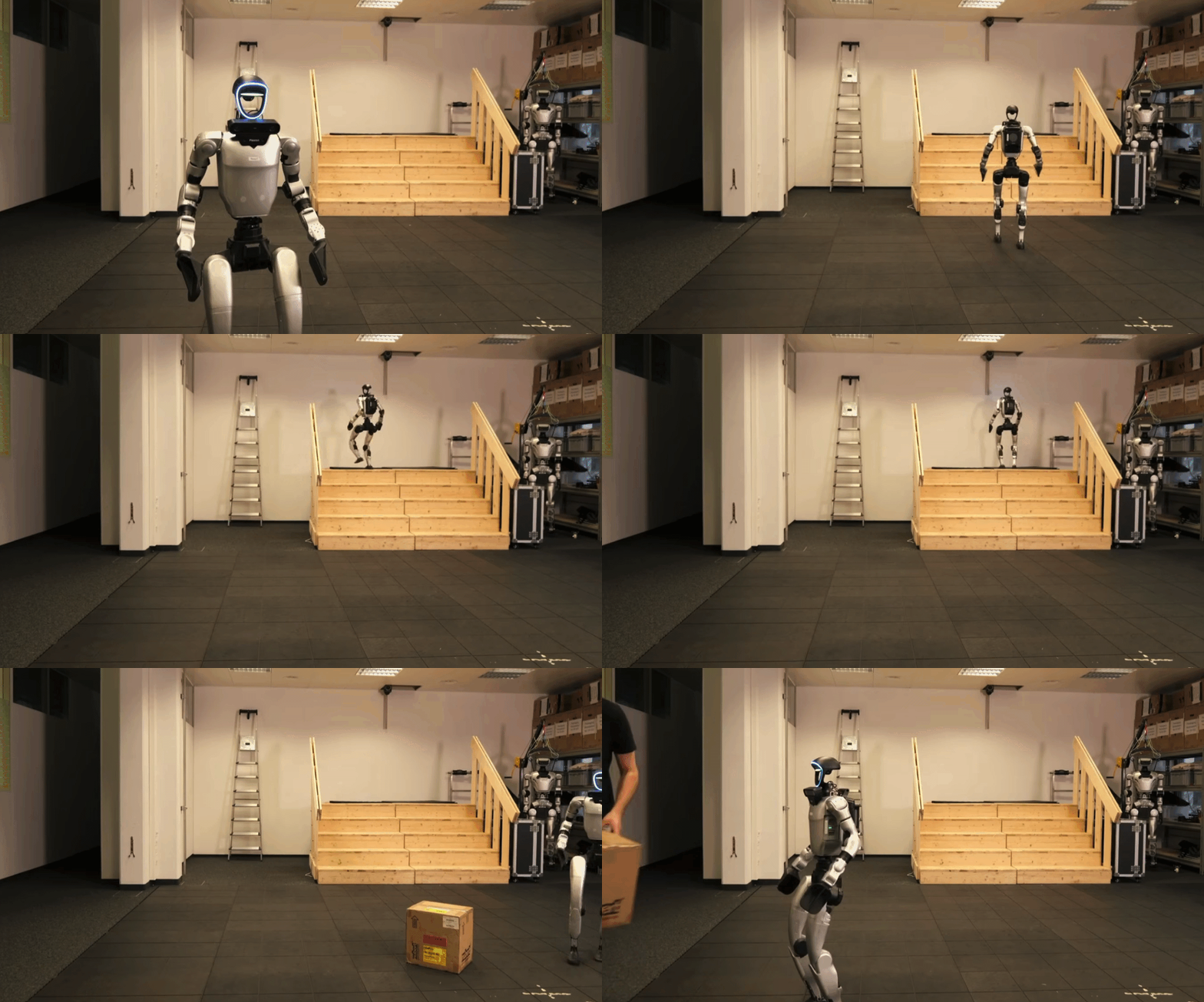
As Flexion Robotics cofounder Nikita Rudin bluntly put it during the demo, the ultimate test for these machines is pass or fail: “Either your robot walks or it fails.” And when a heavy metal robot fails — whether on the factory floor or in a robotic boxing match — it’s not just a software glitch; it’s a potential safety hazard for your employees and a dent in your expensive flooring.
The hidden ‘secondary development’ tax on enterprise robotics
If that $4,900 price tag on the new Unitree R1 Air has you ready to issue corporate credit cards, you might want to hit pause.
Consumer-grade humanoids are dropping below the $5,000 to $6,000 mark, but they come with a major catch: They are heavily locked-down ecosystems. These entry-level models explicitly prohibit “secondary development,” meaning your IT team cannot bypass the manufacturer’s default programming to write custom code or access low-level APIs.
For true enterprise integration, you have to pay the developer tax. Rather than relying solely on the manufacturer’s default programming, companies like Flexion wipe the default systems and replace them with custom software that communicates directly with the robot’s motors and the added “backpack” sensors.
To do that, they must purchase unlocked Education or Developer editions, which can bump the cost up to $9,000 per unit or more.
The new robotics stack looks a lot like enterprise infrastructure
Modern humanoid robots are essentially highly mobile, somewhat intimidating computing platforms.
That means IT teams may soon find themselves responsible for supporting robotic systems that resemble a hybrid of enterprise IT and operational technology (OT). The control architecture for these robots typically follows a layered, multinetwork design:
- Real-time control systems: Run directly on the robot’s onboard compute to manage motors and balance with extremely low latency — because if this layer lags, the robot falls over.
- Vision-language-action (VLA) models: Translate visual data and 3D space into specific autonomous navigation commands and run on-device, albeit at a slightly slower processing speed.
- Planning or agent layers: Coordinate tasks based on high-level goals (like an LLM orchestrating a multistep workflow), which often run on local server racks due to size and compute constraints.
This architecture guarantees that robotics deployments will introduce serious new operational responsibilities for enterprise IT teams, including firmware updates, telemetry monitoring, and version management for physical behaviors.
Simulation is accelerating robot training (and saving the furniture)
One of the biggest shifts in robotics development is the increasing use of simulation-based training. Instead of manually programming every joint movement or forcing humans to teleoperate robots in motion-capture suits — which often results in painfully slow, awkward movements — modern systems rely heavily on reinforcement learning.
In these virtual environments, robots learn behaviors through trial and error. “It takes tens of years of virtual experience to learn how to stand up and walk,” Rudin explained, “but luckily it’s virtual experience. So it’s actually just a few hours of computation on a modern computer.”
Developers train discrete capabilities, like opening doors or climbing stairs, in separate simulations before combining them into a shared control system. This allows the AI to quickly adapt to different robot morphologies — meaning if you upgrade to highly autonomous models like Figure’s new hardware, the software can quickly adjust without needing to be rebuilt from scratch.
Battery life introduces a new operational headache
While robotic brains are advancing at breakneck speeds, physical limitations will still dictate your deployment strategy. Battery life remains one of the most frustrating operational hurdles.
During the Flexion demo, the Unitree robot’s battery was rated to last roughly an hour and a half of normal walking, though doing backflips drains it considerably faster. While some larger industrial robots can push four to five hours on a single charge, they still require frequent downtime.
For IT and operations teams, treating robots like traditional endpoints won’t work. You’ll need to manage them like a fleet of industrial vehicles, factoring in hot-swappable battery schedules to keep the workflow uninterrupted. In other words, managing robots will be a logistical dance of charging docks and power telemetry.
Connectivity and the air-gapped security dilemma
Then there is the glaring question of cybersecurity and network architecture. Large AI models dramatically improve a robot’s reasoning and planning, but beaming that data to the cloud isn’t feasible for most enterprises.
“Everything would be so much easier if they were connected to the internet,” Rudin noted, pointing out that cloud compute would remove hardware limitations. “But typically in industry, they cannot, for security reasons.”
As a result, deployments will likely require air-gapped, on-premises infrastructure.
The heaviest AI models will run on local factory server racks via private Wi-Fi, while the time-sensitive motor controls remain hardcoded on the robot itself. This creates a complex, localized network that IT must secure against intrusions, lest a bad actor turn your helpful warehouse droid into a very expensive, metal-flailing liability.
Industrial deployments will arrive before your robotic butler
Despite the internet’s obsession with household robots, most experts expect industrial environments to adopt humanoids long before they fold laundry in your living room.
Factories and warehouses provide highly controlled environments where tasks can be mapped, defined, and simulated before a single piece of hardware is deployed. “I’m in the industry-first camp,” Rudin said, noting that it only takes a few days for an engineer to simulate a production line and deploy a hundred robots to execute it. Homes, by contrast, are chaotic and unpredictable.
And if you’re waiting for the robotics equivalent of the “ChatGPT moment,” you might need to adjust your expectations. Unlike software that can be copied and pasted globally in seconds, physical robots have to be manufactured, shipped, and localized.
The revolution will be gradual, but with industrial deployments expected to ramp up between the end of 2026 and early 2027, the robotic workforce is officially clocking in, targeting a market that Morgan Stanley estimates could hit $5 trillion by 2050.
Also read: Nvidia’s latest moves in Asia show how the global AI infrastructure race is heating up fast. Here’s what it means for enterprise tech.


