


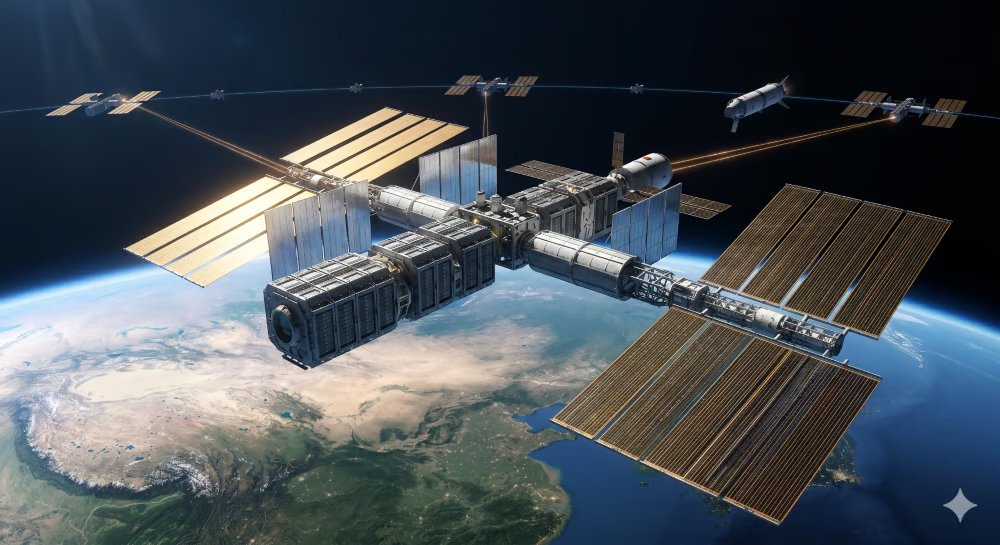
China’s next data center boom may not happen on Earth.
Orbital Chenguang, a Beijing-based startup, has secured early funding and $8.4 billion in strategic credit lines to develop space-based data centers. The pitch sounds like sci-fi, but China is treating it as infrastructure: a way to ease the pressure on power, cooling, and land from surging AI and cloud demand.
If it works, the next major computing frontier may be a network of machines circling hundreds of miles above Earth.
Massive backing means massive priority
According to a new report from SpaceNews, Orbital Chenguang has raised early-stage funding alongside securing 57.7 billion yuan (approximately $8.4 billion) in strategic credit lines from a dozen major Chinese banks. While these credit lines do not represent immediately deployable capital, it’s still a strong vote of confidence and a sign that this isn’t just a fringe experiment.
Instead, Orbital Chenguang’s effort is part of a state-linked initiative to address mounting pressures on Earth-bound computing infrastructure. With demand for cloud services and artificial intelligence continuing to surge, traditional data centers are facing increasing constraints on scalability, including high energy consumption, land-use limitations, and the growing complexity of cooling systems.
A state-backed ecosystem
The startup is backed by the Beijing Astro-future Institute of Space Technology, a government-backed organization coordinating a consortium of 24 companies and research groups. This setup makes Orbital Chenguang feel less like an isolated venture and more like a component in a coordinated national effort.
China’s system blends public policy and private innovation, enabling startups to operate within broader national frameworks designed to accelerate emerging technologies. After all, projects tied to long-term priorities such as space and advanced computing often benefit from alignment among government, industry, and finance.
Data centers in orbit
The reason for the initiative is that data centers on Earth are running into limits. They consume large amounts of electricity, occupy valuable land, and require increasingly complex cooling systems, especially as AI use grows.
Orbital Chenguang’s objective is to move some of that computing off the planet entirely by building a network of satellites operating in a Sun-synchronous orbit about 700 to 800 kilometers above Earth. This orbital configuration would provide near-continuous solar exposure, enabling sustained power generation while leveraging the thermal conditions of space to potentially reduce cooling requirements.
The long-term goal is a gigawatt-scale computing system in orbit by 2035. That would call for a massive leap in space-based infrastructure, as scaling up to a gigawatt would require solar arrays thousands of times larger, along with a vast constellation of satellites operating in coordination.
A phased roadmap to 2035
China is rolling out a phased approach to building this space data center.
Between 2025 and 2027, efforts will focus on solving core engineering challenges and testing early satellites. From 2028 to 2030, the roadmap calls for integrating space-based computing with Earth-based networks. This would create a hybrid infrastructure that distributes workloads between Earth and orbit by 2035, if all goes according to plan.
Other Chinese companies are already moving in this direction, with ADA Space and Zhejiang Lab launching a 12-satellite edge computing constellation in 2025, while additional startups are developing smaller-scale computing satellites and demonstration missions. Together, the broader ecosystem for edge computing in space is beginning to take shape.
China is also expanding its launch capabilities, investing in reusable rocket technology, and building new spaceports to support large constellations, so these new plans fit into the country’s wider space ambitions. Recent filings with the International Telecommunication Union indicate plans for large-scale networks.
Engineering challenges are significant
Of course, major technical challenges are very real, with thermal management among the most critical. While space may be cold, this does not inherently solve cooling problems. Without an atmosphere like Earth’s, heat cannot dissipate through convection and must instead be radiated away, which would require large radiator systems and be much less efficient.
Power is another obstacle, as the solar arrays needed for gigawatt-scale operations would be enormous and complex to deploy. Radiation exposure also poses risks to sensitive computing hardware, as even small amounts of high-energy radiation can disrupt electronic systems.
What this means for the future of computing
China’s investment suggests that orbital computing is being taken seriously as a long-term strategic priority.
While Orbital Chenguang has yet to demonstrate its technology in orbit, as its planned Chenguang-1 test satellite has not yet been confirmed for launch, the company’s backing reflects growing momentum behind the concept.
It’s an early move in what could become a much bigger shift in how computing infrastructure is built. If successful, orbital data centers could reshape how and where computing power is deployed in the coming decades.
Also read: Nvidia’s space-ready AI platforms show how orbital data centers are moving from research concept to infrastructure strategy.
