










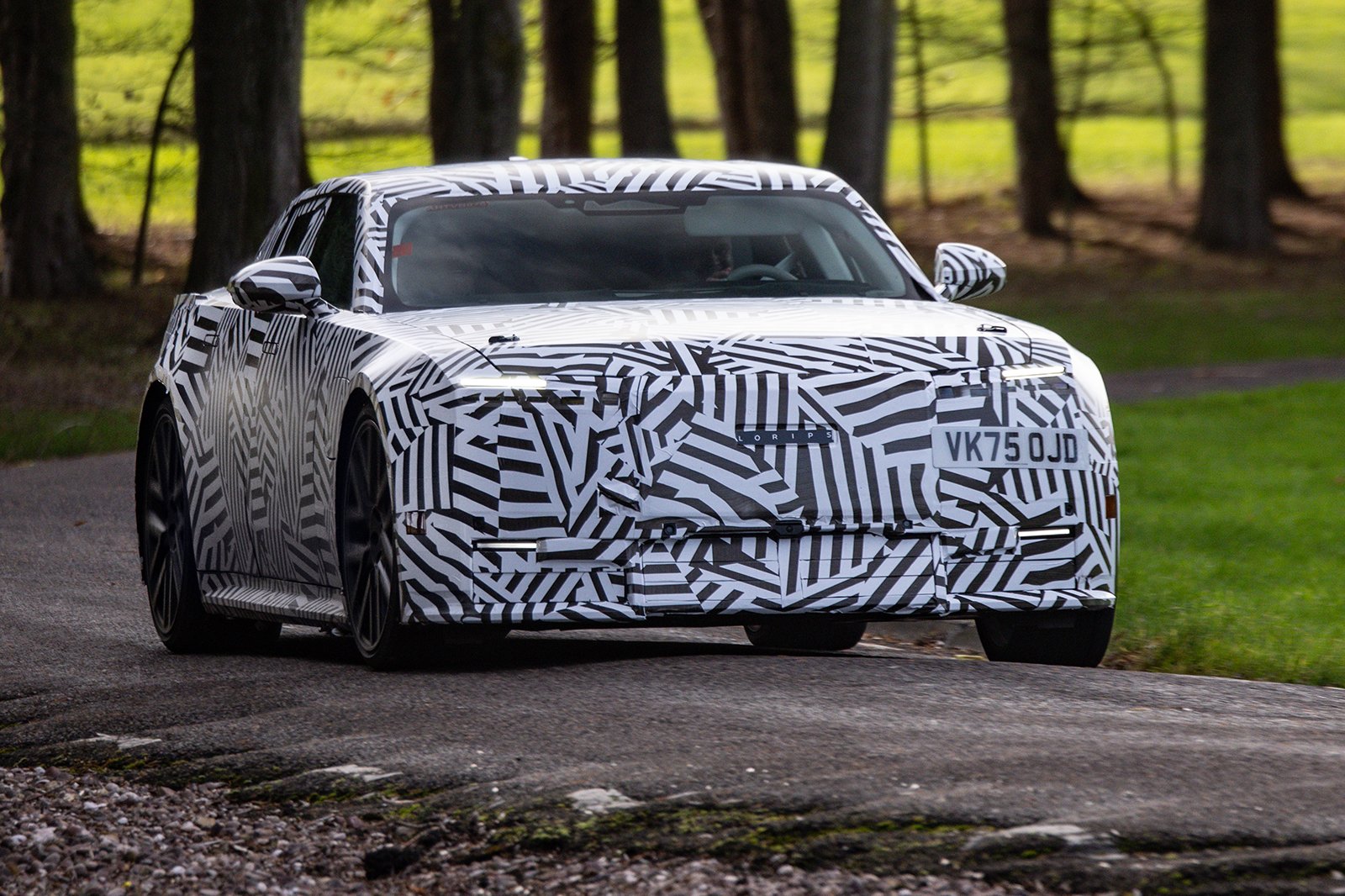
I would be accompanying vehicle development chief Matt Becker, who has performed marvels in previous roles at Lotus and Aston Martin, on a 20-minute demonstration ride on Gaydon’s extensive network of test tracks, which vary from Silverstone-smooth high-speed surfaces to narrow, tight, undulating roads used to test Range Rovers. Gaydon is designed to uncover dynamic shortcomings in cars and 20 minutes with Becker was going to be more than long enough to find them, if they were there.
Our car, disguised in irregularly patterned black and white camouflage, was parked behind the JLR design studios. Up close, it was very long indeed (at 5.4m) but remarkably low, with a very short front overhang and a medium-long one at the rear. Its dominant feature was the long nose, already embraced as a contemporary Jaguar aesthetic cue by the car’s designers. In official terms, the car has a prodigious dash-to-axle distance, which means there’s a lot of space between the front wheel arch and the door opening. The wheelbase is long, which is one reason why this car needs rear-wheel steering to tighten its turning circle. That also helps to enhance high-speed stability.
The car will be built largely in aluminium at a new factory on JLR’s substantial Solihull estate. The body sits on a very rigid skateboard chassis that houses a long, large but thin underbody battery with a capacity believed to be around 120kWh, giving a practical range of more than 400 miles.
There are three motors one up front and one on each rear wheel – with torque vectoring built in. Power totals about 1000bhp. The front-to-rear torque split is variable, but it is understood to settle around 30% front and 70% rear.


