










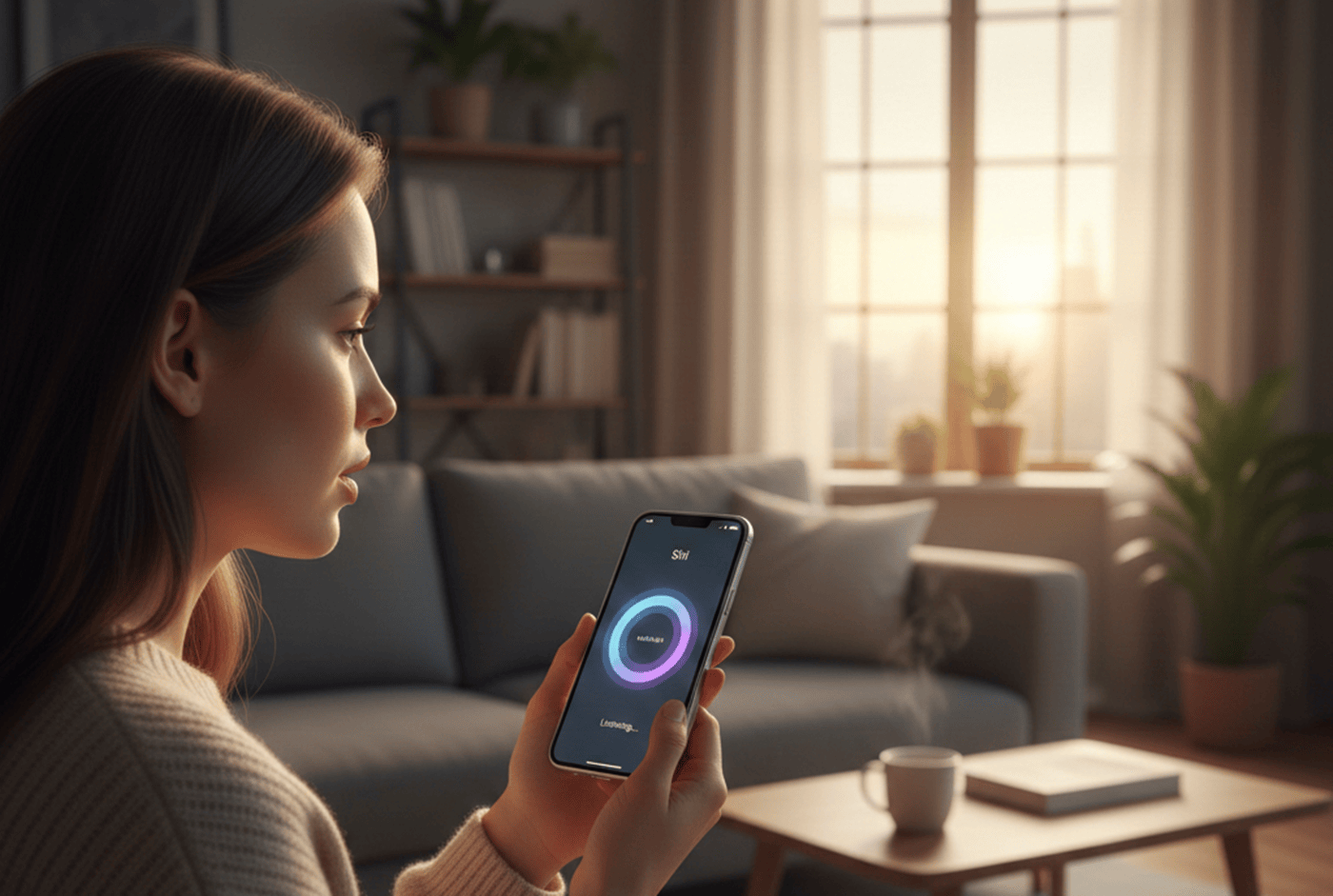
“Commerce is our goal, here. More human than human.” A quote from “Blade Runner” could be apt for Siri.
Apple researchers are proposing a new way to make text-to-speech systems respond more quickly, a change that could subtly but meaningfully improve how natural conversations with Siri feel.
In a newly published research paper, the Apple Intelligence team, working with researchers from Tel Aviv University, outlines a method designed to reduce the delay between a user’s request and a spoken response. While the study is technical in nature, its implications reach into everyday experiences such as using Siri for navigation, dictation, or conversational queries.
Faster speech generation may not sound dramatic, but in voice interfaces even small delays can disrupt the flow of interaction and make an assistant feel less responsive.
Background: Apple’s steady AI research output
Although Apple has reportedly lost some high-profile AI researchers in recent years, it continues to release a steady stream of academic work. Past papers have explored ways to prevent AI systems from taking actions without explicit user approval, as well as techniques to reduce hallucinations in generative models.
The new paper, titled “Principled Coarse-Grained Acceptance for Speculative Decoding in Speech,” shifts focus to speech generation. Text-to-speech is a core component of Apple’s voice-driven products, from Siri to turn-by-turn navigation in Apple Maps, and performance improvements here can have wide-ranging effects.
At its core, the research addresses a familiar tradeoff in AI systems: speed versus accuracy. Generating speech quickly enough to feel natural, without sacrificing intelligibility or correctness, remains a difficult technical challenge.
How modern text-to-speech works
In many AI systems, speech is generated as a sequence of tokens. These tokens represent extremely short snippets of sound, measured in milliseconds, which correspond to phonetic units. When stitched together, they form words, sentences, and entire spoken responses.
Choosing the right token matters. A slight mismatch can result in an odd pronunciation, a misplaced emphasis, or the kind of occasional mispronunciation users have heard from Siri over the years. In Apple Maps, for example, a delayed or incorrect pronunciation of a street name can be jarring, particularly when directions must be delivered at precisely the right moment.
Speed is especially critical in navigation, where a spoken instruction that arrives too late can be worse than no instruction at all. It is also important in conversational settings, where pauses longer than a fraction of a second can make an assistant feel slow or unengaged.
Limitations of existing approaches
According to the researchers, many current text-to-speech systems rely heavily on autoregression. In this process, the system generates speech token by token, narrowing down its choices at each step based on what has already been selected.
Apple argues that this approach is not optimal. The paper notes that working through each token in isolation can cause systems to ignore “acoustic similarity” between sounds and increases the risk of “erroneous acceptances,” where a token is chosen that technically fits the model’s constraints but sounds wrong to human listeners.
Because each token decision depends on the previous one, the system cannot easily skip ahead or parallelize parts of the process, which limits how quickly speech can be produced.
A new idea: Acoustic Similarity Groups
The core proposal in the new paper is to replace strict, exact token matching with a broader, probabilistic approach. Instead of evaluating every possible token individually, Apple’s researchers suggest grouping tokens into what they call Acoustic Similarity Groups, or ASGs.
These groups contain “perceptually similar sounds,” meaning sounds that humans would perceive as closely related, even if they are not identical at a technical level. Crucially, the researchers also propose that tokens can belong to multiple, overlapping groups, reflecting the ambiguity and flexibility of spoken language.
Using probabilities, the system can first narrow its search to a smaller set of relevant groups rather than scanning the entire token space. Within each group, autoregression is still used, but on a reduced and more focused set of options.
The paper describes “two key innovations”: the use of these overlapping groups and a probabilistic acceptance process that allows the system to verify candidate sounds more efficiently. The end result, Apple argues, is a system that is faster “while better preserving generation quality” than previous models.
Why speed matters for users
In practical terms, the improvements described in the paper are unlikely to cut seconds off Siri’s responses. Instead, they aim to shave off tens or hundreds of milliseconds. However, those small differences can be noticeable.
Humans are highly sensitive to timing in conversation. Even brief pauses can signal uncertainty or disengagement, and users often interpret delays from voice assistants as a lack of intelligence or capability. Faster speech generation could make Siri feel more fluid and conversational, even if the underlying intelligence remains unchanged.
The research does not directly address making Siri sound more natural or expressive. However, reduced latency is a necessary foundation for other improvements. A system that responds more quickly can better handle interruptions, follow-up questions, and back-and-forth exchanges.
Looking ahead
Apple’s paper is a research proposal rather than a product announcement, and there is no indication of when or whether the technique will be integrated into Siri or other Apple services. Nonetheless, it signals continued investment in the fundamentals of voice interaction.
Separately, Apple researchers have been exploring ways to tailor spoken responses to a user’s preferences or environment, such as adjusting tone, pacing, or clarity depending on context. Combined with faster speech generation, these efforts point toward voice assistants that feel less mechanical and more responsive.
For users, the payoff would not be a radically different Siri overnight, but a gradual shift toward conversations that feel smoother, quicker, and closer to human speech.
Apple has introduced a new iPhone privacy setting that blurs location data shared with wireless carriers.


