










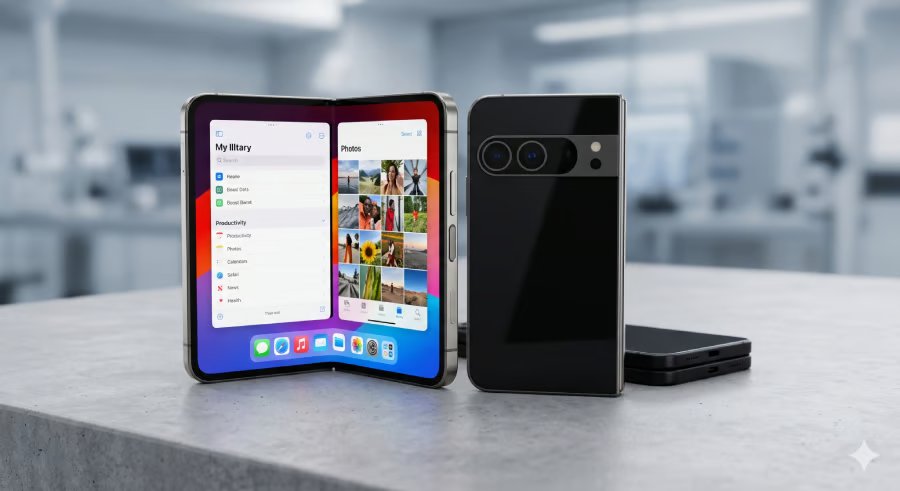
After years of sitting on the sidelines while other brands experimented with bendable screens, Apple is jumping into the fray with the iPhone Ultra.
Unlike the tall, skinny foldables we’ve seen from competitors, the Ultra is expected to take a “passport” shape, wider than it is tall when open. According to reports from 9to5Mac, the design will feature a “book-style fold with titanium, crease-free display,” aiming to solve the annoying screen wrinkle that has plagued early foldable phones.
Ultra-thin build with premium materials
Design leaks point to a remarkably slim profile, possibly around 4.5mm when unfolded. To support that, Apple is expected to use a titanium outer frame paired with aluminum inside, balancing strength with weight.
When folded, the device may resemble two ultra-thin iPhones stacked together. Color options are expected to be minimal, likely limited to black and white. However, achieving that thinness appears to come at a cost.
Camera system scaled back
Unlike Apple’s Pro models, the iPhone Ultra is expected to feature just two rear cameras: a 48MP main sensor and a 48MP ultra-wide lens. The telephoto lens, a staple for zoom photography, is notably absent.
The dual-display design introduces a different twist: two front-facing cameras, one on each screen. Reports suggest Apple may reuse its 18MP Center Stage camera system, though details remain limited.
iPad-style multitasking, but not full iPadOS
On the software side, the foldable experience will rely heavily on updates in iOS 27. According to reports, the device will support side-by-side apps and layouts inspired by the iPad.
However, it will not run iPadOS or offer full desktop-style windowing. Instead, Apple appears to be adapting iPhone software to better fit a larger, foldable screen.
New chip and in-house modem
Under the hood, the iPhone Ultra is expected to debut Apple’s A20 Pro chip, built on a next-generation 2-nanometer process.
The upgrade could bring notable gains in both speed and efficiency. The device is also rumored to include 12GB of RAM and a new C2 cellular modem, part of Apple’s ongoing effort to move away from third-party 5G components and develop its own in-house solution.
Touch ID returns, Face ID steps aside
One of the more interesting changes is the expected return of Touch ID. Instead of Face ID, Apple is reportedly integrating a fingerprint sensor into the power button. The reason appears to be practical: fitting the necessary Face ID components into an ultra-thin foldable design and duplicating them for two displays may not be feasible at this stage.
Pricing and availability questions remain
Pricing is still uncertain, but most estimates put the starting price at or above $2,000, making it the most expensive iPhone ever released.
Launch timing is also unclear. While the device may be announced alongside the iPhone 18 lineup, some reports suggest manufacturing challenges could delay shipments to late 2026 or even 2027.
For more on Apple’s next wave of hardware innovation, check out how the upcoming MacBook Pro redesign could bring OLED, touch support, and the M6 chip.


