


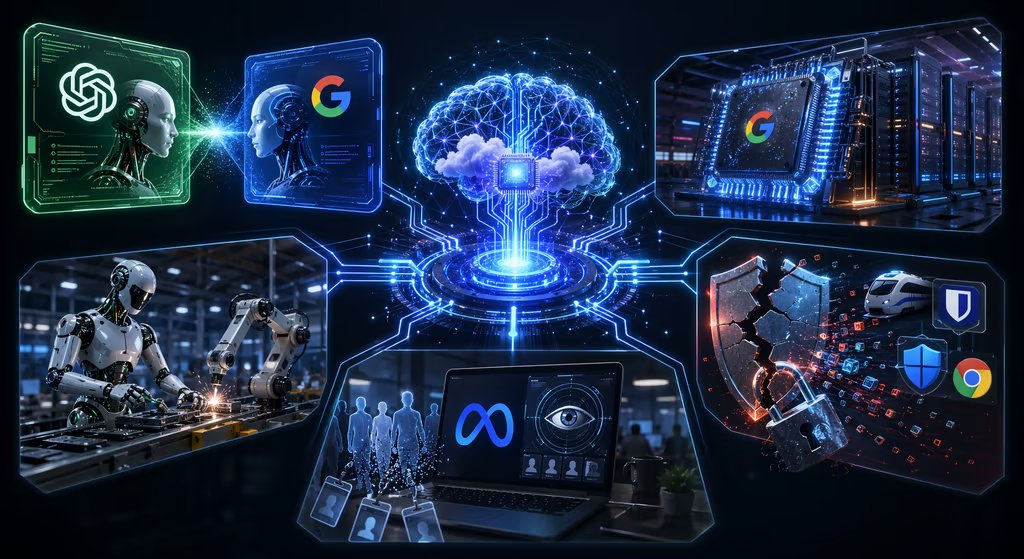
From GPT-5.5 and Google’s agentic AI push to fresh chip ambitions, humanoid robots, major breaches, and corporate turmoil, this week showed how the tech industry’s race for intelligence is also becoming a race for control — over data, infrastructure, workers, and users.
Top news
OpenAI and Google push the boundaries of AI
OpenAI unveiled GPT-5.5, its most advanced model yet, achieving 82.7% on Terminal-Bench 2.0 and surpassing Anthropic’s Mythos preview. The model introduces a “Thinking” mode, improved efficiency, and Trusted Access for Cyber controls, running on NVIDIA GB200/GB300 hardware. It’s available across ChatGPT Plus, Pro, Business, and Enterprise tiers, with API access coming soon.
Meanwhile, Google rebranded Vertex AI as the Gemini Enterprise Agent Platform at Cloud Next, offering a suite for building and managing autonomous office bots. OpenAI countered with Workspace Agents for ChatGPT Business and Enterprise, signaling the dawn of the enterprise “agentic era.”
Google’s hardware and chip innovations
At Cloud Next 2026, Google also introduced Workspace Intelligence, an AI layer spanning Gmail, Docs, Chat, and Drive. The company unveiled its eighth-generation Tensor Processing Units — TPU 8t for training and 8i for inference — linked via its new Virgo fabric, capable of connecting up to a million TPUs for massive-scale workloads.
In another strategic move, Google partnered with Marvell Technology to codesign inference-optimized AI chips. The collaboration diversifies Google’s chip supply chain beyond Broadcom, MediaTek, and Intel, reducing reliance on Nvidia and mitigating supply risks.
Apple and Adobe expand their AI ecosystems
Apple announced that longtime hardware chief John Ternus will succeed Tim Cook as CEO on September 1, marking a leadership transition that underscores Apple’s renewed focus on hardware and AI innovation.
Adobe introduced the Firefly AI Assistant, a conversational creative agent that automates workflows across Photoshop, Premiere Pro, and Frame.io. The assistant integrates with third-party tools like Anthropic’s Claude and will enter public beta soon, though usage will consume paid generative credits.
Robotics and Android updates
AGIBOT launched its “Deployment Year One” initiative, unveiling humanoid and industrial robots alongside an open AI platform. The company plans large-scale production expansion by 2028 following strong revenue growth.
At Hannover Messe, Siemens demonstrated the HMND 01 Alpha humanoid robot, built by UK startup Humanoid using Nvidia’s physical AI stack. The robot achieved over 90% success in autonomous pick-and-place tasks and integrated with Siemens’ Xcelerator platform for real-time factory coordination.
In mobile news, Android 17 will introduce per-SIM custom ringtones, a long-awaited feature expected in Q4 2026 that enhances usability for dual-SIM users.
Insider intel
Thinking Machines Lab, led by Mira Murati, signed a multibillion-dollar deal to train its AI models on Google Cloud’s AI Hypercomputer powered by Nvidia GB300 chips. The partnership accelerates training speeds and strengthens Google’s foothold in the compute arms race, even as Thinking Machines contends with talent losses to Meta and OpenAI.
Security alerts
Major Breaches and Exploits
Amtrak confirmed a breach exposing 2.1 million passenger records after hacker group ShinyHunters compromised a Salesforce account. Exposed data includes names, contact details, and support records, prompting password resets and 2FA advisories.
Bitwarden suffered a 93-minute compromise of its CLI tool (v2026.4.0) when attackers injected credential-stealing code into its GitHub Actions pipeline. Developer secrets were targeted, though user vaults remained unaffected.
Anthropic faced a breach of its Mythos cybersecurity model after a contractor’s Discord credentials were compromised, triggering regulatory scrutiny over potential systemic risks.
Software and platform vulnerabilities
Apple patched a privacy flaw in iOS 26.4.2 and iPadOS 26.4.2 that allowed recovery of deleted Signal and app notifications from system caches. The fix ensures cached data is now automatically wiped.
Microsoft Defender is under active attack through three zero-day vulnerabilities — BlueHammer, RedSun, and UnDefend — granting SYSTEM privileges on Windows 10 and 11. While BlueHammer is patched, the others remain unaddressed.
Microsoft Teams users are being targeted by scammers impersonating IT staff to gain remote access via Windows Quick Assist. Attackers deploy malware through DLL sideloading and exfiltrate data using Rclone.
Android users face new threats from four malware families — RecruitRat, SaferRat, Astrinox, and Massiv — that use overlay scams to steal PINs and credentials from over 800 apps.
Cisco Talos researchers reported that attackers are abusing the n8n low-code automation platform to distribute phishing malware, leading to a 686% surge in malicious webhooks disguised as OneDrive links.
Privacy and browser concerns
OpenAI released Privacy Filter, an open-source model that masks personal data locally, alongside Chronicle, a desktop tool that screenshots user activity for AI context — raising privacy concerns among advocates.
Google Chrome was found to lack built-in protections against browser fingerprinting, leaving users vulnerable to over 30 tracking methods. Experts recommend privacy-focused browsers or VPNs for better protection.
Industry shakeups
Meta’s workforce and monitoring controversy
Meta sparked internal backlash after installing keylogging and screen-monitoring software on employee laptops under its Model Capability Initiative. The move coincides with plans to lay off 10% of staff while pivoting toward AI roles.
On that note, Meta confirmed it will cut 8,000 jobs starting May 20 to fund AI infrastructure expansion, aligning with broader industry trends toward automation.
SpaceX and Trump tech developments
SpaceX is pursuing a $60 billion acquisition or $10 billion partnership with AI coding firm Cursor, signaling a strategic shift toward AI-driven moon factory projects following xAI’s merger into SpaceX.
The Trump T1 smartphone reemerged with a redesigned look but no confirmed release date. Lawmakers have asked the FTC to review its deposit practices amid regulatory uncertainty and lack of FCC guarantees.
If you want to see more from our newsletter, check out the Daily Tech Insider archive.
