








Every business needs a professional email address, but not every business has the budget for one right away.
I’ve tested and reviewed dozens of email hosting providers and business tools, and in this guide, I break down the best legitimate ways to get a free business email address in 2026. Some are completely free, while others bundle email with domains, hosting, or productivity software.
All options listed here are secure, credible, and suitable for real business use and not risky “free email hacks.”
(billed annually) |
||
Why you can trust us
At TechRepublic, our editorial team evaluates dozens of business software tools each year, including email hosting platforms, productivity suites, and website builders. For this guide, I reviewed over a dozen business email providers and hosting platforms, comparing pricing, storage, security, and scalability. I also evaluated their real-world usability for small businesses and startups, referencing verified user reviews.
Additionally, I drew on hands-on testing experience with platforms such as Google Workspace, Microsoft 365, and Zoho Mail, focusing specifically on ease of setup, domain configuration, and day-to-day email management.
This guide is updated regularly to reflect pricing changes, feature updates, and new providers entering the market in 2026.
Free business email solutions at a glance
Zoho Mail: Overall best free business email accounts
Overall rating: 4.47/5
Cost: 4.13/5
Core features: 4.6/5
Ease of use: 4.38/5
Support: 4.63/5
Expert score: 4.75/5
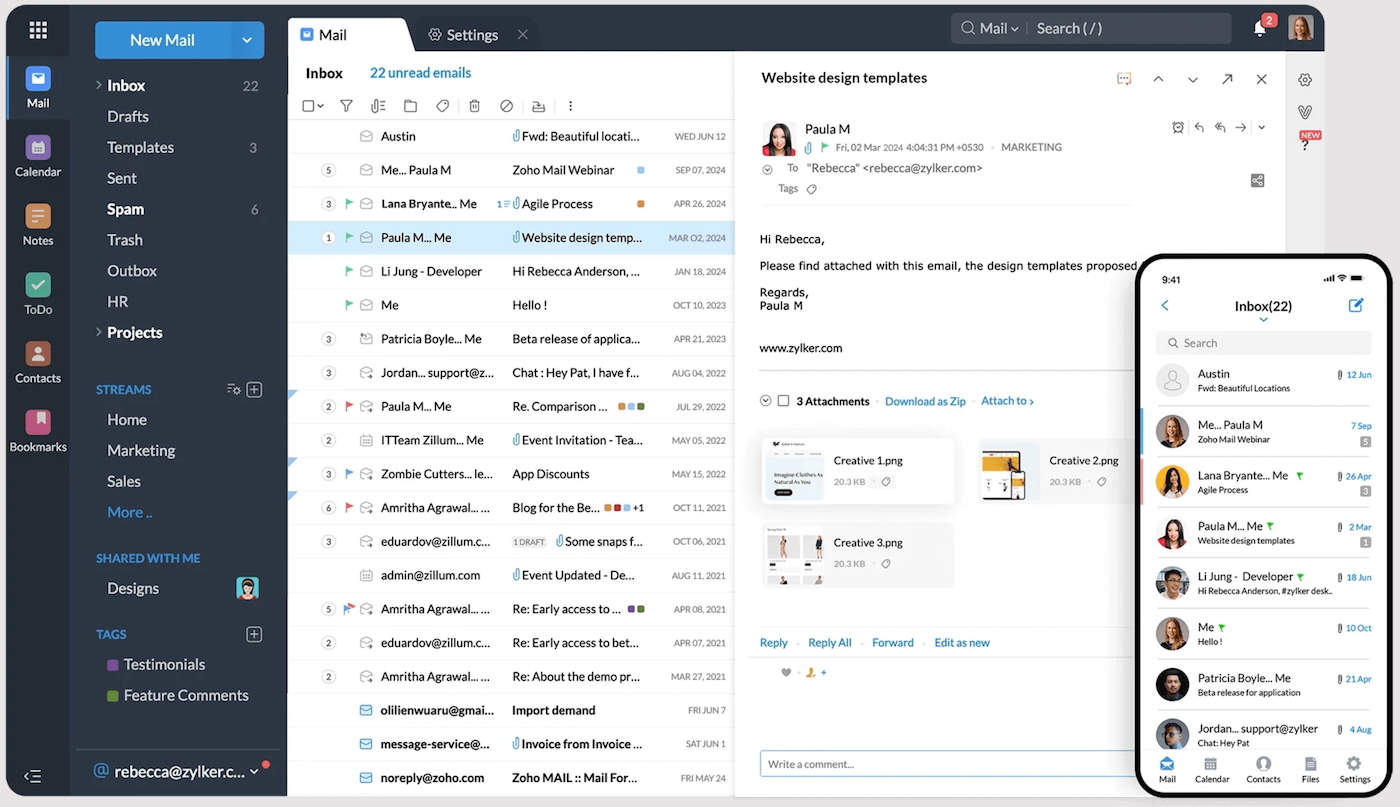
If you want a business email for free, Zoho Mail takes one of the top spots, as you can legitimately get up to five free business email accounts, provided you own a business domain name (e.g., yourbusiness.com). Plus, it integrates seamlessly with over 40 other Zoho apps for sales, marketing, project management, accounting, and more, many of which also have free plans.
Why I chose Zoho Mail
I chose Zoho Mail because it’s one of the few platforms that offers a truly usable free business email solution tied to a custom domain. In my experience reviewing email providers, most “free” options either lack domain support or restrict functionality so heavily that they’re not practical for real business use. Zoho strikes a better balance, giving small teams a professional, ad-free inbox with enough storage and core features to operate day to day without having to upgrade right away.
From a usability and scalability standpoint, I also like how Zoho Mail fits into a larger business ecosystem. When testing business email tools, I look closely at whether a provider can grow with a company, and Zoho does that well. You can start with the free plan and later move to Mail Lite or Workplace without migrating your data. The main limitation is that the free version is best used within Zoho’s own apps, since external client access (like Gmail or Outlook) requires a paid plan.
Pricing
- Forever Free: Free for up to five users with 5GB mail storage per user, email hosting for one domain, and web/mobile access.
- Mail Lite: Starts at $1 per user/month (5GB) or $1.25 per user/month (10GB), billed annually. Includes IMAP/POP access, larger attachments, and domain aliases.
- Mail Premium: $4 per user/month, billed annually. Includes 50GB storage, retention and eDiscovery, S/MIME, and advanced admin controls.
- Workplace: Starts at $3 per user/month, billed annually. Includes business email plus Zoho’s full suite of collaboration and productivity apps.
Key features of free Zoho Mail
- Create up to five free business emails on a domain you own
- 5GB storage per user with an ad-free interface
- Built-in security and privacy features
- Access via web and mobile apps
- Seamless integration with Zoho CRM, Books, and other business tools
- Scalable upgrade path into Zoho Workplace

Pros and cons
| Pros | Cons |
|---|---|
|
|
Proton Mail: Best security features for free business email accounts


Overall rating: 4.33/5
Cost: 4.63/5
Core features: 4.57/5
Ease of use: 3.94/5
Support: 4.13/5
Expert score: 3.94/5
If security and privacy are your top priorities, Proton Mail stands out with its advanced encryption and privacy-first approach. It’s a strong option for businesses that handle sensitive information or want greater control over how their communications are protected.
Why I chose Proton Mail
When evaluating email providers, I pay close attention to how they handle encryption and data access, and Proton is one of the few platforms that uses true end-to-end and zero-access encryption by default. That means even Proton itself can’t read your messages, which is a significant advantage for businesses handling confidential communications.
I also like how Proton balances security with usability. Features like password-protected emails, message expiration, and automatic tracking protection are built directly into the experience rather than added as extras. The tradeoff is that it’s not as flexible as other providers for business use, but for privacy-focused users, those compromises are often worth it.
Pricing
- Free: $0 for one user with 1GB storage, limited daily messages, and a ProtonMail.com email address
- Mail Plus: $4.99/month or $2.99/month billed annually
- Proton Unlimited: $12.99/month or $9.99/month billed annually
- Proton Duo: $19.99/month or $14.99/month billed annually
Business plans:
- Mail Essentials: $7.99/month or $6.99/month billed annually
- Mail Professional: $10.99/month or $9.99/month billed annually
- Proton Business Suite: $14.99/month or $12.99/month billed annually
- Enterprise: Custom pricing
Key features of free Proton Mail emails
- End-to-end and zero-access encryption for all emails
- Password-protected emails and message expiration
- Built-in tracking protection that blocks pixels and hides your IP
- Two-factor authentication and hardware security key support
- One-click email migration tools
- Free ProtonMail.com address with 1GB storage

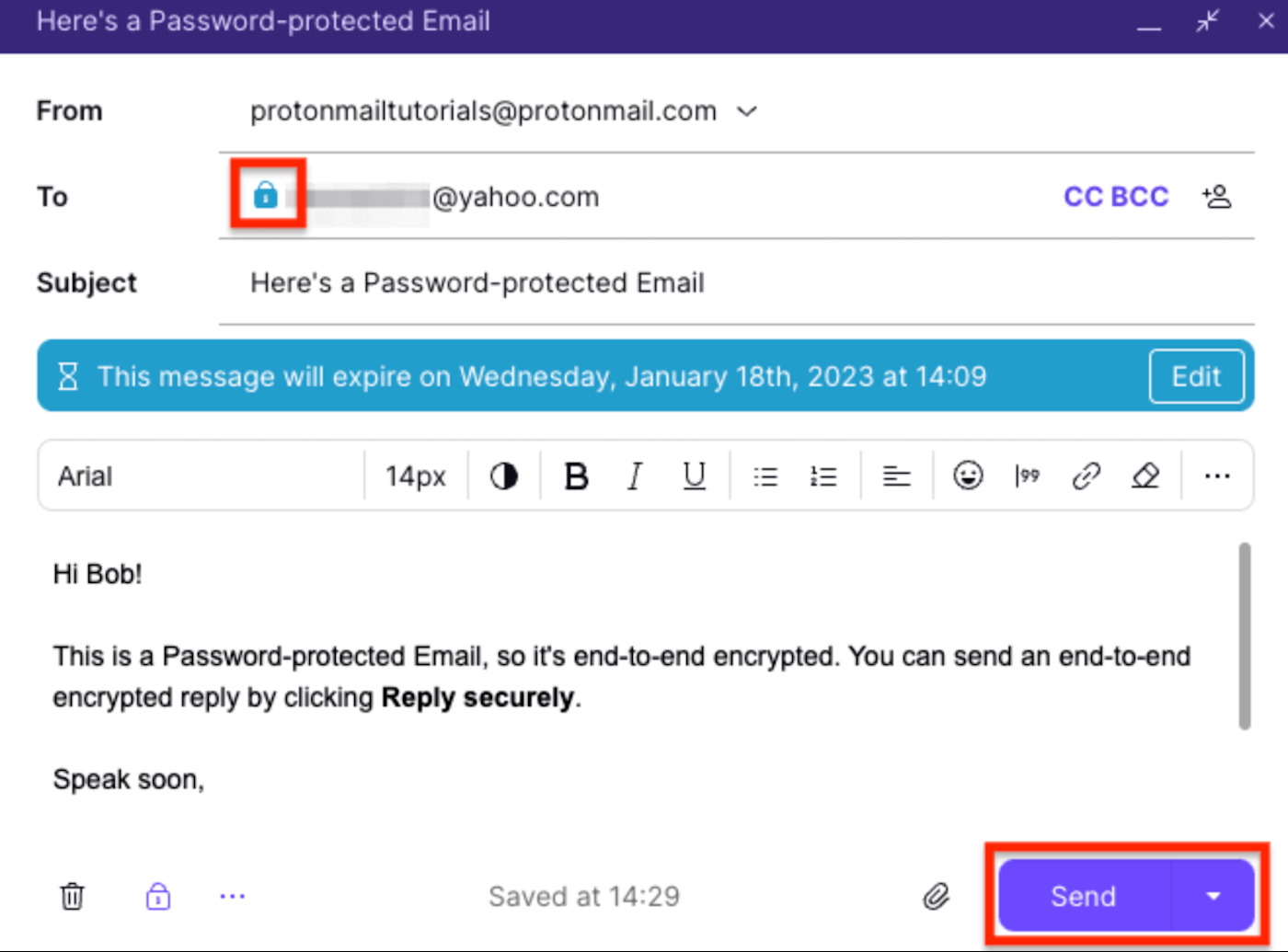
How to get a free business email through Proton Mail
- Go to Proton and click “Create a free account.” Fill out your account information, including your username, then click “Get Proton for free” on the next page.
- Verify via captcha or email to complete the setup of your free corporate email on Proton Mail.
- Import your existing email to Proton’s servers using Easy Switch, a one-step email import solution.
Pros and cons
| Pros | Cons |
|---|---|
|
|
Google Workspace: Best for Gmail business email


Overall rating: 4.31/5
Cost: 3.31/5
Core features: 4.83/5
Ease of use: 5/5
Support: 4.38/5
Expert score: 4.19/5
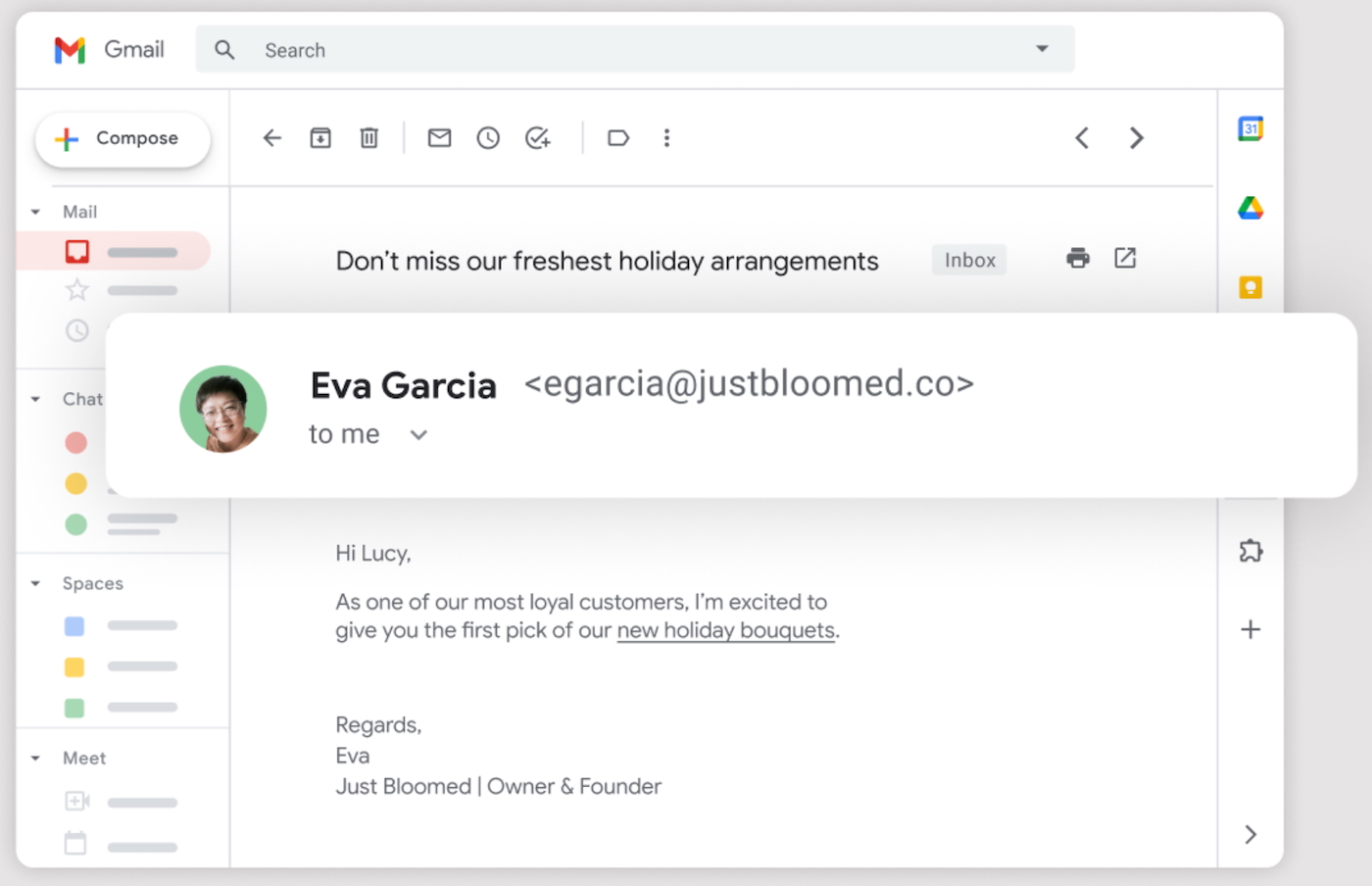
Google Workspace is Google’s business productivity suite and one of the most widely used email platforms globally. Gmail powers business email for billions of users, and Workspace combines it with tools like Google Docs, Sheets, Meet, and Drive for a complete collaboration environment.
Why I chose Google Workspace
Being a long-time user of Google Workspace’s free personal and business versions, I’m a staunch advocate of this platform. The paid version is feature-packed and well worth the cost of the plan. All Google Workspace apps are included in its plans, making it just as easy for a solopreneur with one account or a large team with hundreds to grow and scale their company.
When I test business email platforms, I look beyond the inbox to how well they support daily workflows, and Google Workspace excels in this regard. Features like real-time collaboration, shared drives, and built-in AI tools make it more than just an email provider. It becomes a central hub for communication and productivity.
For more information, read our Google Workspace cheat sheet.
Pricing
- Essentials: This plan is free for one user and includes one email, up to 15GB pooled storage, and default encryption.
- Business Starter: $8.40 per user/month or $7 per user/month billed annually
- Includes 30GB storage per user, custom business email, and core Workspace apps
- Business Standard: $16.80 per user/month or $14 per user/month billed annually
- Includes 2TB storage per user and enhanced collaboration features
- Business Plus: $26.40 per user/month or $22 per user/month billed annually
- Includes 5TB storage per user, advanced security, and eDiscovery
- Enterprise: Contact sales for custom pricing
Key features of free Gmail business emails
- Custom domain email through Gmail
- Full Google Workspace suite (Docs, Sheets, Slides, Drive, Meet)
- Real-time collaboration across teams
- Built-in AI features for email and document workflows
- Large storage capacity compared to most providers
- Easy integration with thousands of third-party apps

Pros and cons
| Pros | Cons |
|---|---|
|
|
Microsoft 365: Best for work email on your Outlook domain


Overall rating: 4.27/5
Cost: 3.94/5
Core features: 5/5
Ease of use: 3.5/5
Support: 4.06/5
Expert score: 4.31/5
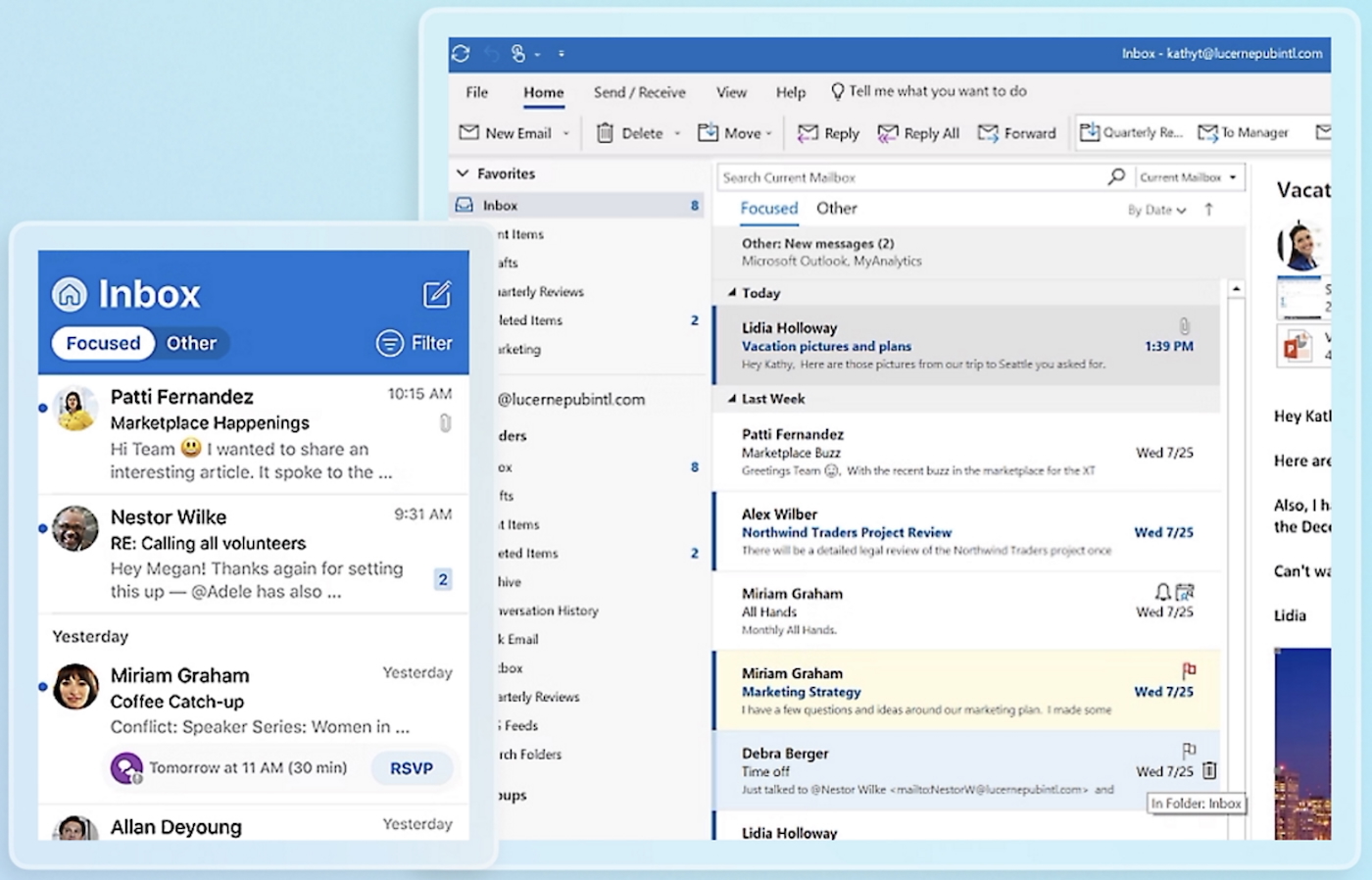
Similar to Google Workspace, Microsoft 365 provides business email through Outlook along with a full suite of productivity tools, including Word, Excel, PowerPoint, and Teams. It’s a strong choice for businesses that rely on Microsoft’s ecosystem and need advanced features and security.
Why I chose Microsoft 365
Microsoft offers a complete, professional-grade solution with deep integration across essential productivity tools like Outlook, Word, Excel, and Teams. For businesses already using Microsoft products, the transition to Outlook business email is seamless, and the level of control over email, files, and user permissions is significantly more advanced than most entry-level providers.
I’ve found Microsoft 365 is especially strong for teams that need structure, automation, and data protection. When testing, features such as email rules, shared mailboxes, calendar coordination, and security controls make a noticeable difference in day-to-day operations. The tradeoff is that the interface can feel more complex than Gmail, particularly for new users, but for businesses that prioritize scalability and control, that added depth is often worth it.
For more information, read our Microsoft 365 software guide.
Pricing
- Microsoft 365 Business Basic: $7.20 per user/month or $6 per user/month billed annually
- Includes custom business email (50GB mailbox), 1TB OneDrive storage, Teams, and web/mobile apps
- Microsoft 365 Apps for Business: $9.90 per user/month or $8.25 per user/month billed annually
- Includes desktop versions of Office apps and 1TB storage (no hosted business email)
- Microsoft 365 Business Standard: $15 per user/month or $12.50 per user/month billed annually
- Includes everything in Business Basic, plus desktop Office apps and enhanced collaboration tools
- Microsoft 365 Business Premium: $26.40 per user/month or $22 per user/month billed annually
- Includes advanced security, device management, and threat protection
Key features of free Microsoft emails
- Custom domain email through Outlook
- 50GB mailbox per user across business plans
- Integration with Microsoft Teams, OneDrive, and SharePoint
- Advanced email rules, automation, and shared mailboxes
- Desktop and web versions of Office apps (depending on plan)
- Enterprise-grade security and compliance tools

Pros and cons
| Pros | Cons |
|---|---|
|
|
DreamHost: Best low-cost email hosting with generous storage


Overall rating: 4.19/5
Cost: 4.25/5
Core features: 3.85/5
Ease of use: 4.06/5
Support: 4.69/5
Expert score: 4.38/5
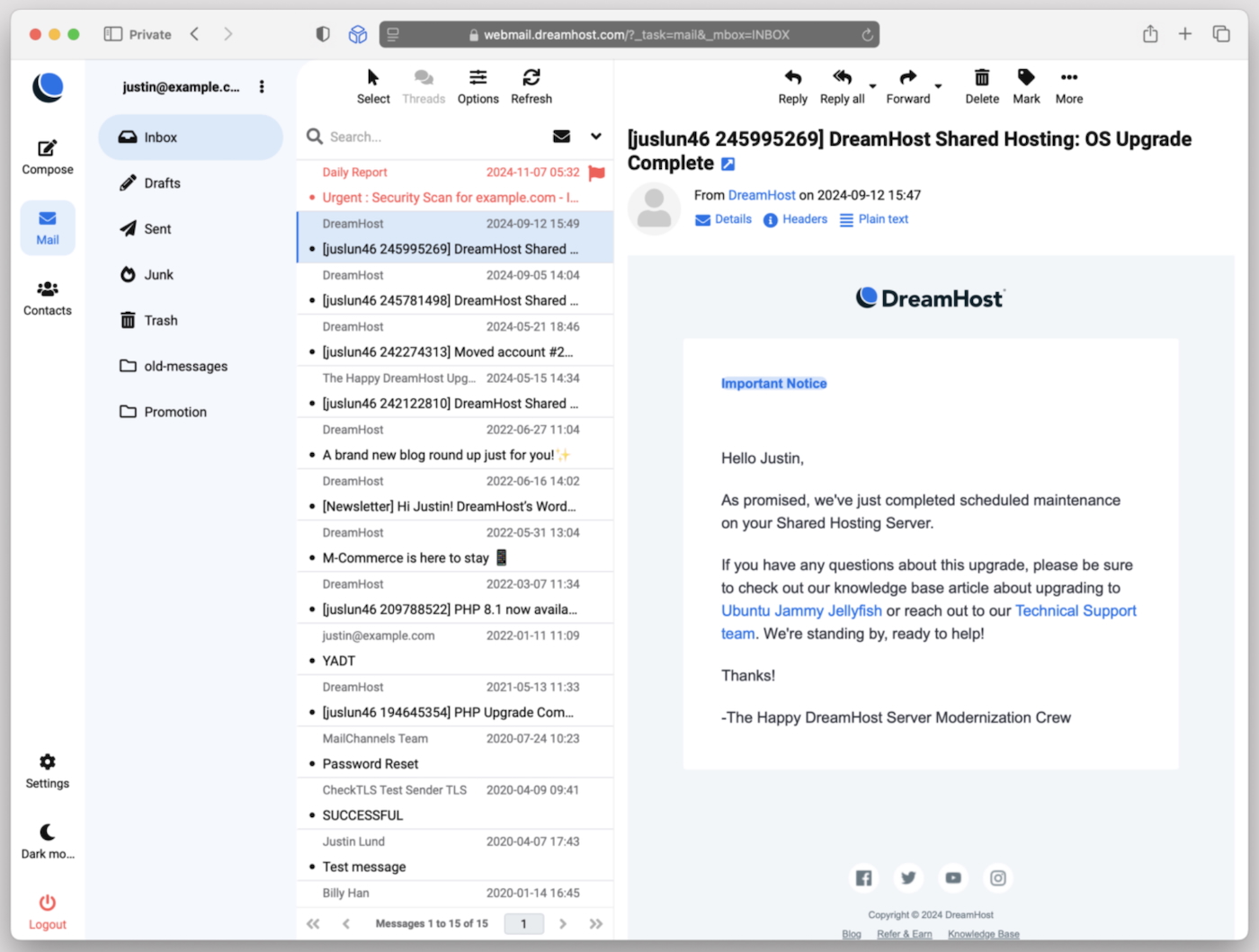
DreamHost is a web hosting provider that offers shared, VPS, and dedicated hosting, along with domain registration and cloud services. It also provides professional email hosting with custom domain support, making it a practical option for businesses that want a branded email without paying for a full productivity suite.
Why I chose DreamHost
DreamHost strikes the perfect balance between affordability and professionalism. Many low-cost options either limit storage or include ads, but DreamHost keeps things simple with a clean, ad-free inbox and a generous 25GB mailbox. That makes it a solid choice for small businesses that primarily need reliable email without extra complexity.
From a usability standpoint, I’ve found that DreamHost works best for businesses that already manage a website or domain. When evaluating these tools, I look at how well email fits into a broader setup, and DreamHost makes it easy to bundle email with hosting or run it as a standalone service. The tradeoff is that it doesn’t include built-in collaboration tools like Google Workspace or Microsoft 365, so it’s better suited for businesses that just need email rather than a full productivity platform.
Pricing
- Email Hosting: $1.99 per mailbox/month or $1.67 per mailbox/month billed annually
- Includes 25GB storage per mailbox, custom domain email, and IMAP/SMTP access
- Shared Hosting: Starts at $4.95/month (intro pricing may be lower with annual billing)
- Includes website hosting with optional email add-on
- WordPress Hosting: Starts at $2.95/month billed annually
- Includes managed WordPress hosting with optional email add-on
DreamHost: Best low-cost email hosting with generous storage
Key features of free DreamHost business emails
- Custom domain email hosting
- 25GB storage per mailbox
- Built-in spam filtering and virus protection
- Ad-free webmail interface
- IMAP/SMTP support for external email clients
- Option to bundle with hosting or use standalone

Pros and cons
| Pros | Cons |
|---|---|
|
|
Hostinger: Best website builder with multiple free emails


Overall rating: 3.84/5
Cost: 4.25/5
Core features: 3.5/5
Ease of use: 3.44/5
Support: 4.38/5
Expert score: 3.69/5
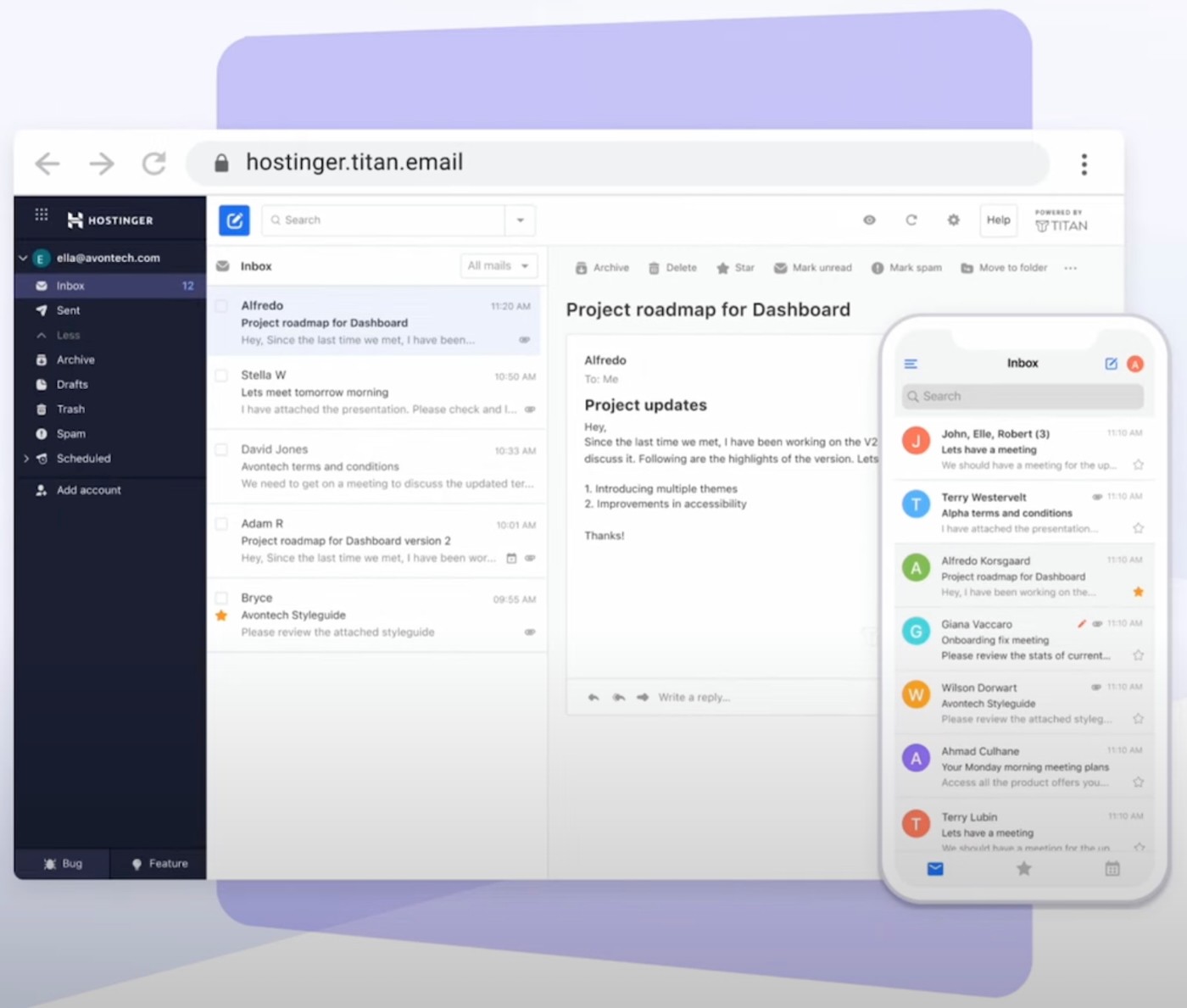
Hostinger is a budget-friendly hosting provider that also offers business email services, making it a strong option for small businesses that want to bundle website hosting and email in one place. While it doesn’t offer a standalone free email plan, many of its hosting packages include free business email accounts tied to your domain.
Why I chose Hostinger
Hostinger delivers a three-in-one punch of an AI website builder, web hosting, and a cheap email provider. This bundled approach is often the easiest path for small businesses to get online quickly without managing multiple tools. Hostinger’s dashboard is straightforward, and setting up a domain with email is noticeably simpler than with more technical hosting platforms.
Hostinger also incorporates AI tools into its website builder and overall platform, with AI-generated site content and a guided setup that make it easier for non-technical users to launch and manage a business presence. But the trade-off is that the included email functionality is more basic than that of dedicated providers, so it works best for businesses that prioritize affordability and convenience over advanced email features.
For more information, read our Hostinger review.
Pricing
- Starter Business Email: $2.95 per mailbox/month or $0.45 per mailbox/month billed annually
- Includes business email hosting with webmail access and essential features
- Premium Business Email: $5.95 per mailbox/month or $2.45 per mailbox/month billed annually
- Includes increased storage, enhanced features, and improved performance
- Website Builder + Email: Starts at $3.99 per month billed annually
- Includes website builder, hosting, free domain (first year), and bundled email accounts
Key features of free Hostinger business emails
- Free business email accounts included with hosting plans
- Custom domain email support
- Proprietary webmail interface
- Integration with website builder and hosting tools
- AI-powered website and content generation features
- Scalable email plans with higher storage tiers

Pros and cons
| Pros | Cons |
|---|---|
|
|
IONOS: Best free email address with cheap domains


Overall rating: 3.82/5
Cost: 3.38/5
Core features: 4.21/5
Ease of use: 3.75/5
Support: 3.75/5
Expert score: 3.94/5
IONOS is a web hosting provider and domain registrar known for its low-cost plans and bundled services. It offers business email hosting alongside domains, website builders, and other hosting services, making it a practical option for startups looking to get a branded email address at minimal cost.
Why I chose IONOS
IONOS offers one of the most affordable ways to set up a professional business email with a custom domain, even though it’s not entirely free. It’s perfect for getting started on a tight budget, and the ability to bundle a domain and email together makes it especially appealing for businesses just getting started. IONOS also impressed me with its reliable uptime, basic AI tools, and simple user interface, making it easy to manage business communications without extra complexity.
When testing similar providers, domain setup and email configuration can be barriers for new users, but IONOS streamlines the experience. However, pricing increases after introductory offers, and costs can add up as you scale, so it’s best suited for small teams looking for an affordable starting point rather than a long-term all-in-one productivity solution.
Pricing
- Mail Basic 1: $4 per month or $1.10 per month (3-year term); Renews at $2 per month and includes basic email hosting for one account
- Mail Basic 25: $6 per month or $2 per month (3-year term); Renews at $4 per month and includes expanded storage and features
- Mail Business: $6 per month or $3 per month (3-year term); Includes business email features with enhanced functionality
Key features of free IONOS business email
- Custom domain email included with domain or hosting plans
- Free private domain registration for added security
- Email aliases and forwarding options
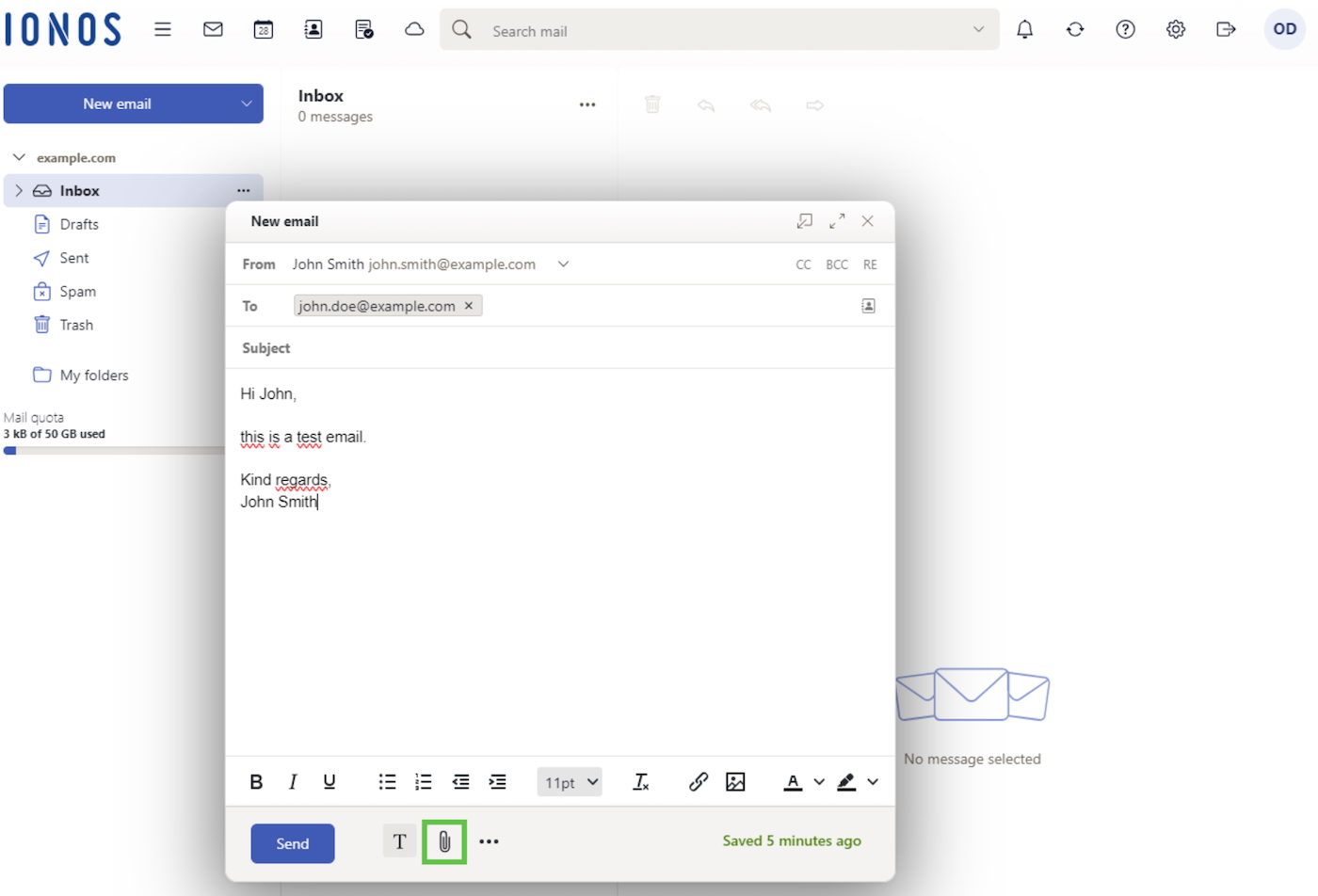
- Webmail interface with calendar, contacts, and task management
- IMAP and POP support for external email clients
- 24/7 customer support

Pros and cons
| Pros | Cons |
|---|---|
|
|
Internxt: Best for free temporary business emails


Overall rating: 3.71/5
Cost: 2.94/5
Core features: 3.79/5
Ease of use: 3.75/5
Support: 4.44/5
Expert score: 4.06/5
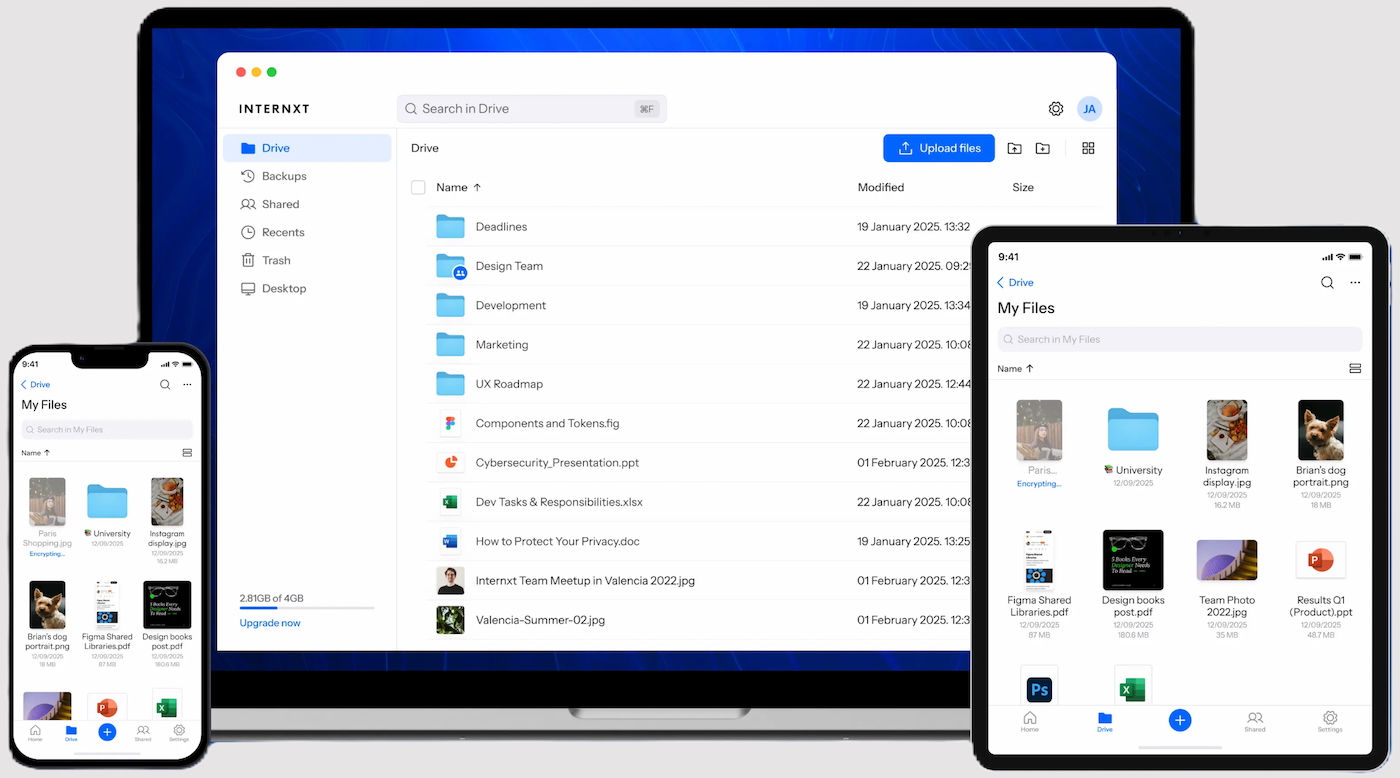
Internxt is a privacy-focused cloud storage provider that also offers free temporary email addresses. It’s designed for users who want a quick, anonymous inbox without sign-up, making it useful for one-time interactions or for protecting your primary business email from spam.
Why I chose Internxt
Internxt offers one of the simplest ways to create a disposable email address without sacrificing privacy. While most free options either require registration or collect user data, Internxt removes that friction entirely. You can generate an email instantly, receive messages, and avoid exposing your real inbox, which is especially useful for testing tools, signing up for services, or filtering out unwanted communications.
Unlike traditional free email providers, Internxt doesn’t collect personal data or show ads, and its zero-knowledge encryption ensures that even they can’t access my messages. I can use it for account verification, downloads, on-demand webinars, one-time events, and online purchases. It’s not a full business email solution, but for one-time signups, testing, or protecting my identity during early-stage outreach, Internxt offers unmatched simplicity and peace of mind.
Pricing
- Free temporary email: Free to use with no sign-up required
- Essential: $30 per year (renews at $149 per year) or $400 lifetime (discounted to $1,999)
- Includes 1TB encrypted storage, VPN, antivirus, and secure file sharing
- Premium: $60 per year (renews at $299 per year) or $600 lifetime (discounted to $2,999)
- Includes 3TB storage, file versioning, collaboration features, and additional tools
- Ultimate: $80 per year (renews at $399 per year) or $800 lifetime (discounted to $3,999)
- Includes 5TB storage and expanded platform capabilities
Key features of free Internxt temporary emails
- Instant, anonymous email address with no registration
- Automatic inbox expiration after inactivity
- Zero-knowledge encryption and privacy-first design
- No ads or tracking
- Simple browser-based inbox

Pros and cons
| Pros | Cons |
|---|---|
|
|
How to choose the best free business email address provider
Selecting the right free business email provider is crucial for making a strong first impression and keeping your communication organized and secure. While budget is a factor, it’s equally important to evaluate the features that support your business needs today and as you grow.
- Custom domain support: Look for providers that allow you to use your own domain (e.g., [email protected]), which enhances professionalism and brand credibility.
- Storage limits: Check how much mailbox storage is offered. Some free plans only include up to 5GB, which may be limiting over time.
- Security features: Ensure the provider includes spam filtering, virus protection, and, ideally, end-to-end encryption to keep your data safe.
- User limits: Many free plans restrict the number of users. Make sure the provider supports your current team size or allows for future expansion.
- Ease of use: A clean, intuitive interface and easy setup process can save time and reduce onboarding frustration.
- Support access: Free plans typically offer limited support, so look for providers that offer helpful resources or a responsive community forum.
- Upgrade path: Consider whether the provider offers affordable paid plans with advanced features so you can scale without switching platforms.
By weighing these factors, you can choose a provider that aligns with your brand image, communication needs, and long-term business goals without overspending.
Free vs paid business email: What’s the difference?
Choosing between a free and paid business email plan depends on your company’s size, needs, and growth goals. Free plans are ideal for individuals or small teams just starting out, offering basic email functionality at no cost.
However, paid plans unlock advanced features such as larger storage, custom domains, enhanced security, and business tool integrations, which are critical for scaling and maintaining professionalism.
Free email can be a great starting point, but for businesses aiming to grow or project a more professional image, paid email services often offer the essential tools and flexibility needed to succeed.
| Feature | Free business email | Paid business email |
|---|---|---|
| Custom domain | Limited or not included | Fully supported (e.g., [email protected]) |
| Storage per user | Typically 1GB-5GB | 15GB to unlimited, depending on the plan |
| Ad-free experience | Sometimes includes ads | Completely ad-free |
| Security and encryption | Basic spam filtering | Advanced security, encryption, and data loss prevention (DLP) features |
| Support access | Community support or limited email support | Priority customer support via chat, phone, and/or email |
| Collaboration tools | Minimal or none | Integrated calendar, docs, and video conferencing |
| Admin controls and management | Basic or none | Full admin dashboard for user and data management |
| Scalability | Limited to small teams | Easily scalable for growing businesses |
| Integration with business apps | Limited or unavailable | Seamless productivity suites (e.g., Office and Google Workspace) |
| Professional branding | Uses generic email domains (e.g., gmail.com) | Custom domains enhance credibility and trust |
Benefits of a professional business email
From my experience testing email platforms, switching from a generic Gmail or Outlook address to a branded domain email is one of the fastest ways to improve business credibility.
Here’s why it matters:
- Stronger first impressions: Clients are far more likely to trust a custom domain email
- Better deliverability: Lower risk of landing in spam folders
- Improved security: Business-grade email providers include stronger protections
- Centralized control: Manage users, permissions, and data in one place
- Seamless workflows: Integrates with tools like CRMs, calendars, and cloud storage
- Scalability: Add new team members without losing structure
Methodology: How I evaluated the best business email providers
The providers above can’t be fully compared apples-to-apples, as each platform is distinctly different. To be considered for this guide, providers had to either have a 100% free option or include free email alongside other products small businesses need, such as hosting or site builders.
In addition, I used my own firsthand experience to select and rank providers based on customer support, ease of use, popularity, and use cases. Each provider was evaluated using consistent criteria that reflect how businesses actually compare software:
- Pricing & Value (25%): I compared free plans and entry-level pricing, focusing on features and long-term affordability. This includes assessing renewal rates and any hidden fees that may affect overall costs.
- Core Features (30%): I evaluated essential email capabilities such as sending, receiving, and organizing emails. Storage capacity and domain support were also reviewed, including the number of custom domains that can be linked and the management process.
- Ease of Use (15%): I tested the setup process for new users, evaluating the interface’s intuitiveness and the learning curve required to efficiently navigate the platform.
- Customer Support (15%): I assessed the availability of customer support channels, including live chat and email, and gauged responsiveness and the quality of self-help resources, such as FAQs.
- Expert Score (15%): My assessment included hands-on experience with each service, providing an evaluation of usability and overall effectiveness based on the factors mentioned.
Frequently asked questions (FAQs)
Which free email is best for business?
The best free email for business often depends on your needs, but Gmail is widely regarded as the top choice due to its reliability, user-friendly interface, generous storage, and seamless integration with Google Workspace tools like Docs, Sheets, and Drive.
Other strong options include Outlook.com for its professional layout and Microsoft integrations, and Zoho Mail for its ad-free experience and business-oriented features, even in the free plan.
What email should I use for my LLC?
For a professional image, your LLC should use a custom domain email (e.g., [email protected]) instead of a generic free email address. This can be set up using platforms like Google Workspace or Microsoft 365, which allow you to create branded email addresses linked to your domain, helping build trust with clients and partners.
Is there a free Gmail for business?
While Gmail itself is free for personal use, business-grade Gmail through Google Workspace is not free. Google Workspace offers custom domain email addresses (e.g., [email protected]) along with professional tools and enhanced security starting at a monthly fee. However, small businesses can use a free Gmail account with a generic address as a temporary solution, though it lacks the branding and control of paid plans.
How can I get a free business email without a domain?
If you don’t have a custom domain to use for email yet, I recommend using Outlook. You can create a free email address for your business that leverages Microsoft’s reputation, such as [email protected], using an Outlook extension. Then, when you’re ready, purchase a domain and set up a Microsoft business email to build your brand’s presence and reputation.
Which is better for business email: Outlook or Gmail?
Whether Outlook or Gmail is better for business email depends on the features you want and the productivity software you prefer (Google Workspace or Microsoft 365). Gmail is the better option for collaborative teams (as is Google Workspace). Those looking for advanced features and automations may find that Outlook and Microsoft 365 are the best options.


