


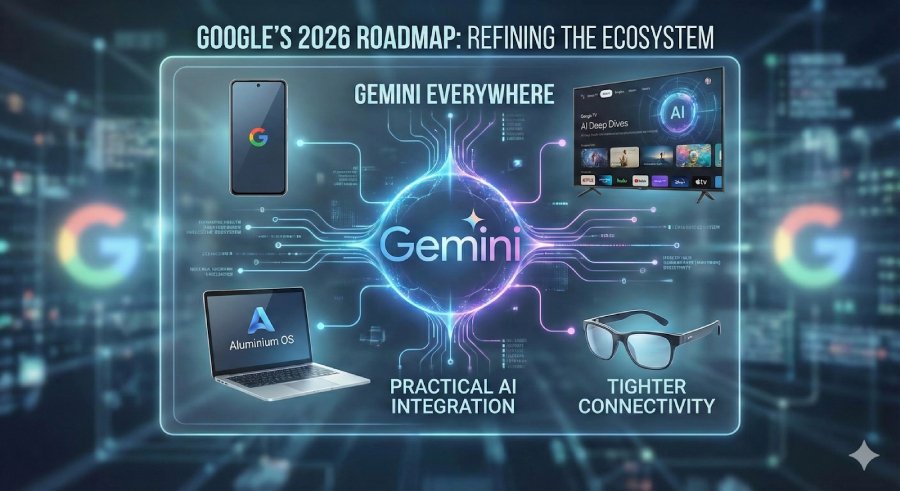
Google’s roadmap is starting to take shape, and early signs suggest the company is moving away from flashy launches and focusing on improving its existing AI.
Gemini is becoming more embedded across products, and there are also quieter updates for Pixel and new platforms like Google TV. Google also seems to be tightening its ecosystem rather than introducing entirely new categories.
Reports from major outlets have indicated that Google’s next phase centers on making its AI investments more practical, scalable, and secure. Instead of chasing novelty, the company appears focused on refining what it has already built. This shift could influence how people interact with Google’s products through 2026.
1. Gemini starts showing up across more Google products
Gemini is expected to become Google’s default AI layer in 2026, replacing Google Assistant and extending across phones, smartwatches, cars, and smart home devices.
According to MSN, Google confirmed that Gemini will fully take over Assistant duties as it expands systemwide. Google Assistant is based on a set of rules, but Gemini will go beyond this to enable more advanced interactions.
The Verge also reported that Google had already taken steps toward replacing Assistant in 2025 by letting users initiate phone calls, set timers, and send messages through Gemini with the Apps Activity toggle off. Google told The Verge in December that it will continue its work to “upgrade Assistant users to Gemini on mobile devices into 2026” instead of its original plan to make the switch by the end of 2025.
2. A new OS could replace ChromeOS with Aluminium OS
Google is reportedly building a successor to ChromeOS that may arrive soon this year, combining Android and desktop computing into a unified, AI-first platform internally known as Aluminium OS.
Early reporting from Wired noted that Google has acknowledged a planned merger of its existing platforms into a new OS this decade, with the effort likely culminating this year.
Wired also noted that at Qualcomm’s Snapdragon Summit in September last year, Google announced that ChromeOS and Android will merge, with hardware chief Rick Osterloh describing it as “bringing Android to the PC market.”
The company is partnering with Qualcomm on the new platform, leveraging the chipmaker’s expertise in phones, tablets, and laptops as a key advantage. Google executives confirmed the merged operating system will launch in 2026, likely at Google I/O.
3. Pixel gets smarter AI without major design changes
Google’s Pixel lineup is likely to continue evolving in small, deliberate steps in 2026 rather than undergoing a major reset. According to 9to5Google, this approach is expected to begin early in the year with the Pixel 10a, which will follow the Pixel 9 and Pixel 10 series and continue Google’s push into the mid-range phone market.
Later in the year, the Pixel 11 is expected to serve as the flagship follow-up. TechAdvisor noted that at this point, “there are no reports to suggest that Google is looking to change the design of the Pixel 11 series in any major way,” and current expectations point to “familiar hardware with incremental improvements” rather than a dramatic redesign.
TechAdvisor also highlighted that, given how much “Google has been pushing forward with on-device AI operations, a more efficient Tensor chip could also give Google greater scope for more complex AI-driven tasks in the future.”
4. Google brings Gemini deeper into Google TV
At CES 2026, Google previewed a wave of Gemini-powered features designed to make Google TV more useful across a wide range of devices, including smart TVs and projectors.
According to Google, Gemini now offers a visually rich way to explore topics directly on the TV screen, combining imagery, videos, and real-time sports updates. For more complex subjects, new “deep dives” provide narrated, interactive overviews designed for shared viewing.
Google also showed how Gemini can connect with personal content. Users will be able to search their Google Photos libraries using natural language, apply artistic styles with Photos Remix, or turn memories into cinematic slideshows. New Nano Banana and Veo tools will allow users to reimagine personal photos or create original media directly on the TV.
5. AI glasses return as a real product bet
After years of prototypes, Google confirmed plans to launch AI-powered smart glasses in 2026. CNBC reported that Google is collaborating on hardware design with Samsung, Gentle Monster, and Warby Parker to bring Gemini-powered glasses to market, marking a renewed push into wearable hardware.
The glasses are expected to run on Android XR and support hands-free interaction with Gemini, including navigation and live translation. MacRumors also noted that Google plans both audio-first models and versions with in-lens displays.
Bottom line: What Google’s 2026 is shaping up to be
Most of what’s in store for Google in 2026 indicates the company is focused on refining existing products rather than launching something entirely new. Instead of chasing new categories, Google seems committed to making Gemini the connective layer across its ecosystem, from phones and TVs to wearables and desktops.
Some of these plans are already public, while others remain in early or experimental stages, and not everything announced will necessarily ship on schedule. Still, the consistency across Google’s announcements and reports from outside sources points to a clear direction: tightening how its products work together.
For a closer look at how another major tech giant is shaping its next year, see TechRepublic’s breakdown of Apple’s 2026 roadmap.
