


Paul SeddonPolitical reporter
 Getty Images
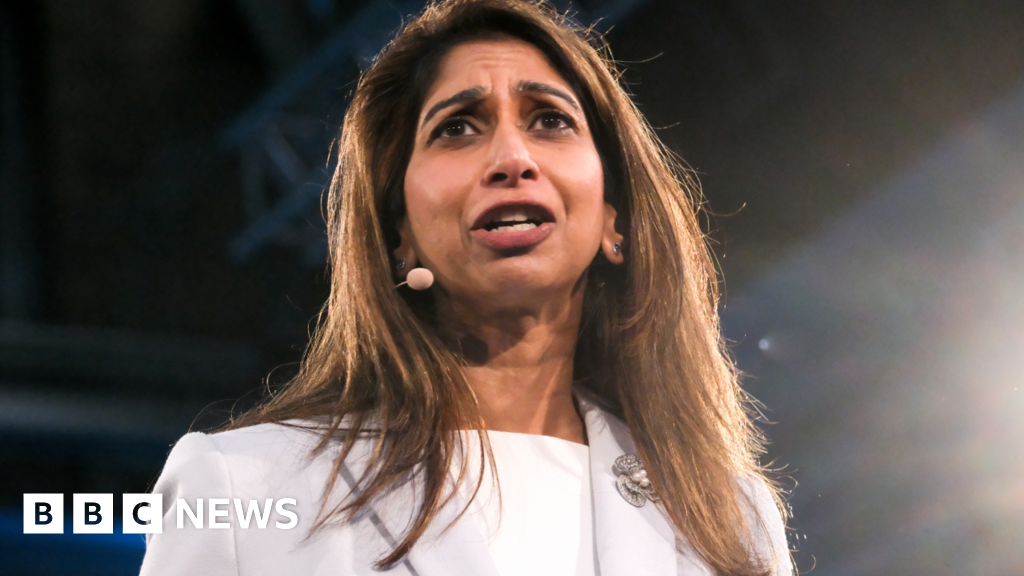
Suella Braverman once said the Conservative Party needed to do “everything we can” to win back former Tory voters switching to Reform UK.
But the former home secretary has now gone in the opposite direction herself, becoming the latest in a clutch of senior Tories to join Nigel Farage’s party.
A big figure on the right of the party in the last government, she had long been seen as a potential defector to the Reform cause.
She now says the Conservatives are “too weak to save themselves, let alone the country”.
Braverman was a notable survivor of the Tory election wipeout in 2024, which saw several of her former cabinet colleagues ejected from Parliament.
She won the newly-created Fareham and Waterlooville seat by just over 6,000 votes, down from the 26,086 majority she had enjoyed in the predecessor constituency after the Conservative landslide in 2019.
She was seen as a potential candidate to run in the leadership race that followed the rout, but in the end she did not throw her hat into the ring in the contest to replace Rishi Sunak.
She was not offered a position in Kemi Badenoch’s shadow cabinet, and became a vocal critic of the party’s record in office on immigration, net zero and what she branded “woke” thinking.
Dallas inspiration
Braverman’s rightward leanings were evident at an early age. In 1997, the year of Labour’s landslide victory, she won a mock election as the Conservative candidate at her independent all-girls school in Harrow.
A classmate at the time said she had turned the school “in completely the opposite direction” during the election, using her “personality, joviality and optimism”.
Braverman was born Sue-Ellen Fernandes in April 1980, named after Sue-Ellen Ewing, the matriarch of the American TV show Dallas, one of her mother’s favourite shows.
Teachers shortened it to Suella at school, where she was a high-flying student – crowning her time there as head girl.
Her parents were both of Indian origin, and met in London, after her father fled Kenya and mother emigrated from Mauritius to become a nurse.
She studied law at Cambridge University, where she chaired the Conservative Association – a post held by Tory grandees (and former home secretaries) Ken Clarke and Michael Howard.
After Cambridge, she studied for two years in Paris, gaining a postgraduate degree in European and French law at Panthéon-Sorbonne University, and developing a love for the works of Marcel Proust and songs of Belgian singer Jacques Brel.
Staunch Brexit backer
Braverman’s legal career took her from the UK to the US, passing the bar exam in both London and New York. She was also set on politics, gaining work as a lawyer for the government and unsuccessfully standing as the Conservative candidate in the then-solid Labour seat of Leicester East in 2005.
She was selected as the Conservative candidate for the safe seat of Fareham in Hampshire, a role she secured by doing the most “homework”, according to a member of her selection panel.
In the 2015 election she was duly elected as an MP, and quickly made a name for herself for her views on the EU, immigration, and law and order.
A fervent supporter of Brexit, she chaired the Eurosceptic European Research Group (ERG) of Tory MPs, after the UK left the EU.
It was in the melee following the 2016 referendum that she got her first government job, becoming a junior minister at the Department for Exiting the European Union (DExEU).
She resigned from the role 10 months later, alongside her boss at DExEU Dominic Raab, in protest at Theresa May’s Brexit deal, which she called “a betrayal”.
She changed her name to Suella Braverman, having married South African business executive Rael Braverman in 2019.
Sir John Hayes, one of Braverman’s oldest allies in politics, said Rael “reinforced” his wife’s conservatism.

 Reuters
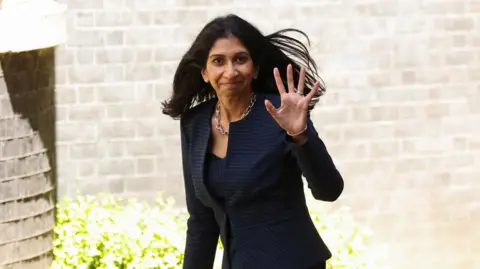
Braverman made a return to government when she was appointed attorney general by Boris Johnson, but maintained an independent streak.
As the chief legal adviser to the government, she was criticised by lawyers for backing the Internal Market Bill – setting post-Brexit customs and trade rules – which broke international law in a “specific and limited way”.
She also made history in 2021 as the first cabinet minister to take maternity leave, following the passage of a new law.
Following Johnson’s resignation as prime minister, Braverman was the first to announce she was running to replace him.
She was installed as home secretary by eventual winner Liz Truss, but was forced to resign within the space of a few weeks, after it emerged he had shared a government document with a Tory colleague using her personal email.
Return to office
In a twist that stunned Westminster, she was then reinstated as home secretary just six days later, after Rishi Sunak entered 10 Downing Street.
She was to prove a thorn in Sunak’s side, with the prime minister repeatedly distancing himself from her language on immigration and homeless people.
Eventually, she left the Home Office again, sacked the following year over an article accusing the Metropolitan Police of bias in the policing of pro-Palestinian protests in London.
She now says that she had grown increasingly frustrated within government about the party’s direction, particularly Britain’s continued membership of the European Convention on Human Rights (ECHR).
At a press conference alongside Farage, she dismissed her former party as dominated by “centrists” and “One Nation wets”.
Unveiled as Reform’s latest recruit during a party rally, she told activists: “I feel like I’ve come home.”
