










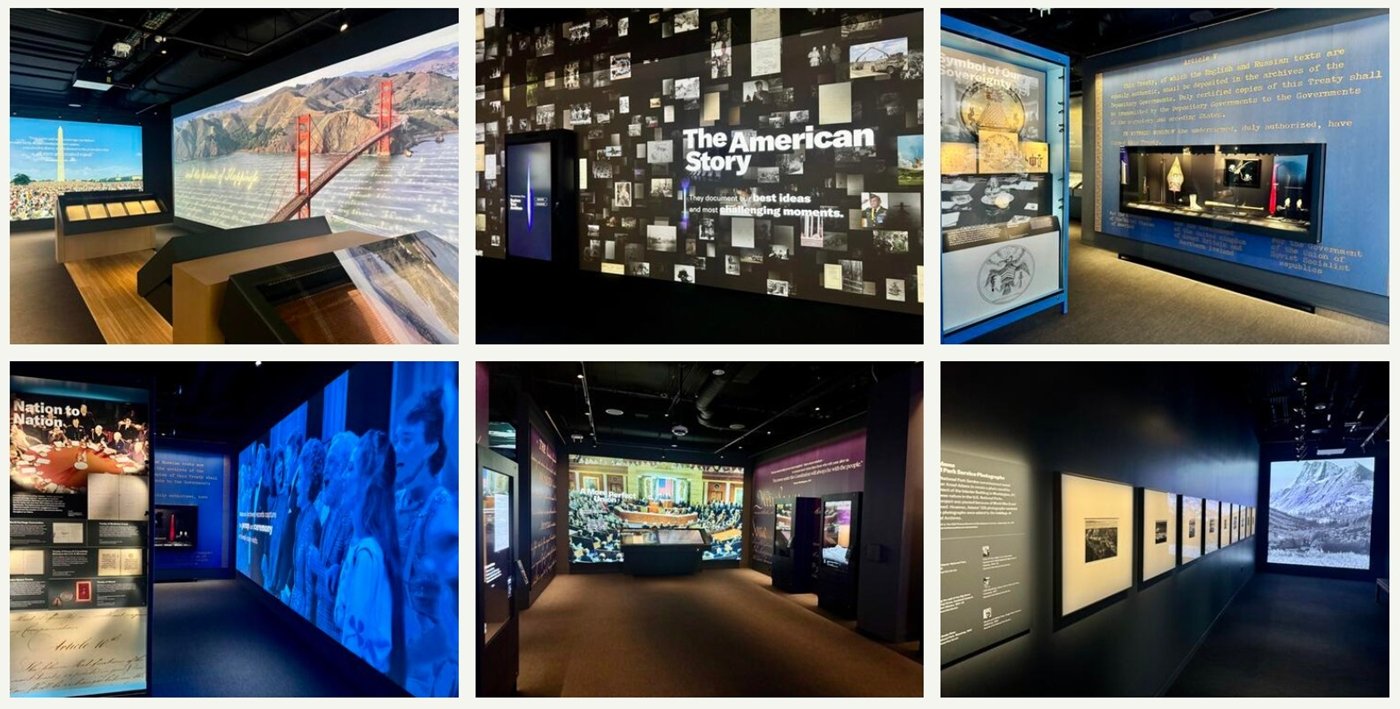
The National Archives is turning to AI to help modernize how Americans engage with the country’s historical records.
The exhibit, called “The American Story,” opened at the National Archives Museum on the National Mall, ahead of the United States’ semiquincentennial in 2026. It represents one of the most ambitious efforts yet by a major cultural institution to use AI not to generate content, but to organize and present it at scale.
Museum officials say the project reflects a broader shift underway in libraries, archives, and museums that are grappling with how to make vast collections usable and relevant to a public accustomed to personalized digital experiences.
Access, not creation
At the heart of “The American Story” are interactive portals that function like recommendation engines. Visitors begin by selecting topics they care about, along with preferred formats such as documents, photographs, or maps. From there, an AI system analyzes those interests and surfaces related archival materials.
The system relies on natural language processing to enable chatbot-style interactions, allowing visitors to refine their searches conversationally. Once visitors find records they want to explore further, they can scan a QR code to access the material online after leaving the museum.
Importantly, museum officials stress that AI is not being used to invent or recreate historical content.
“We’re not doing anything generative,” John McCarthy, principal of interactive design at Cortina, the Archives’ technology partner, told Axios. “We’re not reinventing history or anything like that.”
Instead, the technology is used to tag, structure, and connect existing records, helping visitors navigate collections that would otherwise be overwhelming.
Growing data challenge
The National Archives holds one of the largest collections of records in the world, a scale that makes traditional curation increasingly difficult. The institution keeps only 2% to 5% of federal records generated each year, yet that still amounts to roughly 13.5 billion pages of text, along with maps, charts, drawings, photographs, films, videos, and sound recordings.
The new exhibit includes more than two million records curated by archivists and cataloged with the help of AI, part of a $40 million investment in modernizing the museum experience. The National Archives Museum says it is the first institution on the National Mall to power an exhibit with AI.
Personalization meets public history
One of the key goals of “The American Story” is personalization, a feature more commonly associated with streaming platforms and e-commerce sites than with museums.
The personalization aspect of the exhibit helps visitors find unexpected connections in the catalog of documents, according to National Archives capital campaign director Franck Cordes.
“Part of the magic of this system is that it’s nudging visitors into new territory and new areas of content that they didn’t think about exploring,” McCarthy says.
That approach reflects a growing belief among museum designers that visitors are more likely to engage deeply with history when they can follow their own curiosity, rather than move through a fixed narrative.
Concerns about accuracy
The National Archives’ approach comes amid growing public concern about AI’s impact on historical accuracy. The rapid spread of generative AI tools has increased the volume of political deepfakes and misleading imagery online, complicating public trust in visual and documentary evidence.
Big Tech companies have faced criticism for testing chatbots in public, leading to high-profile AI gaffes such as producing images of Black founding fathers or Asian colonial Americans. In parallel, filmmakers and historians worry that generated material could be mistaken for authentic sources and incorporated into future work.
Against that backdrop, the creators of “The American Story” are eager to draw a clear line between AI as an organizing tool and AI as a creative one.
AI is likely to hit female-dominated occupations harder than other parts of the US labor market.


