







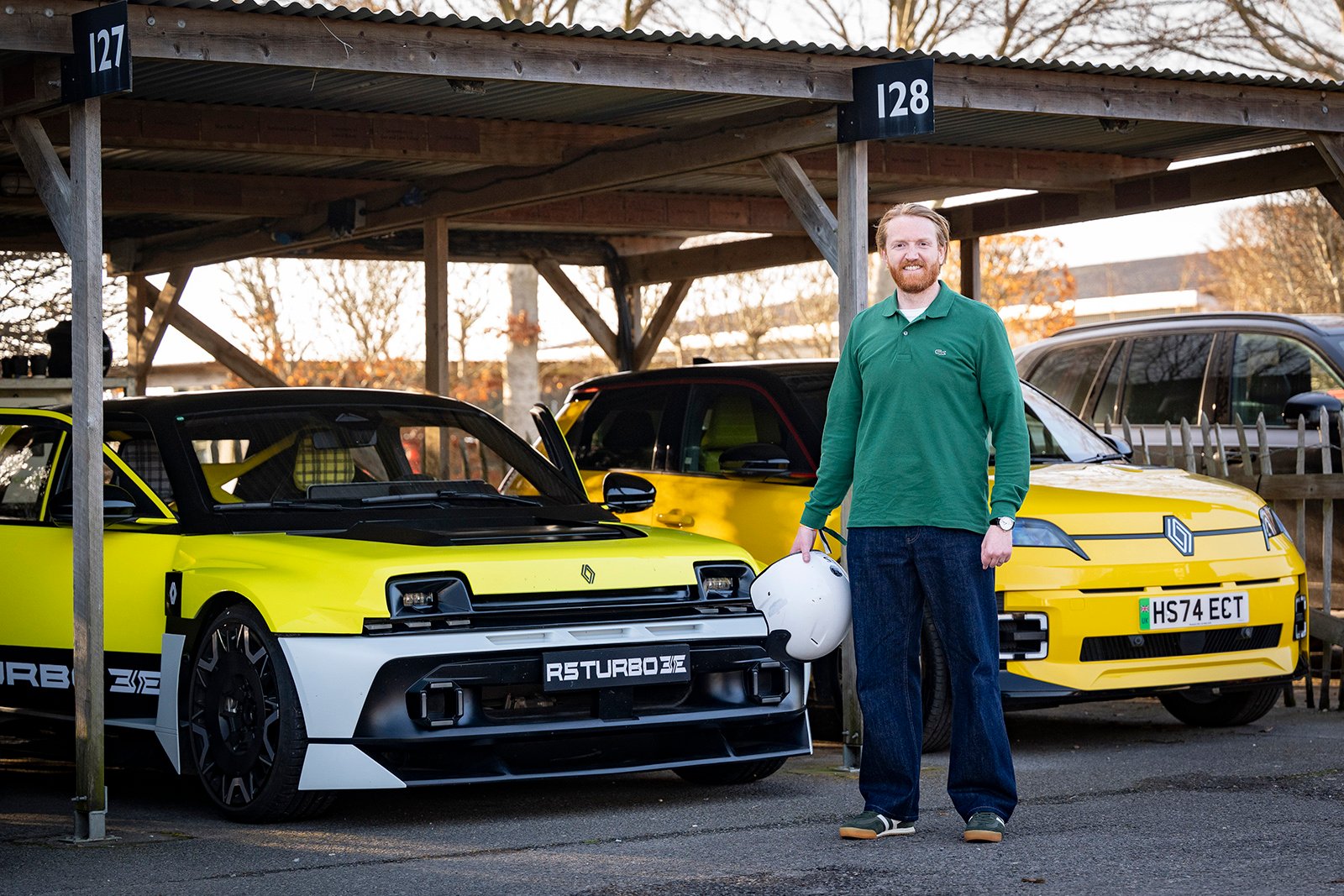
Here it is: the most expensive Renault to date. Prices for the slightly awkwardly named Renault 5 Turbo 3E will start at £140,000, rising to £220,000 once options are ticked.
In truth, it is vastly different from the standard Renault 5 with which it shares its name; only the mirrors, door handles, and tail lights are carried over. It sits on the Alpine Performance Platform, which will form the basis of the new electric Alpine A110.
It has been designed from the outset to look like a supercar, and it succeeds: before taking to the passenger seat for a lap of the Goodwood circuit, I had to fight through throngs of awestruck influencers and journalists who’d been drawn to its cartoonish silhouette.
Being a passenger in an EV can often induce a specific kind of nausea, stemming from the sensory conflict between fierce acceleration and a distinct lack of noise. Conversely, riding shotgun on track in a fast petrol car can overwhelm for the opposite reason: too much speed and too many sensory inputs to keep track of.
It speaks volumes about this electric hooligan that it is too visceral to trigger the former, yet raw enough to provoke the latter.
The 533bhp EV was piloted by long-time Renault test driver David Praschl. It is a hugely important halo car for the Renault Group. Only 1980 examples will be built – a nod to the original car’s launch year – and they are already close to selling out.
Slipping into the cabin, you appreciate just how low and tightly formed the car is, giving a cocooning sensation that is amplified by six-point harnesses and a beefy roll cage. This is not your mum’s Renault 5 Campus.
This is an unfinished pre-production model, but what struck me most were the interior’s contrasts. The seats are bespoke items with a steampunk, retro-futuristic quality; their shape, fit, and feel resemble a professional video-gamer’s setup, finished in an upmarket, GTI-aping tartan. Yet the screens are lifted almost directly from the standard Renault 5.
Alongside the obligatory fail-safe switches, mysterious control boxes and general prototype addenda, a bright yellow hydraulic handbrake springs proudly upright like the first daffodil of spring. Joy.
We pull away in silence, as you would expect, and at low speeds the car settles into a restless chunter reminiscent of every other piece of specialised hardware that resents travelling slowly – before zipping out of the Goodwood pit lane with just a touch of wheelspin. Praschl tells me the car isn’t operating at full power owing to a low battery percentage, but from the passenger seat, it certainly feels like 533bhp of instant EV muscle. The 0-62mph sprint is expected to take about 3.5 seconds, which feels entirely plausible.


