










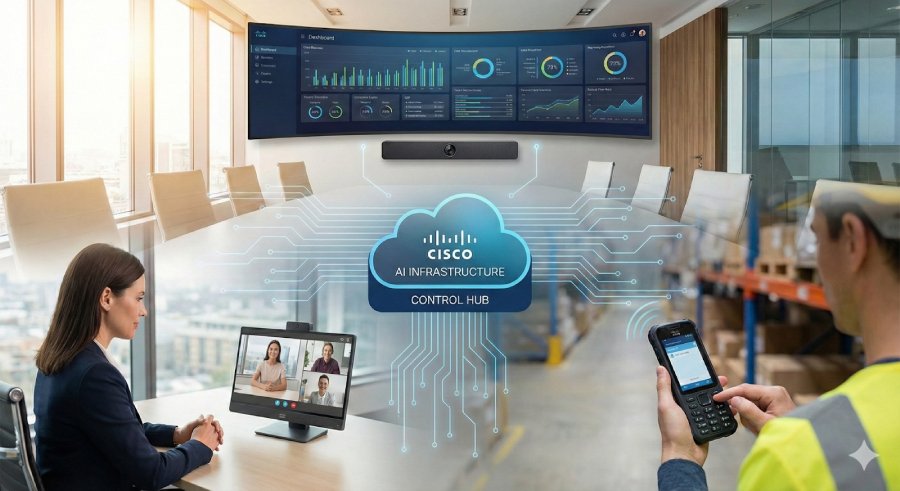
Collaboration devices are nothing new. Historically, they’ve been meeting accessories that mostly sit idle on users’ desks or in meeting rooms. Cisco is aiming to change that with the unveiling of several new endpoints.
Last week at the Integrated Systems Europe (ISE) show, the company rolled out a new generation of collaboration hardware that infuses AI directly into physical workspaces, from boardrooms and desks to hospitals and warehouses.
The lineup includes the Room Kit Pro G2, Desk Pro G2, and Wireless Phone 9821. It’s important to understand that these aren’t your parents’ cameras and phones. Rather, they should now be considered critical infrastructure on par with Wi-Fi access points and network switches. Cisco has loaded these devices up with advanced capabilities such as ThousandEyes agents, environmental sensors, Nvidia GPUs, and more.
However, large, high-impact spaces such as boardrooms, training rooms, and auditoriums are still difficult to manage. They are often built using a patchwork of third-party technologies that weren’t designed for AI-driven experiences.
Cisco is trying to move collaboration hardware beyond standalone products. The goal is to have rooms, desks, and frontline devices managed through the same platform, with more AI running directly on the devices themselves.
This would reduce complexity and give IT teams a consistent way to support collaboration across different types of workspaces, said Espen Loberg, vice president and general manager of Cisco’s collaboration devices business, during a news briefing.
“With the collaboration devices, we are bringing connected intelligence into physical spaces — they’re the last mile of AI infrastructure into the workplace. Our devices sit at the intersection where AI meets the physical world, processing intelligence at the edge, understanding spaces and people,” said Loberg.
Room Kit Pro G2 for complex AV environments
Cisco is presenting the Room Kit Pro G2 as an alternative to traditional, multi-vendor audio-visual (AV) setups that use separate digital signal processors (DSPs), switchers, adapters, and custom cabling.
It has an audio-video-over-IP (AVoIP) design that connects cameras and microphones directly to the network using Ethernet. Built-in Power over Ethernet (PoE) ports provide both power and connectivity, so there’s no need for separate High-Definition Multimedia Interface (HDMI) cables or other legacy wiring.
Cisco developed the Room Kit Pro G2 in partnership with Nvidia, integrating Nvidia’s Jetson AI compute platform into the device. This gives the Room Kit Pro G2 about 25 times more AI processing power than the previous generation. Additionally, it supports up to seven 4K cameras and eight microphones for speaker tracking and multi-camera views.
“For more than a decade, we have collaborated with Nvidia to bring intelligence to every meeting room,” said Loberg. “Now we’re partnering again to solve the AV puzzle. We work together to design this incredibly complex and innovative compute module that is unlike anything that’s been seen before.”
When Cisco first announced it was loading its devices up with Nvidia chips, it seemed overkill at the time, but given the volume of data generated and the use of AI, the GPUs let Cisco position its endpoints as edge computing devices.
The Room Kit Pro G2 is managed through Cisco’s Control Hub, where devices can be set up remotely rather than configured individually. Rather than logging into each room, admins can see cameras, microphones, and displays across their entire environment in one view.
The Room Kit Pro G2 is Cisco’s first large-room device certified for Microsoft’s device ecosystem, with native support for Webex, Microsoft Teams, and Zoom. While other devices can run multiple collaboration platforms, only Cisco devices can do so without rebooting when switching between meeting platforms.
Soon, the Room Kit Pro G2 will cover more types of spaces, including extra-wide rooms and long conference tables. Cisco is also expanding its partnership with Samsung, so Samsung displays can be selected directly inside Cisco’s Workspace Designer tool when planning meeting rooms.
Desk Pro G2 for personal and shared workspaces
The Desk Pro G2 is a second-generation desk device designed to work as both a personal workstation and a small-group collaboration system. It has dual 4K cameras — one optimized for close-up framing and another with a wide-angle lens for small meetings. It also has a 27-inch 4K interactive display and single-cable USB-C connectivity.
“This is the power of our platform packaged for any small workspace scenario. For high-stakes one-on-ones, the dual 48-megapixel cameras deliver executive presence. When more colleagues gather, the 105-degree wide-angle lens enables an instant collaboration space with natural depth and perspective,” said Loberg.
Like the Room Kit Pro G2, the Desk Pro G2 is managed through Cisco’s Control Hub. Both use the same centralized management tools across Cisco’s collaboration portfolio. In essence, Loberg noted, the same platform that already powers millions of devices can now be extended to any small space.
Wireless Phone 9821 for frontline communication
The Wireless Phone 9821 is a rugged handset with a physical keypad and a swappable battery, designed for environments where people are constantly on the move. It integrates with Cisco’s existing systems, so organizations don’t have to introduce a separate platform for frontline workers.
“Consumer devices lack enterprise integration and third-party solutions create management complexity. When milliseconds matter for safety, delays are unacceptable. This is why we built the Cisco 9821, the next innovation in our 9800 series phones. It enables frontline workers with agentic AI in our platform,” said Loberg.
The device uses Wi-Fi 6E for ultra-low-latency voice communication in fast-paced environments such as factories, warehouses, and hospitals. It runs on Cisco’s PhoneOS and is provisioned the same way as other devices in the 9800 Series. Administrators can deploy and manage it through Cisco Unified Communications Manager (CUCM) or Control Hub.
Control Hub AI support for IT teams
In addition to launching the devices, Cisco previewed new AI agent integrations for Control Hub, aimed at simplifying day-to-day device management.
The integrations bring Control Hub data directly into tools like Microsoft Copilot, Amazon Quick Suite, and ChatGPT. For example, administrators can ask basic questions about room usage, device health, or workspace performance and get answers in plain language.
“With this, you will get automated insights, trend reporting, and proactive recommendations in your platform of choice with a secure, managed access to the information you need,” said Loberg.
Cisco is starting a beta for the AI agent integrations in Q1 2026. As for hardware, the Room Kit Pro G2 will be available in mid-February and will ship in Q2 2026. The Wireless Phone 9821 is also expected in Q2 2026. The Desk Pro G2 is already available.
Also read: Microsoft Teams is getting five major AI upgrades in 2026.


