









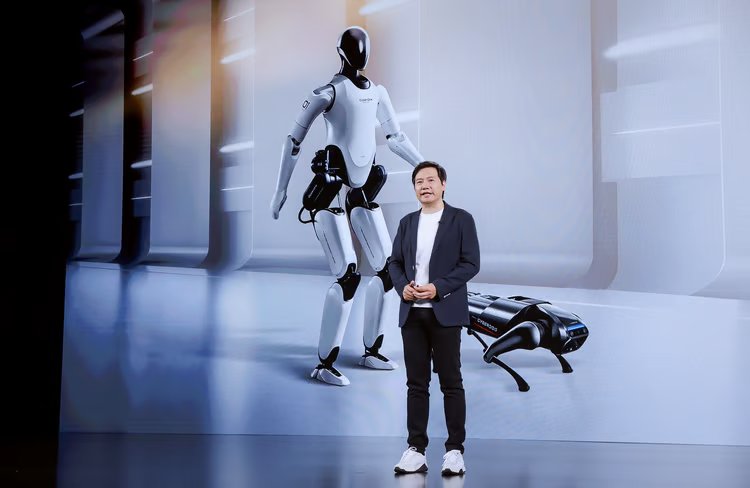
When Xiaomi first started talking about humanoid robots in its electric vehicle plant earlier this week, the company framed it as an “internship,” a careful, supervised trial where the machines learn the ropes.
Now we have actual numbers from that first shift, and they paint a clearer picture of what happens when a bipedal robot clocks in at an auto factory.
Xiaomi President Lu Weibing sat down with CNBC at the Mobile World Congress trade show in Barcelona and broke down the trial results. Two humanoid robots worked a three-hour shift at Xiaomi’s EV plant, handling tasks such as installing nuts and moving materials. According to Lu, they completed about 90% of the work assigned during that window.
That’s not a theoretical demonstration. That’s a shift.
The numbers matter because factory floors don’t care about flashy demos. They care about cycle times, repeatability, and whether the machine can still function at hour three the way it did at minute one. Xiaomi’s production line spits out a new car every 76 seconds, which means the robots had to move at human speed, or faster, without dragging the line down.
“The biggest challenge is for them to keep up with the pace,” Lu told CNBC. “In Xiaomi’s car factory, every 76 seconds, a new car gets off the assembly line. The two humanoid robots are able to keep up our pace.”
Still interns, not replacements
Before anyone starts worrying about robots taking over the factory floor, Lu was careful to reset expectations. “The robots in our production lines weren’t doing an official job, more like the interns,” he told CNBC.
That framing matters. Interns get supervised. Interns don’t run critical stations alone. Interns make mistakes, and someone steps in to fix them before they become a problem. Xiaomi’s robots are currently operating in that same gray zone between proof of concept and production asset.
The company isn’t selling the humanoid model used in the trial, and Lu said it’s “too early to say” how big the robotics market will actually become, even as RBC Capital Markets projects a $9 trillion global market for humanoids by 2050, with China accounting for more than 60% of that.
Xiaomi isn’t alone in this. BMW just announced plans to pilot humanoids at its Leipzig plant this summer. Tesla’s Optimus robots are already doing basic factory tasks, with Elon Musk teasing a Version 3 launch later this year. XPeng has its own humanoid in development. Even smartphone player Honor debuted its first robot model on Sunday.
The open question
What Xiaomi still hasn’t released publicly: how often operators had to step in during that three-hour run, whether the 90% figure counts partial completions or only fully successful cycles, and how the robots handle variation in parts, lighting, or unexpected clutter on the line. Those are the details that separate a successful trial from a technology ready to scale.
Xiaomi’s robots remain in that intern phase for now, learning the job, making mistakes where humans can catch them, and proving they can at least keep up with the line.
Also read: Amazon’s shelved Blue Jay warehouse robot shows how hard it is to turn a robotics debut into dependable automation.


