









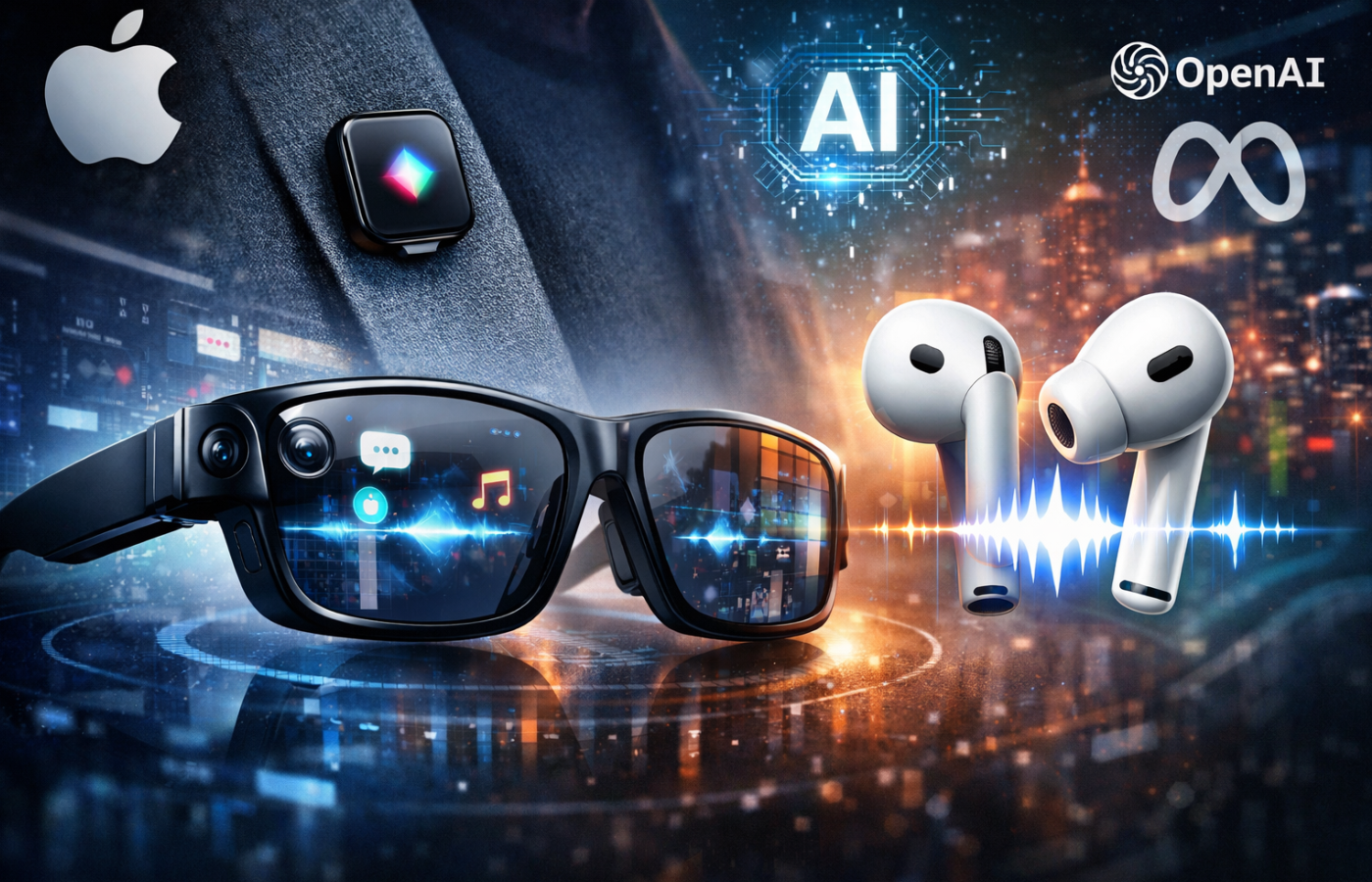
Apple is planning a significant expansion in the wearables market… with artificial intelligence set to sit at the heart of three new devices.
The three devices are smart glasses, a pin-like pendant, and AI-embedded AirPods. Apple has reportedly accelerated development after seeing the success of Meta’s smart glasses and amid rumours of an AI device from OpenAI. This news was first reported by Mark Gurman at Bloomberg, who sees the push as a way for Apple to reclaim some ground in the AI race.
Apple plans to make the new version of Siri, set to launch at WWDC 2026 in June, central to how these devices operate. Apple has reportedly tapped Google’s Gemini model as the backbone of the relaunched Siri, which would function as both a voice assistant and a text-based chatbot.
Apple has faced criticism from investors for playing catch-up in the AI market. The launch of several AI-embedded devices could ease some of that pressure, especially if the upgraded Siri is well-received by customers.
Competing with Meta in the smart glasses market
The smart glasses are expected to function similarly to Meta’s range, with a camera capable of capturing photos and videos, while also allowing the wearer to take calls, speak to AI, and play music or other audio from a connected device.
Apple’s twist is that it is developing its own lenses and frames rather than relying on third parties. Meta works with EssilorLuxottica to develop lenses for its glasses, while Oakley and Ray-Ban supply frames.
Apple believes its hardware expertise will give it an advantage over Meta. The company plans to use high-end materials and include two camera lenses: one for high-resolution images and another dedicated to computer vision, enabling Siri to interpret the wearer’s surroundings.
It is reportedly targeting a 2027 release for its first smart glasses. This may coincide with the company’s 20th-anniversary iPhone launch, which is expected to feature a major design overhaul, including an all-glass build and a buttonless design.
Like Meta, Apple has shifted its focus to head-worn devices from virtual reality headsets to smart glasses. Apple’s Vision Pro, while a technical achievement, has not achieved mass adoption, and most analysts predict a gradual uptake, with the next few versions likely to be incremental updates.
Meta reportedly sold seven million smart glasses in 2025, according to EssilorLuxottica’s CEO on a recent earnings call, triple the figure in 2024. While respectable, Apple will be aiming for a much larger market. The company sold more than 200 million iPhones in 2025.
Fending off OpenAI’s hardware ambitions
Apple is also preparing an AI-embedded pendant, similar to the Humane AI Pin, designed to act as an accessory to the iPhone. It would feature an always-on camera to capture what the user sees, alongside a microphone for voice commands and dictation. Apple is reportedly considering adding a speaker to enable two-way conversations with Siri.
It is unclear when Apple plans to launch the device, which is said to be similar in size to an AirTag but with computing power closer to that of the AirPods. The move appears aimed at competing with OpenAI and former Apple design chief Jony Ive, who is reportedly working on a similar device that is not expected to ship before late February 2027.
Apple is also planning to integrate new AI features into the next version of its AirPods. Siri will be embedded directly into the earbuds, and users are expected to gain access to a live translation mode.
Also read: OpenAI drops ‘io’ branding for planned AI hardware.


