



Apple held its annual spring launch event this week, announcing updates across its iPad, iPhone, and Mac lines. The company introduced new chips, refreshed designs, and a completely new entry-level laptop called MacBook Neo.
Over three days, the company announced seven new products under the banner of its spring #AppleLaunch, touching everything from its cheapest laptop ever to the most powerful chips it has ever built for a notebook computer. Whether you’re a student counting every dollar or a filmmaker rendering 8K footage, Apple has something new to put in front of you.
Here’s what dropped… and what it all means.
iPhone 17e adds MagSafe and doubles storage
The week kicked off on Monday, March 2, with the iPhone 17e, the most affordable model in the iPhone 17 family. Apple positioned it squarely for people who want a current-generation iPhone without paying current-generation flagship prices.
The A19 chip powers the device and includes Apple’s C1X cellular modem, which the company said is twice as fast as the C1 modem in iPhone 16e.
The phone features a 48-megapixel Fusion camera that supports an optical-quality 2x telephoto mode. It records 4K video in Dolby Vision at up to 60 frames per second. The front display uses Ceramic Shield 2, which Apple said offers three times the scratch resistance of the previous generation and reduces glare.
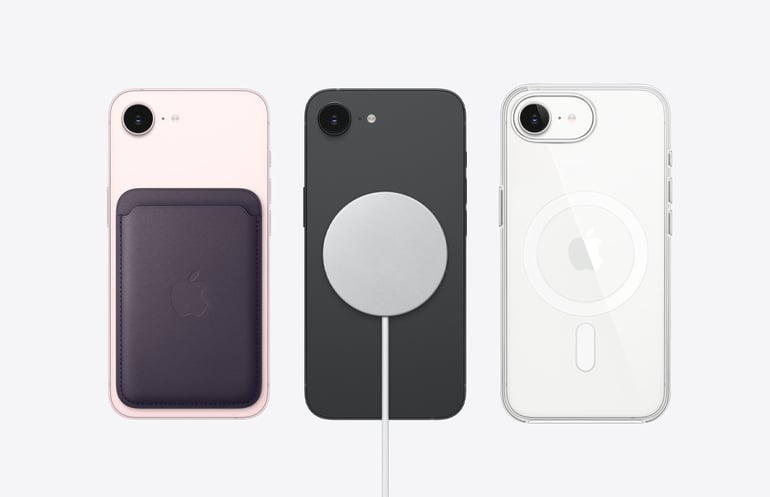
For the first time in the “e” lineup, iPhone 17e includes MagSafe support for wireless charging up to 15 watts and accessories. The device also includes the Action button, previously available only on Pro models, which users can customize to access the flashlight, camera, or other features.
Satellite features, including Emergency SOS, Roadside Assistance, Messages, and Find My are available when outside cellular and Wi-Fi coverage.
The base storage is 256GB, double the starting storage of iPhone 16e, at the same $599 price. The phone comes in black, white, and soft pink matte finishes.
iPad Air now ships with M4 chip
Also announced on Monday was a new iPad Air powered by Apple’s M4 chip. Apple kept the starting price unchanged at $599 for the 11-inch model and $799 for the 13-inch, while pushing the performance ceiling considerably higher.
The M4 upgrade brings 50% more unified memory than the previous generation, now at 12GB, along with a memory bandwidth of 120GB/s. Apple says the new iPad Air is up to 30% faster than the M3 version and up to 2.3x faster than the M1 model. The jump to M4 also brings a 16-core Neural Engine that is three times faster than M1’s, making it meaningful for on-device AI tasks.
New to iPad Air this generation are Apple’s N1 wireless chip, which enables Wi-Fi 7 and Bluetooth 6, and the C1X cellular modem on cellular models, the same modem found in the iPhone 17e. Apple says C1X offers up to 50% faster cellular data performance and 30% lower modem energy consumption than the M3 iPad Air.
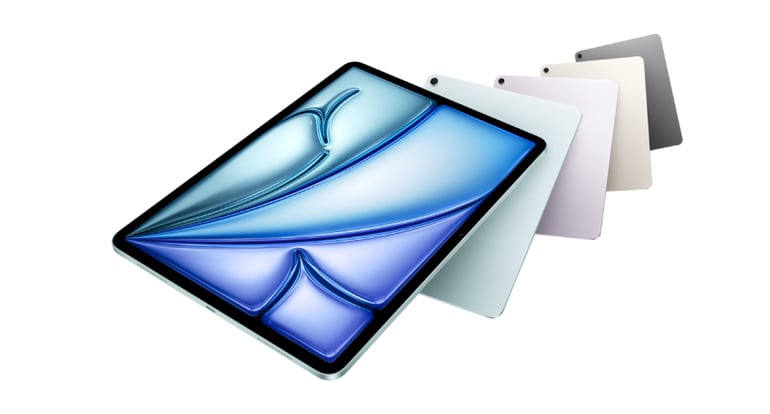
The new iPad Air also ships alongside iPadOS 26, which introduces a redesigned windowing system, a new visual language called Liquid Glass, and an improved Files app. Both sizes come in blue, purple, starlight, and space gray.
MacBook Pro gets M5 Pro and M5 Max chips
The MacBook Pro announcement was the week’s technical centerpiece. Apple unveiled M5 Pro and M5 Max, built using what the company calls its new Fusion Architecture, a design that combines two silicon dies into a single chip for the first time.
The M5 Pro and M5 Max feature an 18-core CPU with six “super cores” and 12 performance cores. According to Apple, the new chips deliver up to 30% faster CPU performance for professional workloads compared to the previous generation. The GPU includes Neural Accelerators in each core, and the company said this results in up to four times the peak GPU compute for AI compared to M4 Pro and M4 Max.
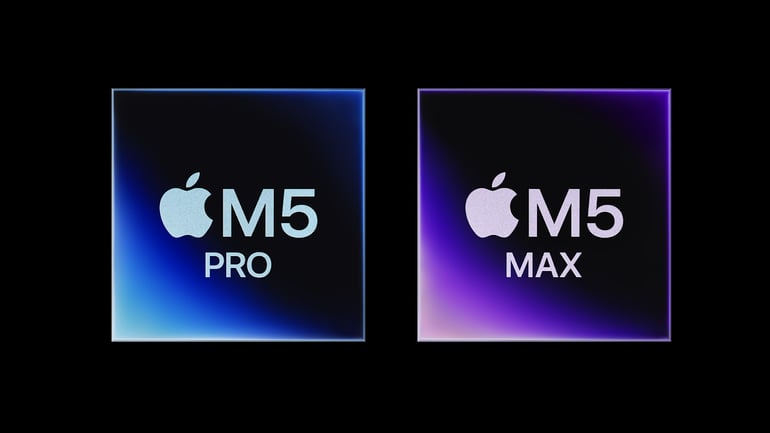
Memory bandwidth increases to 307GB/s on M5 Pro and 614GB/s on M5 Max. M5 Pro supports up to 64GB of unified memory, and M5 Max supports up to 128GB.
The new MacBook Pro includes the N1 wireless chip for Wi-Fi 7 and Bluetooth 6. Storage performance is twice that of the previous generation, according to Apple, with read/write speeds up to 14.5GB per second. The M5 Pro model starts at 1TB of storage, and the M5 Max model starts at 2TB.
The laptops feature Liquid Retina XDR displays with an optional nano-texture finish, a 12-megapixel Center Stage camera with Desk View support, and six-speaker sound systems. Thunderbolt 5 ports support high-speed data transfer and display connections.
Battery life is rated at up to 24 hours. The 14-inch MacBook Pro with M5 Pro starts at $2,199, and the 16-inch model starts at $2,699. The 14-inch with M5 Max starts at $3,599, and the 16-inch with M5 Max starts at $3,899.
Apple introduces two new Studio Displays
Alongside the new MacBook Pro, Apple announced an updated Studio Display and an all-new Studio Display XDR, its most capable external monitor to date, and a direct replacement for the Pro Display XDR.
The standard Studio Display features a 27-inch 5K Retina display with 600 nits of brightness. It includes a 12-megapixel Center Stage camera with Desk View support, a three-microphone array, and a six-speaker sound system with force-canceling woofers that Apple said deliver 30% deeper bass than the previous generation. Thunderbolt 5 connectivity allows daisy-chaining up to four displays.

The new Studio Display XDR is designed for professional users. It features a 27-inch 5K Retina XDR display with a mini-LED backlight and more than 2,000 local dimming zones. Peak HDR brightness reaches 2,000 nits, and SDR brightness reaches 1,000 nits. The display supports both P3 and Adobe RGB color gamuts and has a 120Hz refresh rate with Adaptive Sync.
Both displays include Thunderbolt 5 ports and USB-C ports. The Studio Display starts at $1,499, and the Studio Display XDR starts at $2,999.
MacBook Air adds M5
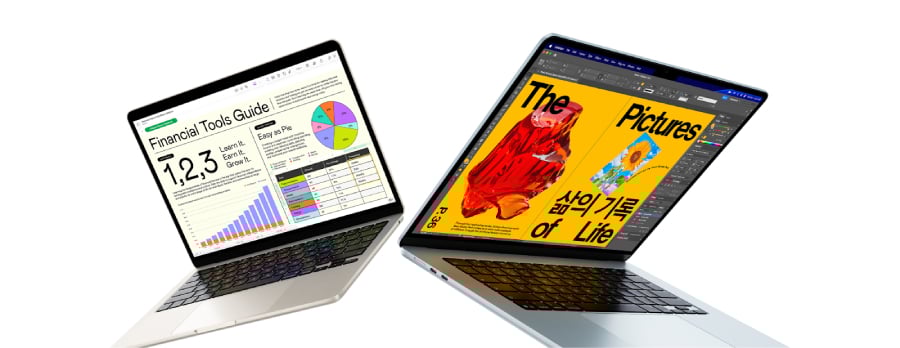
Apple updated the MacBook Air with the M5 processor, available in 13-inch and 15-inch models. The M5 chip includes a 10-core CPU and up to a 10-core GPU with Neural Accelerators in each core.
According to Apple, the MacBook Air with M5 delivers up to 4x faster AI task performance than the M4 model and up to 9.5x faster than the M1 model. The company also cited performance comparisons to Intel-based PCs, stating that web browsing is up to 50% faster than a PC laptop with an Intel Core Ultra X7 processor.
The base storage is now 512GB, double the previous generation, and can be configured up to 4TB for the first time. Apple said the new SSD delivers twice the read-write performance of the previous model.
The laptops include the N1 wireless chip for Wi-Fi 7 and Bluetooth 6. They feature Liquid Retina displays with 500 nits of brightness, 12-megapixel Center Stage cameras with Desk View support, and six-speaker sound systems with Spatial Audio.
Battery life is rated at up to 18 hours. The laptops come in sky blue, midnight, starlight, and silver finishes.
The 13-inch MacBook Air with M5 starts at $1,099, and the 15-inch model starts at $1,299. Education pricing starts at $999 and $1,199, respectively.
MacBook Neo: Apple’s Cheapest Laptop Ever
Wednesday brought perhaps the most unexpected announcement of the week: the MacBook Neo, a brand-new laptop that starts at just $599 or $499 for students. It is the cheapest Mac Apple has ever made.
Running on the A18 Pro chip, the MacBook Neo isn’t aimed at pros; it’s aimed at first-time Mac buyers, students, families, and anyone priced out of the MacBook Air. Apple says it is up to 50% faster for everyday tasks than the best-selling PC with the latest Intel Core Ultra 5 processor.

Despite its price, it carries a genuinely good spec sheet: a 13-inch Liquid Retina display at 500 nits of brightness with support for one billion colors, up to 16 hours of battery life, a 1080p FaceTime HD camera, dual speakers with Spatial Audio, and Wi-Fi 6E with Bluetooth 6. It comes in four colors — blush, indigo, silver, and citrus — and weighs just 2.7 pounds. There are two USB-C ports, but no Thunderbolt.
Apple also flagged that MacBook Neo carries the highest recycled content of any Apple product at 60%, including 90% recycled aluminum overall.
Everything Ships March 11
Every product announced during Apple’s launch week — iPhone 17e, iPad Air with M4, MacBook Air with M5, MacBook Pro with M5 Pro and M5 Max, Studio Display, Studio Display DR, and MacBook Neo — goes on sale Wednesday, March 11. Pre-orders for all of them are open now through apple.com and the Apple Store app.
It is a rare sweep. Apple doesn’t often refresh this many product lines in a single week, and across a $599 phone, a $599 tablet, a $599 laptop, and chips that power machines well north of $3,000, the company has deliberately covered nearly the entire price spectrum in one move.
All prices listed are US retail. Education pricing is available through Apple’s education store.
Want more Apple news? Check out our look at the upcoming Mac Studio refresh, expected to bring powerful M5 Max and M5 Ultra chips and potentially launch between March and June 2026.
