








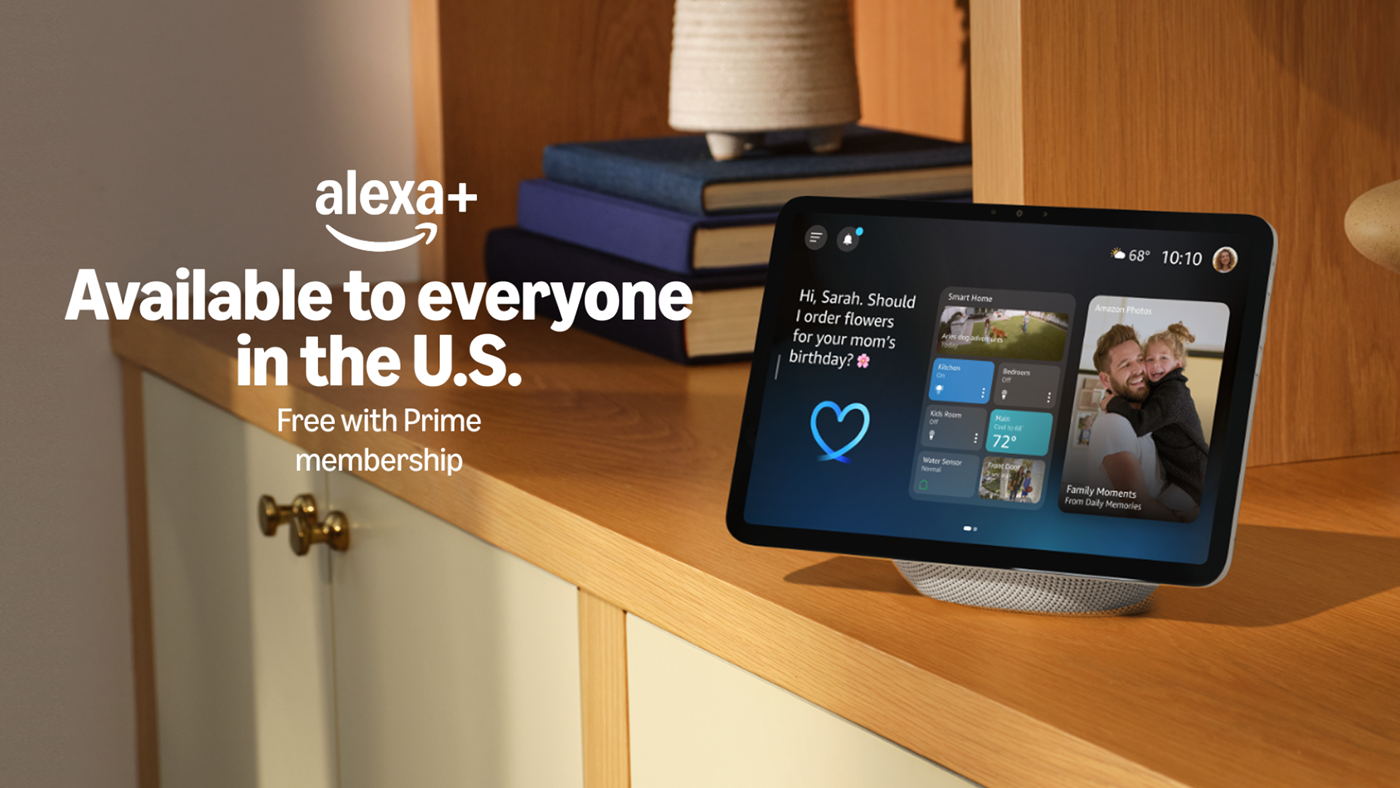
Amazon is making its generative AI-powered Alexa+ assistant available to everyone in the U.S., nearly a year after the revamped service first launched in a limited early-access preview.
The broader rollout, announced today (Feb. 4), marks a major milestone in Amazon’s effort to reinvent Alexa for the age of large language models, as competition from AI chatbots such as OpenAI’s ChatGPT, Google’s Gemini, and Anthropic’s Claude reshapes how consumers interact with digital assistants.
Alexa+ has been in early access since March of last year, a phased launch that required users to either join a waitlist or purchase newer Echo devices to try the service. With the nationwide expansion, Amazon is opening Alexa+ to the public through compatible devices, as well as through a new website and mobile app designed to support more conversational, chatbot-style interactions.
Rebooting Alexa for the generative AI era
Amazon introduced Alexa in 2014, and the voice assistant quickly became one of the company’s most visible consumer products. Millions of households adopted Echo smart speakers, using Alexa primarily for simple tasks such as setting timers, playing music, checking the weather, or controlling smart home devices.
Over time, however, Alexa struggled to move beyond basic commands, even as conversational AI advanced rapidly. The emergence of powerful generative AI systems over the past two years underscored the limitations of traditional voice assistants and raised questions about Alexa’s long-term relevance.
Alexa+ is Amazon’s answer to that challenge. The upgraded assistant is designed to handle more complex, multi-step requests and maintain context across conversations. Amazon has described Alexa+ as capable of acting as an “agent” that can take actions on a user’s behalf, such as booking a repair service, ordering groceries, or requesting a ride.
Unlike the original Alexa experience, which centered almost entirely on voice interactions through smart speakers, Alexa+ places greater emphasis on text and multimodal use. Amazon has introduced a dedicated website and mobile app that allow users to type or speak queries, mirroring how many consumers already interact with chatbots like ChatGPT or Gemini.
Pricing and access strategy
As part of the broader rollout, Amazon is beginning to charge users $19.99 per month for Alexa+. However, the service is included at no additional cost for Amazon Prime members, adding another perk to the company’s $139-per-year subscription.
Amazon is also offering a free version of Alexa+ that users can access through the website and app, though the company said usage will be limited. The free tier appears designed to give consumers a taste of the new assistant while encouraging heavier users to subscribe or join Prime.
The pricing strategy reflects Amazon’s broader push to find sustainable revenue models for its AI investments. Generative AI systems are expensive to build and operate, requiring significant spending on data centers, specialized chips, and cloud infrastructure. Charging directly for Alexa+ represents a shift from Amazon’s earlier approach, in which Alexa was largely treated as a loss leader intended to drive device sales and engagement across Amazon’s ecosystem.
A response to intensifying AI competition
The timing of the nationwide release underscores the growing pressure on Big Tech companies to demonstrate tangible progress in AI. Over the past year, Google, Microsoft, and OpenAI have rapidly rolled out new AI features across search, productivity software, and consumer-facing products.
For Amazon, the stakes are particularly high. While the company is a major player in cloud computing through Amazon Web Services, it has faced criticism for being slower than rivals to deliver compelling consumer AI experiences. Alexa+ is widely seen as a test of whether Amazon can translate its technical capabilities into a product that resonates with everyday users.
The nearly yearlong early-access period also highlights the complexity of deploying generative AI at scale. Unlike traditional voice assistants, large language models can generate unpredictable responses, raising concerns around accuracy, safety, and trust. Amazon has said it used the preview phase to gather feedback, refine performance, and add safeguards before opening the service more broadly.
Implications for Amazon’s ecosystem
A more capable Alexa could have far-reaching implications for Amazon’s broader business. If Alexa+ succeeds in becoming a central interface for tasks such as shopping, scheduling, and service bookings, it could deepen customer engagement and create new opportunities for commerce and advertising.
At the same time, the move raises questions about consumer willingness to pay for AI assistants. While Prime members receive Alexa+ at no extra cost, non-Prime users face a relatively high monthly fee compared with other AI services. Whether Alexa+ can justify that price will likely depend on how reliably it delivers on its promise of being a true digital agent rather than a more talkative voice assistant.
Amazon is once again trimming its workforce in Washington state, with nearly 2,200 employees expected to lose their jobs this spring.


