










From OpenAI’s expanding dominance to sweeping security incidents and corporate realignments, this week underscored how AI continues to reshape every corner of the tech landscape — from government contracts to consumer devices and enterprise infrastructure.
Top news
OpenAI expands its AI arsenal
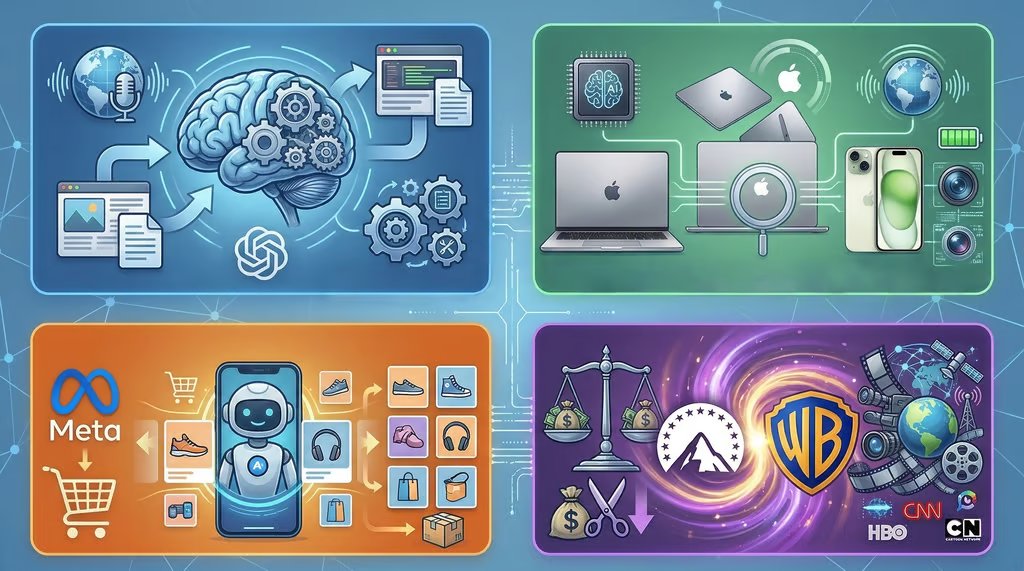
OpenAI launched GPT-5.4, available in Thinking and Pro versions, designed for professional reasoning and automation. The model can interpret screenshots, click buttons, and manage workflows across apps, achieving a 75% success rate on desktop navigation benchmarks. It also debuts Tool Search, which cuts token use by 47%, and introduces a ChatGPT Excel add-in. Pricing begins at $2.50 per million input tokens.
The company also rolled out GPT-5.3 Instant, replacing GPT-5.2 as ChatGPT’s default model. The update boosts response speed, reduces hallucinations by nearly 27%, and trims unnecessary preambles. It’s also available via API and Microsoft Copilot integrations.
Google’s AI Workspace and robotics revival
Google introduced Canvas in AI Mode to all US Search users, adding a project panel that lets users build and iterate on documents, dashboards, and code directly from search results. Integrated with Gemini, Canvas supports live updates and coding assistance, positioning it as a direct rival to OpenAI’s and Anthropic’s workspaces.
Meanwhile, Alphabet is bringing its robotics spin-out Intrinsic back in-house. The move connects robotics development with DeepMind and Gemini teams to accelerate “physical AI” systems and standardize robotic software through the Flowstate platform.
Apple’s hardware blitz
Apple unveiled the $599 MacBook Neo, powered by the A18 Pro chip and featuring macOS with on-device Apple Intelligence. Targeting students and budget buyers, it offers up to 16 hours of battery life and a 13-inch aluminum design.
The company also introduced M5-powered MacBook Air and Pro models with faster chips, improved storage, Wi-Fi 7, and up to four times faster on-device AI performance.
In mobile, Apple’s iPhone 17e brings MagSafe charging, doubles base storage to 256 GB, and adds AI-driven features like Live Translation and Visual Intelligence.
Government and enterprise AI moves
The Pentagon replaced Anthropic with OpenAI for classified AI systems, citing security concerns. The new deal includes restrictions on surveillance and autonomous weapons, though critics warn of broad “all lawful purposes” language.
Microsoft introduced Copilot Tasks, an AI assistant capable of executing multi-step tasks like drafting reports or managing schedules autonomously. The feature is currently in limited preview.
Browser and platform updates
Google Chrome will move to a biweekly update cycle starting Sept. 8, doubling its release frequency to stay competitive with AI-first browsers like Atlas and Comet.
AI meets commerce
Meta launched a shopping research mode in its AI chatbot that curates personalized product carousels using data from Facebook, Instagram, and WhatsApp. The feature currently redirects users to retailer sites for checkout.
Corporate restructuring for AI efficiency
Block CEO Jack Dorsey announced a 40% workforce reduction, citing AI-driven restructuring that boosted profits and investor confidence. The move follows a broader trend of AI-related layoffs across major tech firms.
Insider intel
Analysts say the Pentagon’s OpenAI deal marks a turning point in U.S. AI governance. According to Axios, Washington’s growing control over AI deployment signals the end of industry self-regulation and the beginning of a new era of federal oversight in AI ethics and defense applications.
Security alerts
Major data breaches and leaks
LexisNexis confirmed a breach exploiting an unpatched React2Shell flaw, exposing about 2 GB of legacy client data. Hackers claim access to millions of records and AWS secrets, though the company says only pre-2020 contact data was affected.
A DHS contractor data leak exposed sensitive vendor details from firms like Microsoft and Palantir, raising supply-chain attack concerns.
Meanwhile, a ManoMano vendor breach compromised data from 37.8 million shoppers across Europe via a hacked Zendesk account.
Critical vulnerabilities
The MS-Agent flaw (CVE-2026-2256) allows remote code execution through crafted prompts, earning a 9.8 CVSS score. CERT recommends sandboxing and strict command allowlists.
Google’s March Android update patched 129 vulnerabilities, including an active Qualcomm exploit, according to TechRepublic. CISA has mandated federal agencies to patch by March 24.
Google’s Threat Intelligence Group also revealed “Coruna”, a leaked US government iPhone exploit kit targeting iOS 13–17.2.1, used in espionage and cryptotheft campaigns.
Privacy and device threats
A flaw in Perplexity’s Comet AI browser allowed attackers to hijack local files via calendar invites. The issue was patched on February 13, but users are advised to disable automatic sign-ins.
Meta’s Ray-Ban smart glasses were found to send user videos to third-party reviewers in Kenya, prompting EU GDPR investigations.
Attackers are also exploiting signed drivers to disable Windows security tools. The BYOVD technique grants kernel-level access for ransomware deployment. Experts recommend Secure Boot and driver blocklists.
Finally, Truffle Security discovered thousands of leaked Google Cloud API keys granting unauthorized Gemini access, urging immediate key rotation.
Industry shakeups
AI-driven restructuring and layoffs
Oracle is preparing thousands of layoffs to offset the cost of a $50 billion AI data center expansion. The move follows a $300 billion OpenAI deal and mirrors AI-driven restructuring seen at Microsoft and Block.
Telecom and media realignments
Motorola announced a partnership with GrapheneOS to deliver a privacy-focused smartphone by 2027, expanding the secure OS beyond Google Pixels.
In media, Paramount clinched a $111 billion all-cash acquisition of Warner Bros. Discovery after Netflix withdrew its bid. The deal consolidates major media assets and faces regulatory scrutiny amid expected cost-cutting measures.


