


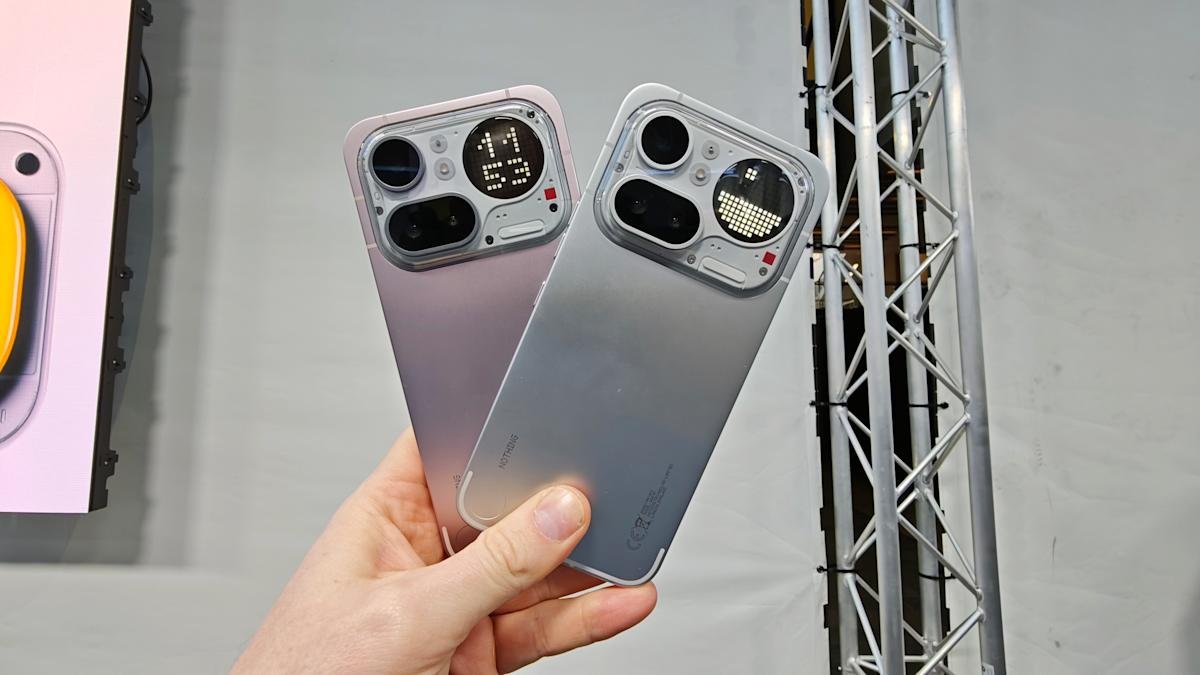
Nothing has announced its latest premium midrange device, the Phone 4a Pro. The company says it’s the thinnest full-metal phone on the market, measuring in at 7.95mm. It also looks notably different from the prior A-series phones – and pretty much any of the company’s phones to date.
It features an aluminum unibody while retaining Nothing’s retro-clear hardware design touches, with a clear, redesigned camera unit. Yes, the aggressively protruding circular camera unit of the Phone 3a Pro is gone, replaced with an oblong housing that houses the triple-camera array and a tweaked Glyph Matrix, similar to what debuted on last year’s Nothing Phone 3. It also feels incredibly premium – more so than even the company’s flagship phones.
Despite that, Nothing seems to be strikeinga balance between affordability and wow factor with the Phone 4a Pro. It has a slightly higher price tag ($499) than the 4a and alongside a major hardware redesign, a lot of the improvements here make this phone feel “pro” compared to its smaller sibling. This new premium vibe comes at a cost of design excitement, though.
It also looks a little like another certain smartphone or two. Don’t call it a camera plateau.
Image by Mat Smith for Engadget
The Phone 4a Pro has its own take on the Glyph Matrix, composed of 137 mini-LEDs. That’s fewer LEDs than the Nothing Phone 3, but they are 100 percent brighter at around 3000 nits. It supports pretty much all the Glyph toys we enjoyed on last year’s Nothing flagship, although the 4a Pro lacks a dedicated Glyph Button, which is a shame. This means in order to hop between toys and modes, you’ll have to dig into Glyph settings inside the settings menu – not the existing Glyph menu – in order to flit between them. Honestly, may make me less likely to play around with the Glyph, but I’ll have to see after further testing. It’s a little odd when there’s a circular metal detail on the lower left corner that looks like it could have been a Glyph button. Ah well.
The gigantic camera unit seen on the Phone 3a Pro is no more. (Image by Mat Smith for Engadget)
The Phone 4a Pro has a slightly bigger screen than both its predecessor and the 4a, but the real news isn’t just the extra fraction of an inch. The 6.83-inch display can now reach 144Hz refresh rates, while it can also top out at 5,000 nits of brightness with HDR content. That makes it up to 66 percent brighter than its predecessor, and it was noticeably easier to read in Nothing’s harsh spotlights and daylight.
Nothing has further refined the cameras, and the 4a Pro uses the same telephoto sensor as the flagship Phone 3. That’s paired with a new 50-megapixel Sony LYT-700C camera sensor that’s 24 percent bigger than the 50MP sensor inside the 3a Pro. It’s also faster at auto-focus than its predecessor, and seems to more easily lock onto subjects without having to tap on what you want in focus.
There’s also a new triple 12-bit Image Signal Processor (ISP), which enables up to 140x ultra zoom, like we’ve seen on Galaxy phones for the last few years. Don’t expect to be blown away by those zoom extremes: it seems to work well on the easy-to-guess structures of buildings and patterns, but a 70x zoom range and higher aren’t settings I’m going to lean into much.
I haven’t had time yet to fully scrutinize the 4a Pro’s camera, but there’s a lot of feature parity with pricier phones. It can capture super-slow 120fps video at full HD, while Action Mode is built directly into the camera app to shoot up to 30 Ultra XDR images in a row. Codeveloped with Google, Ultra XDR images are high-dynamic-range images that capture 13 RAW frames at different exposures and combine them into a single image. In practice, this should offer another way to pull usable shots from challenging low-light or harsh-light environments.
Power users may also like new presets, alongside Nothing’s own collection of camera filters. There are seven new editing options, letting you tweak (and save) contrast levels or even apply a vignette effect. I’m a fan of the built-in presets, but it’s nice to have access to the same camera settings to make and save my own B&W filter.
Nothing says you can expect 30 percent improved graphics performance and 27 percent faster CPU speeds, with “flagship” LPDDR5X memory, which makes it 100 percent faster than last year’s 3a Pro. Improvements to the chipset and memory speed weren’t immediately noticeable during my time seeing the device.
Nothing continues to refine its own OS skin, but it’s still a refreshing, different take on the Android interface you’re used to. And if you’re not a fan, you can turn it back to a more stock look. Based on user feedback, there are new size options for the home screen widgets and a new custom lock screen. It may be due to the more powerful processor, but both the 4a Pro and the base 4a seem to have smoother animation flourishes when opening and switching between apps or swiping across content.
New AI software includes a formal launch of Essential Search, able to scour the entire device for information, images, documents, apps and more. The 4a series include the first Nothing devices to include cloud access for the still useful Essential Space app, housing your voice notes, screengrabs, text notes, and more. This means, hopefully, I can transition everything across from my Nothing Phone 3. (Or even between the Phone 4a and 4a Pro.)
Image by Mat Smith for Engadget
It’s a different look for Nothing, and the 4a Pro’s price (and timing) will pit it against both the Pixel 10a (priced the same) and base flagship devices from Samsung. The Phone 4a series pre-orders are open now at nothing.tech and other retailers, with sales of the Phone 4a Pro starting March 27. Expect our full review in the coming weeks.
