


The Rise of Nicolas Maduro
Nicolás Maduro Moros was born on November 23, 1962, in Caracas, Venezuela, into a working-class family. His father, Nicolás Maduro García, was a prominent trade union leader and militant member of the Movimiento Electoral del Pueblo (MEP), who died in a motor vehicle accident in April 1989. This working-class background would shape Maduro’s political identity and trajectory throughout his career.
Maduro attended Liceo José Ávalos, a public high school in El Valle, where his introduction to politics began through his school’s student union. According to school records, Maduro did not graduate from high school. After leaving school, he worked as a bus driver for the Caracas Metro company for many years, an experience he often referenced during his political career.
Early Political Activism and Union Leadership
While working as a bus driver, Maduro founded an unofficial trade union at the Caracas Metro company, which had banned unions at that time. This act of defiance demonstrated his early commitment to workers’ rights and socialist principles. He also worked as a bodyguard for José Vicente Rangel during Rangel’s unsuccessful 1983 presidential campaign.
At age 24, Maduro traveled to Havana, Cuba, sent by the Socialist League to attend a one-year course at the Escuela Nacional de Julio Antonio Mella, a political training center directed by the Union of Young Communists. According to reports, during his time in Cuba, Maduro received instruction from Pedro Miret Prieto, a senior member of the Politburo of the Communist Party of Cuba who was close to Fidel Castro. This Cuban education would profoundly influence his political ideology and future governance style.
The Chavez Era and Maduro’s Ascent
Maduro’s political fortunes changed dramatically when he aligned himself with Hugo Chávez, the army officer who led a failed coup attempt in 1992. After Chávez’s release from prison and subsequent election as president in 1998, Maduro became a key figure in the Bolivarian Revolution. In 2000, Maduro was elected to the National Assembly, marking his entry into formal political power.
As a loyal member of the United Socialist Party of Venezuela (PSUV), Maduro held numerous high-ranking positions under Chávez. He served as President of the National Assembly, demonstrating his legislative skills and party loyalty. From 2006 to 2012, Maduro served as Minister of Foreign Affairs, gaining international experience and diplomatic connections that would prove valuable during his presidency.
In 2012, Chávez appointed Maduro as vice president, positioning him as the heir apparent. When Chávez announced his cancer diagnosis, he publicly designated Maduro as his chosen successor, asking Venezuelans to vote for Maduro if he could not continue. This endorsement proved crucial for Maduro’s legitimacy.
Assuming the Presidency
After Hugo Chávez’s death in March 2013, Maduro assumed the presidency and won a special presidential election in April 2013. However, his victory was narrow and controversial, with opposition candidates challenging the results. Unlike Chávez, who possessed charisma and a military background, Maduro struggled to maintain the same level of popular support.
Maduro inherited an economy already showing signs of strain from years of socialist policies, price controls, and declining oil revenues. The Venezuelan economy, once the wealthiest in Latin America, began a catastrophic decline under Maduro’s leadership. By some estimates, the economy shrank to one-fifth of its former size, representing an 80% recession—one of the worst economic collapses in modern history outside of wartime.
Rule by Decree and Authoritarian Consolidation
Since 2015, Maduro has ruled Venezuela largely by decree through powers granted to him by the ruling party-controlled legislature. This concentration of power allowed him to bypass democratic checks and balances, implementing policies without significant opposition input. His government has been accused of systematically dismantling democratic institutions and suppressing dissent.
Human rights organizations documented widespread abuses under Maduro’s regime, including the murdering and torturing of political opponents. The government’s security forces, including the National Bolivarian Intelligence Service (SEBIN) and the Bolivarian National Guard, were accused of arbitrary detentions, extrajudicial killings, and systematic repression of protests.
The Economic and Humanitarian Crisis
Under Maduro’s leadership, Venezuela experienced hyperinflation reaching millions of percent annually, making the currency virtually worthless. Basic goods disappeared from store shelves due to price controls, currency restrictions, and widespread corruption. The healthcare system collapsed, with hospitals lacking basic medicines and equipment. Malnutrition and preventable diseases surged across the population.
This economic catastrophe triggered one of the largest refugee crises in modern Latin American history. More than seven million Venezuelans—nearly one-quarter of the population—fled the country, seeking refuge in Colombia, Peru, Chile, Brazil, Ecuador, and beyond. This massive exodus destabilized neighboring countries and created a regional humanitarian emergency.
Narco-Terrorism Accusations
The United States government accused Maduro of transforming Venezuela into a narco-state, allegedly leading the “Cartel de Los Soles” (Cartel of the Suns), named after the sun insignias worn by high-ranking Venezuelan military officers. In March 2020, the US Department of Justice indicted Maduro and several top Venezuelan officials on charges of narco-terrorism, conspiracy to import cocaine into the United States, and weapons-related offenses.
The indictment alleged that Maduro and his associates conspired with the Revolutionary Armed Forces of Colombia (FARC) to flood the United States with cocaine while enriching themselves through drug trafficking proceeds. The US government offered a $15 million reward for information leading to Maduro’s arrest, which was later increased to $50 million. Maduro consistently denied these allegations, characterizing them as US propaganda designed to justify regime change and seize Venezuela’s oil wealth.
The 2024 Election Controversy
Maduro claimed victory in Venezuela’s July 2024 presidential election, but the results were widely disputed by international observers, opposition parties, and many foreign governments. The opposition, led by María Corina Machado and candidate Edmundo González, presented evidence suggesting they had won by a substantial margin. The disputed election intensified international pressure on Maduro’s government and further isolated Venezuela diplomatically.
The Trump administration refused to recognize Maduro’s claimed electoral victory and increased economic sanctions and military pressure throughout late 2024 and into 2025. This set the stage for the escalating confrontation that would ultimately lead to the January 2026 US military operation.
Personal Life and Image
Maduro married Cilia Flores, a prominent Venezuelan lawyer and politician who served as President of the National Assembly. Flores became First Lady when Maduro assumed the presidency and was considered one of his closest advisors. She was captured alongside her husband during the January 3, 2026 US operation.
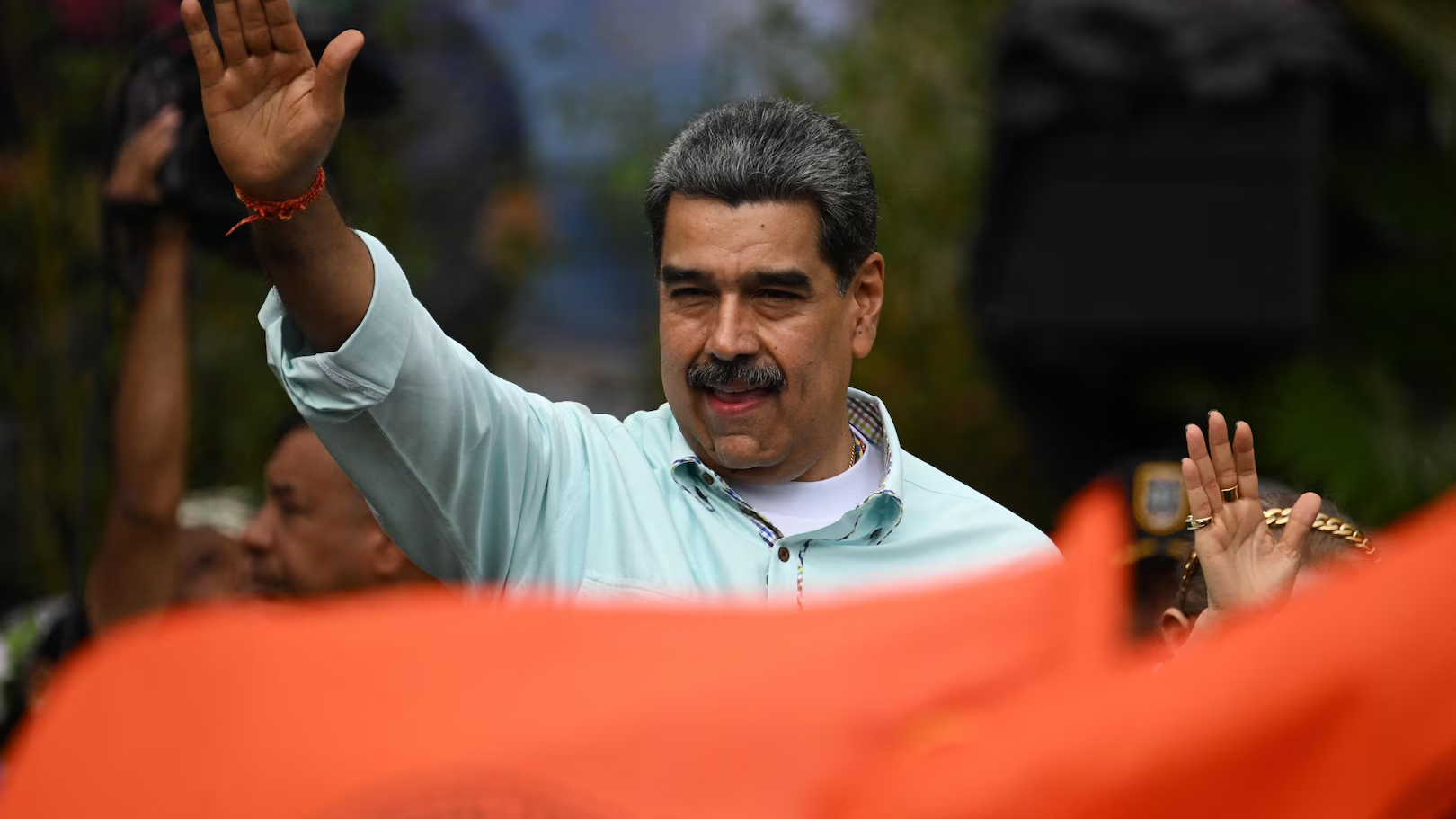
Throughout his presidency, Maduro cultivated an image as a man of the people, frequently referencing his working-class roots and experience as a bus driver. He often appeared in casual clothing, dancing salsa or playing musical instruments on television. In one notable instance less than two weeks before his capture, Maduro appeared on national television singing John Lennon’s “Imagine” while advocating for reduced tensions with the United States.
The Final Days and Capture
In November 2025, President Trump reportedly called Maduro and issued an ultimatum: leave Venezuela within one week with his immediate family or face consequences. Maduro refused the offer, apparently believing his military could defend against US action or that Trump was bluffing. The Trump administration then closed Venezuelan airspace and positioned substantial military assets in the Caribbean.
On January 3, 2026, US forces launched a large-scale strike on Venezuela, and Delta Force operatives captured Maduro at his presidential palace in Caracas. He was transported aboard the USS Iwo Jima and taken to the United States to face criminal charges. Thus ended the rule of a leader who had transformed Venezuela from one of Latin America’s wealthiest nations into one of its poorest, presiding over economic collapse, mass emigration, and humanitarian catastrophe.
