


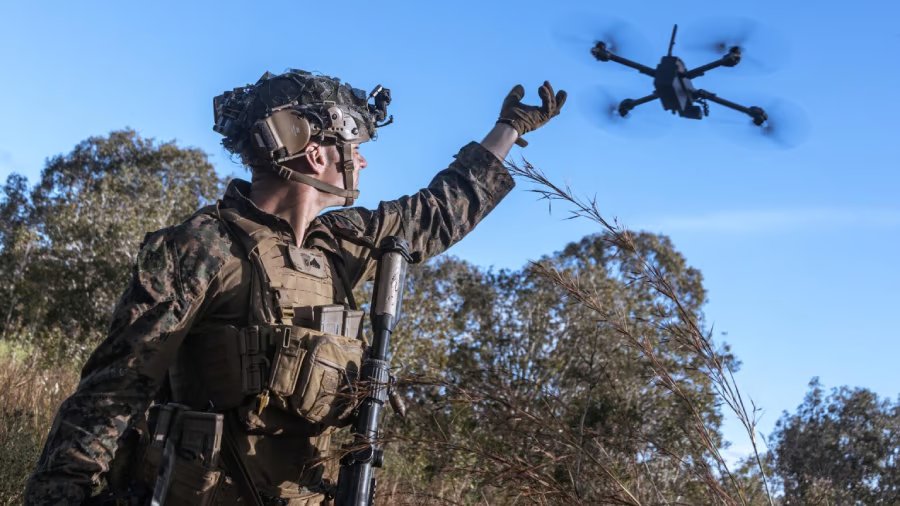
The Pentagon is pushing ahead with one of the most ambitious military technology pivots in modern history, seeking more than $54 billion to expand the use of artificial intelligence and autonomous systems in warfare.
New budget documents show the funding would go toward a newly formed unit, the Defense Autonomous Warfare Group (DAWG), marking what analysts describe as an escalation in the race to integrate AI into combat operations.
According to details reported by The Guardian, the funding represents a staggering increase of more than a hundredfold compared to previous allocations for similar programs.
The money is expected to support a wide range of systems, including autonomous drones and remotely operated platforms designed for deployment in multiple environments, from underwater missions to aerial combat. A key focus is the so-called “Drone Dominance” initiative, which aims to scale up the use of unmanned systems on the battlefield.
A doctrine gap and lessons from past wars
In an opinion piece for The Hill, former CIA director David Petraeus and tech entrepreneur Isaac C. Flanagan called it “the largest single commitment to autonomous warfare in history.” While the dollar amount is eye-popping, experts are worried the US is buying the tools before it knows how to use them.
Petraeus and Flanagan warned that the military risks repeating the mistakes of the early Iraq and Afghanistan wars. Back then, the US bought Predator drones but didn’t have the staff or the playbook to run them efficiently. Today, they argue that less than 2% of this new $54 billion is being spent on doctrine and training.
“Without such a joint doctrine, ‘autonomous’ is just a label, not a capability,” Petraeus and Flanagan wrote in The Hill. They added a warning about the global race for tech supremacy: “The U.S. will outspend its competitors on remotely piloted and autonomous hardware, but the decisive asymmetry may lie in how quickly operational experience translates into adaptation.”
The funding request has sent a surge through the defense-tech ecosystem. Established players like Palmer Luckey’s Anduril and newer startups like Skydio and Powerus, a company backed by Donald Trump’s two eldest sons, stand to gain significantly, according to the Guardian.
Olaf Hichwa, the co-founder of Neros Technologies, told The Guardian he sees the move as a sign that the Pentagon is finally learning from the front lines in Ukraine.
“What I’m excited for is that the Pentagon seems to be taking battlefield feedback seriously from Ukraine and from Centcom and around the world. This is a clear vote of confidence in small drones and I am hopeful it will be spent on useful systems,” Hichwa said.
However, not everyone is convinced the money is being distributed wisely. Kristofer Harrison, a former State Department specialist, told The Guardian that the fund “seems like a slush fund for Anduril,” suggesting the US should instead invest in the cheaper, battle-tested drone technology currently being produced in Ukraine.
The funding comes as the US is slashing Chinese-made drones and components from its supply chain. Petraeus and Flanagan argue that, unlike previous military transitions, early advantages in autonomous warfare will create persistent gaps that grow harder to close over time.
They recommend that Congress allocate at least 5% of funding to doctrine, training, and force design. Otherwise, they warn, this $54 billion investment risks producing not a decisive fighting force, but “a very expensive inventory.”
Also read: China’s push to make military-grade infrared chips far cheaper shows how fast the global race in defense technology is widening.
