


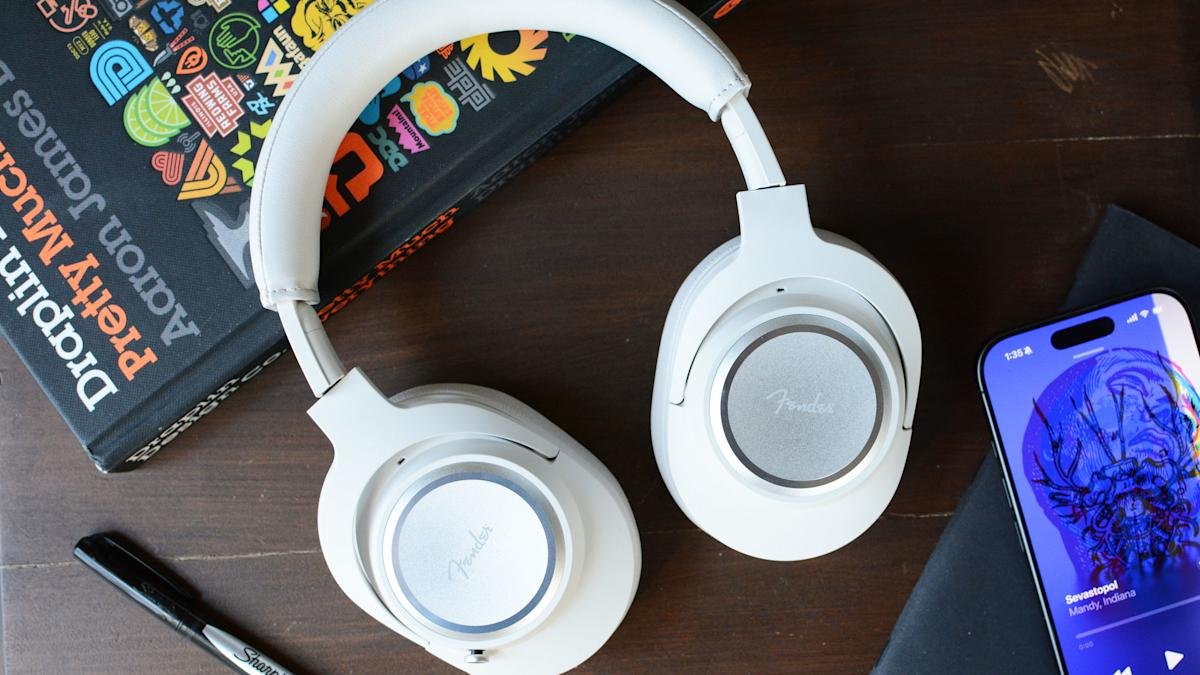
I know what you’re thinking: “Isn’t Fender a guitar company?” It sure is, and has been one of the most iconic names in guitars and amplifiers since 1946. So what is the company doing making headphones and speakers? Well, it isn’t, exactly. Like Zound Industries used to do with Marshall (before buying the amp business), another company is licensing the Fender name for its consumer audio products. Fender Audio, the brand that’s on the headphones I’m reviewing, is owned by the Fender Corporation, but Riffsound oversees the design and production of portable audio gear.
The first products from Fender Audio are the Mix headphones and the Elie speaker (in two sizes). The company revealed these in January before properly showing them off at CES. I’ll get to those speakers in a few weeks, but the Mix headphones are first up on the review docket.
With the Mix, Fender Audio seeks to offer a set of premium over-ear, noise-canceling headphones at a lower price than the likes of Sony, Bose and Sennheiser. There’s also marathon battery life, several smart design touches, a lossless Bluetooth transmitter and swappable parts that combine for a unique formula to take on those big names. I’m honestly impressed that Fender Audio could cram all of that in a more affordable package, but the final verdict on the Mix isn’t so straightforward.
Fender Audio’s first set of headphones makes a strong initial impression, but a deft hand with tuning and some added utility would’ve made them even better.
- Smart design touches
- Ready for lossless streaming
- Bass-heavy stock tuning
- Lacks modern features like wear detection and head gestures
What’s good about the Fender Mix headphones?
Fender Audio made numerous smart design decisions on the Mix headphones, and they resulted in my favorite things about using them. To start, you can swap out the ear pads, ear cups and headband as you see fit. The ear cups attach to the headband via USB-C ports, so they’re easy to snap on and off. Obviously, this allows you to change the look of the Mix over time, within the bounds of Fender’s available colors.
Underneath the ear pads, Fender put a storage slot for the lossless dongle on the left side and gives you access to the removable battery on the right. I’m thrilled that I can enjoy higher quality Bluetooth connectivity without having to remember to bring along such a small accessory. Plus, it’s nice to know that users will be able to install a fresh battery, provided the company sells those at some point.
I also enjoy how Fender Audio designed the onboard controls. First, they’re physical buttons, which are always my preference over touch- or gesture-based options. Second, the main one is a five-way joystick, so they’re very simple. Press it to play/pause, press and hold for pairing mode or press longer to power on or off. If you push the joystick up or down, you can adjust the volume, while moving it left and right skips the track forward or backward. You can also push down twice to enable Auracast pairing right on the headphones. A second button, which is just the regular kind, is used to cycle through noise canceling modes: ANC, transparency and both off.

The lossless Bluetooth dongle inside the left ear cup (Billy Steele for Engadget)
Sonically, the Mix headphones are at the height of their powers in lossless mode, which is enabled by the Bluetooth dongle hidden inside the ear cup. Bass tuning that’s otherwise overpowering in most cases is restrained, and you can pick up finer details in the more balanced mix. When listening to Watchhouse’s Rituals, I got the sense that I was surrounded by the band, with strings, drums and vocals enveloping my ears with sound — rather than it simply being projected from the left and right channels. There’s more nuance with the lossless mode, and it kept calling me back to the Mix headphones at the times when I’d probably opt for the conveniences of earbuds or a speaker.
ANC performance is respectable, although it’s not on the level of Bose. It’s good enough to block out mild-to-moderate distractions, but it struggles with louder human voices and sudden jolts of noise. It will certainly do the job in the office or coffee shop, but you may notice some sounds invade your ears during a commute. For calls, transparency mode provides natural sound and it picks up enough of my voice that I never felt the need to shout. Call quality, though, is a different matter (more on that in a bit).
Another big perk of the Mix is its long battery life. Fender Audio says you’ll get up to 52 hours with ANC on or a whopping 100 hours with it off. The company is forthcoming with the fact that the latter number is achieved at 50 percent volume, which will be too low for most “regular” use. Still, with noise canceling enabled and the volume around 70 percent, I had 52 percent battery left after nearly 30 hours of use. I spent most of that time with either ANC or transparency mode on.
What’s not so good about the Fender Mix?

The five-way joystick and ANC button on the Fender Mix (Billy Steele for Engadget)
Out of the box, Fender Mix’s tuning is too bass heavy. I realize a lot of people prefer a thundering low-end tone out of their headphones, but I found it to be too overpowering here. The stock sound profile is my biggest issue with this model, although it’s somewhat alleviated by using the lossless Bluetooth dongle. In that mode, the bass is slightly subdued, but it’s still quite prominent at times when it shouldn’t be.
On that Watchhouse album, the kick drum starts to drive the sound, rather than the guitars, mandolin and other instruments. When I listen to the same songs on other headphones, I’ve noticed a better blend of drums and strings. With more intense genres, like the hardcore riffs and breakdowns of Incendiary’s Product of New York, the booming bass isn’t as much of an issue. The distorted guitars still cut through, and there’s plenty of texture in their tone. And when each song hits its climax, the cranked up lows offer extra oomph. It works for metal, but it isn’t always nice for bluegrass, jazz and synth-laiden electronic tunes where the extra bass can muddy the mix.
The Fender Mix also lacks many of the smart features that are present in premium headphones today, which is probably how the company is able to sell them for $299. Things like automatic EQ tweaks and adaptive ANC are missing, as is automatic pausing when you speak or things like head gestures. These headphones don’t have wear detection either, so they don’t pause the audio when you take them off. There’s also no app available to dial in the EQ or adjust other settings (it’s coming soon).
These headphones only have two microphones for calls, and you can tell almost instantly that those are insufficient. Despite claims of “crystal clear calls,” your voice will just sound okay to the person on the other end. Honestly, I would’ve sounded better just using my iPhone with no headphones. The Mix works to get your voice across, but don’t dream of dialing into a podcast recording with them. What’s more, the Mix isn’t good at blocking background noise, so you’ll need to use them in a quiet location to have a chance at sounding decent. Which, again, is about the best these headphones can muster.
While the modular design allows for a decent degree of customization, the extra parts you’ll need aren’t on sale yet. What’s more, only two colors — white, which is really more of a light gray, and black — are currently available. So, for now, one of the perks of the Mix remains untapped.
Wrap-up

The Fender Mix headphones (Billy Steele for Engadget)
There’s a lot to like about the Fender Mix, from the clever design choices to the crisp, detailed sound. The lack of finesse with the bass tuning and the omission of advanced features, particularly the absence of an app for settings changes, keeps these headphones firmly planted in the midrange category.
Clearly that’s not what the company is aiming for with tools like the lossless Bluetooth dongle, but that’s where it lands for me at the end of the day. So, at $299, the Mix is a tough call when a $250 price tag would make these an easier sell. Sure, there’s enough here to make these a capable daily audio accessory, but not everything I’d need to call them a must buy.
