


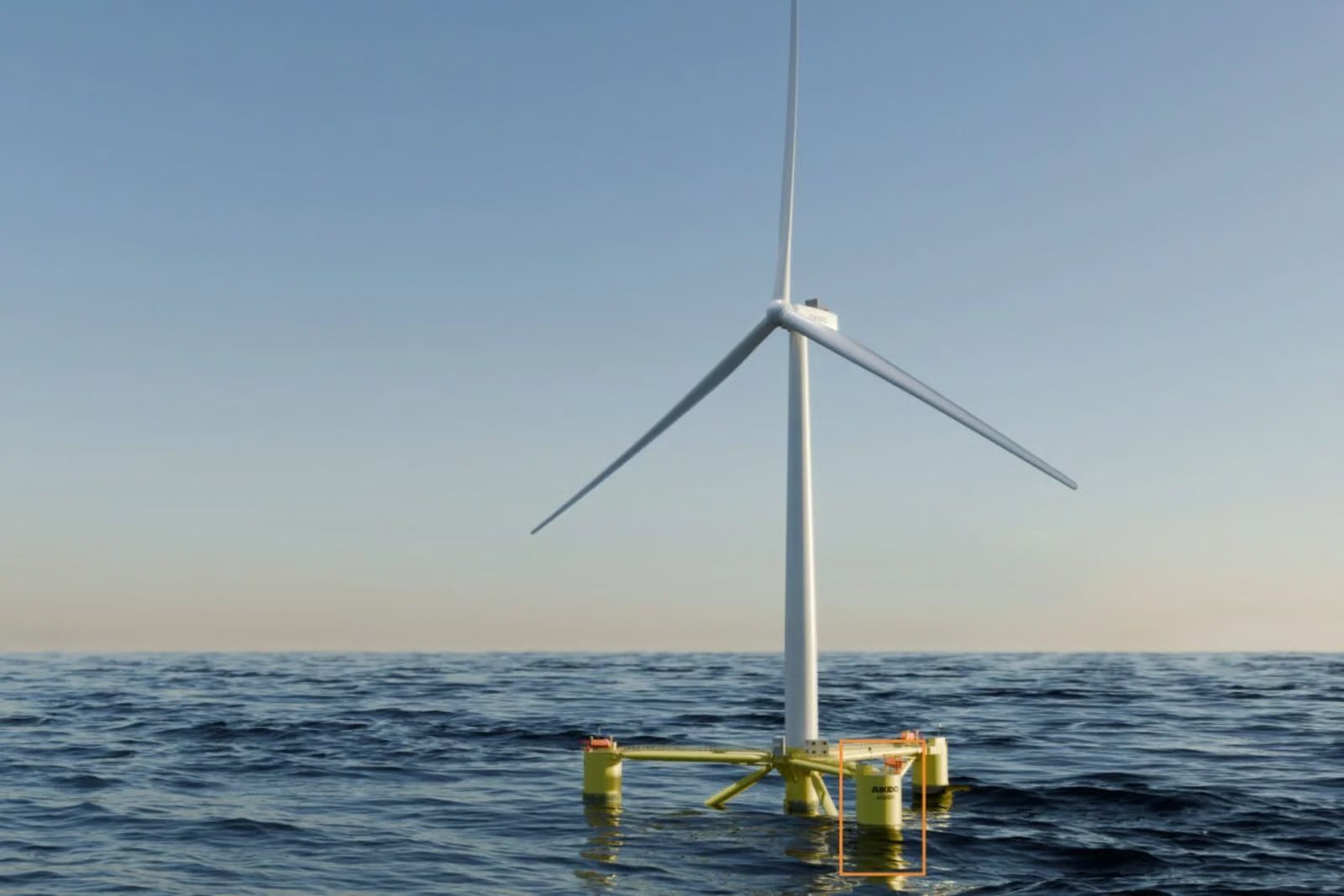
Data centers in space have dominated headlines in recent weeks, yet a far nearer option with vast space and renewable energy potential may lie beneath the ocean.
Offshore wind developer Aikido Technologies has announced plans to launch a 100-kilowatt demonstration data center off the coast of Norway this year. The unit will be housed in a submerged pod beneath a wind turbine, anchored to the seabed. Power will come from the turbine above, while data will be transmitted through a fibre-optic cable laid along the seabed.
If the demonstration succeeds, Aikido plans to deploy a larger 10- to 12-megawatt data center off the coast of the United Kingdom in 2028, powered by a 15- to 18-megawatt turbine.
Aikido was founded less than five years ago with the concept of floating offshore wind platforms designed to make deploying turbines cheaper and faster. The platform is anchored to the seabed, limiting movement even in the harsh conditions of the North Sea.
According to CEO Sam Kanner, the data center concept emerged when he realised the turbine platform already provided two things hyperscalers desperately need: large amounts of renewable energy and access to natural cooling.
The wind turbine provides the power, and offshore wind farms typically generate up to five times more energy than onshore wind. In the North Sea, strong and consistent winds keep turbines operating for longer periods, sometimes producing more electricity than the grid can absorb. Meanwhile, the surrounding seawater can cool the data center, removing the need for complex cooling systems.
Aikido is not the first company to test a data center underwater.
In 2018, Microsoft deployed Project Natick, a submerged data center on the seabed near the Orkney Islands. The trial was largely successful, with only six of the 864 servers failing during the two-year deployment. Microsoft later open-sourced its related patents in 2021 and abandoned the project entirely in 2024.
The allure of space
While the ocean may be closer and easier to access, the idea of data centers in space has captured the imagination of several companies and governments.
Elon Musk has been among the most vocal proponents, using the concept as part of the rationale for bringing his two companies, SpaceX and xAI, closer together. SpaceX would likely be the company best positioned to attempt such a project, although experts say it remains years away from being cost-effective.
China’s aerospace sector, supported by the government, is also exploring plans to place data centers and digital infrastructure into orbit within the next few years. The country is seeking to strengthen its position in the global space economy through initiatives spanning data infrastructure, space tourism, and other aerospace operations.
Huge capacity increase needed
The growth of artificial intelligence has led to a surge in demand for data center capacity. Goldman Sachs estimates that an additional 42 gigawatts of operational capacity will be added by 2030, although that would still fall short of the 83 gigawatts of demand forecast by Bain.
At the same time, total energy consumption from data centers is expected to double by 2030, largely driven by AI workloads.
OpenAI, one of the leaders of the AI boom, could account for as much as 10 gigawatts of this new capacity if it succeeds in building the data centers planned under the Stargate project. The company is reportedly targeting around $600 billion in infrastructure investment by 2030, much of it tied to this initiative.
Even so, it is unlikely that every planned data center will ultimately be built. Projects can stall for a range of reasons, including funding shortfalls, companies collapsing, reduced infrastructure spending, opposition from local communities, or a potential slowdown in the AI market itself.
A study by the Uptime Institute suggests that roughly half of announced projects will either fail to reach construction or will be delayed significantly.
