


When Apple unveiled the iPhone 17 lineup, it talked up major battery gains. But a side-by-side test suggests the story is more nuanced.
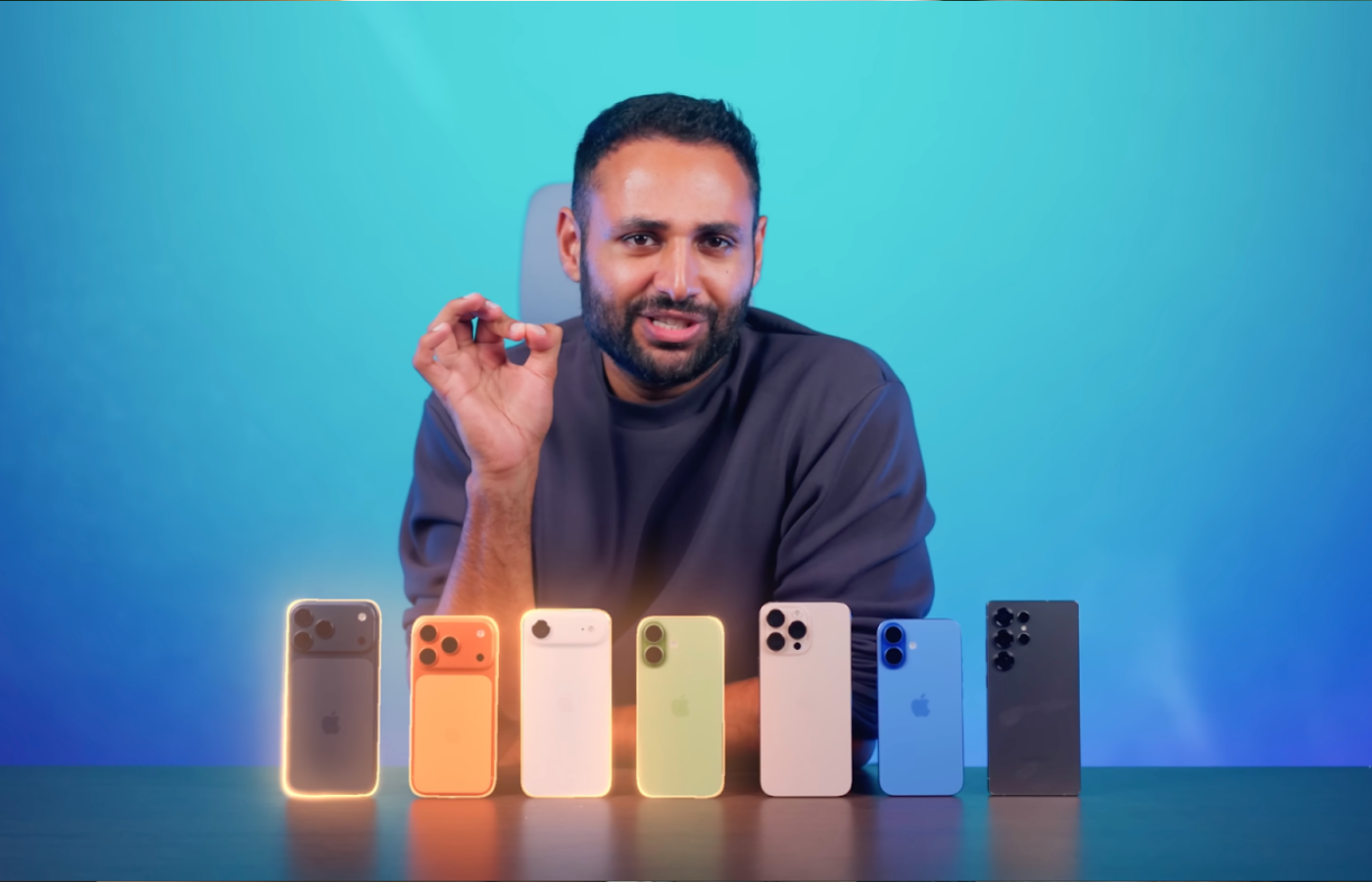
Popular tech creator Arun Maini, better known as Mrwhosetheboss, lined up every iPhone 17 model and ran them through what he described as a realistic day of use to determine which model actually lasts the longest and whether Apple’s bold promises hold up.
The experiment compared the iPhone 17, 17 Pro, 17 Pro Max, and the new Air model against the iPhone 16, 16 Pro Max, and Samsung’s Galaxy S25 Ultra.
All phones were charged to 100%, updated to the latest software, and used in a controlled 16°C room. The usage simulated a normal day: watching YouTube, scrolling through Instagram and X, messaging on Slack, streaming music, and recording 4K video at 60 fps. Devices were kept side by side to ensure consistency.
Apple had claimed up to a 35% increase in battery life with the new generation. The company also said the Pro models would deliver an “enormous leap” compared to their predecessors. Early on, the iPhone 17 Pro Max and iPhone 16 Pro Max were nearly identical in performance.
However, after three and a half hours, Maini noted that the base iPhone 17 wasn’t significantly outperforming the iPhone 16, despite Apple’s claims.
The eSIM factor
One key detail could explain part of the gap between expectations and results.
Apple has been pushing eSIM-only models in certain markets, including the US. Without a physical SIM tray, the company can fit a slightly larger battery inside the phone. According to the test discussion, eSIM versions of the iPhone 17 Pro Max have about 5.5% more battery capacity, while the iPhone 17 Pro sees nearly a 7% increase.
However, Maini’s UK-based test units used physical SIM cards, meaning they did not benefit from that extra capacity. That may help explain why the real-world results showed more modest gains.
The first to fall: iPhone 17 Air
The thinnest model in the lineup, the iPhone 17 Air, struggled the most.
It was the first device to shut down, lasting 7 hours and 18 minutes. Recording 4K video and sustained heavy use appeared to hit the slim phone especially hard.
In the video, Maini said, “Apple said that this phone [Air] should have the same battery life as the iPhone 16 Pro,” highlighting the gap between expectation and outcome. He added, “I don’t think that’s terrible battery life, it’s about the upper end of what I expected given how thin the thing is. It just really makes it tangible how much you are giving up to have a thin phone.”
The middle ground: 17 and 17 Pro
The base iPhone 17 managed 10 hours and 28 minutes, beating the iPhone 16 by about 40 minutes. That’s an improvement, but not the dramatic leap some might have expected. The iPhone 17 Pro eked out a slightly longer life at 10 hours and 48 minutes, better than the base model, but not by a landslide.
The Android contender: Samsung S25 Ultra
Samsung’s flagship put up a respectable fight, lasting 11 hours and 58 minutes. That’s enough to outlast every iPhone except the Max models, proving that Android flagships aren’t messing around when it comes to endurance.
The champion: iPhone 17 Pro Max
Taking the top spot with 13 hours exactly was the iPhone 17 Pro Max. That’s about 45 minutes longer than the iPhone 16 Pro Max, a 6% improvement, which is solid but falls short of Apple’s more ambitious claims.
However, here’s where that eSIM caveat comes back into play. The reviewer noted that the eSIM-only versions of these phones would have lasted approximately 13 hours and 45 minutes, a number that gets much closer to what Apple promised.
What it means for buyers
The test reinforces one key takeaway: “The battery life you get is not really about whether you go Pro or not. It’s really just what size of phone you get,” according to Maini.
For buyers in eSIM-only markets, the gains could be slightly stronger than those shown in this UK-based test. But for many users, especially outside the US, the iPhone 17 lineup represents an incremental step forward rather than a dramatic battery revolution.
Also read: iPhone settings can stretch daily battery life with tweaks like Auto-Brightness and Low Power Mode.
