


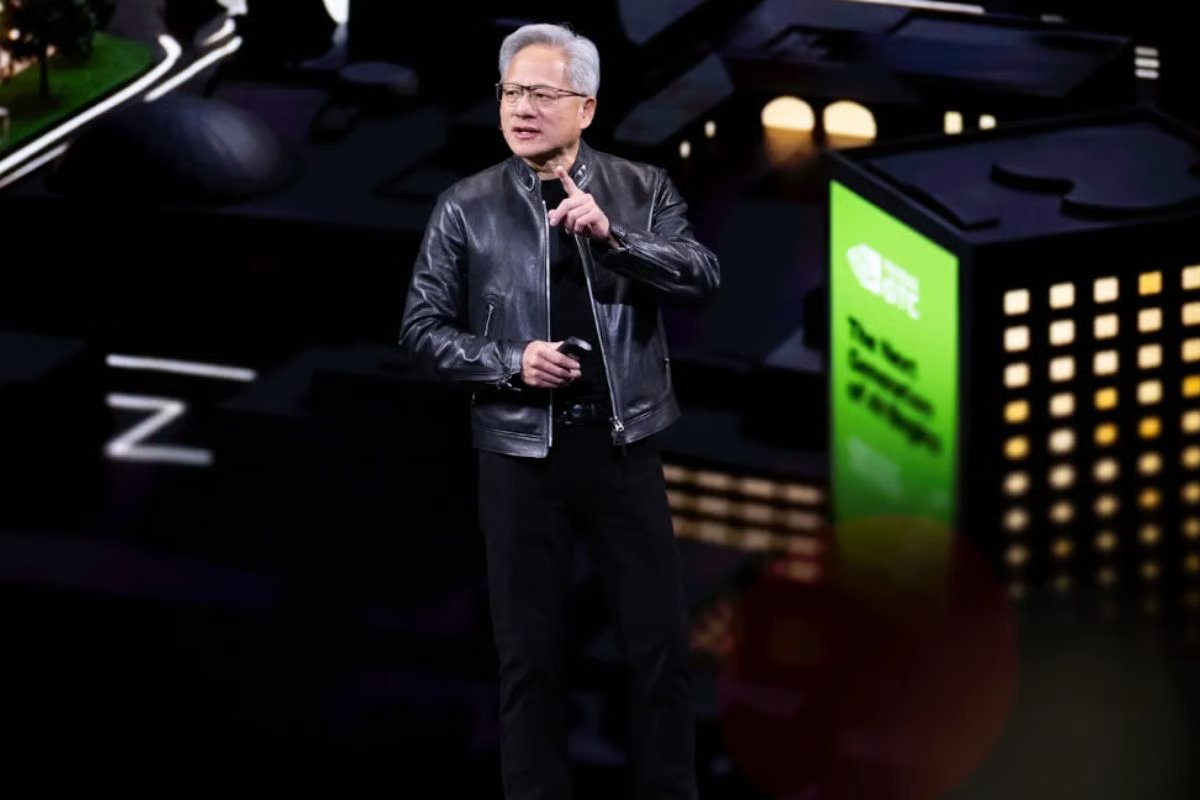
I’ve been covering the tech sector for a long time, and I’ve seen my share of “platform shifts.” Usually, it’s a lot of hype followed by a slow crawl toward reality. But what I witnessed at this year’s GTC keynote from Nvidia CEO Jensen Huang was something entirely different.
We aren’t just looking at faster chips or cooler software; we are witnessing the birth of the next industrial revolution. This is something we haven’t seen since the birth of the Internet, but the impact of AI will be orders of magnitude bigger.
The internet redefined how we work, live, and learn, and AI will do the same, reshaping global economics along the way. However, the Internet took decades to achieve this, and AI will have the same impact in just a few years.
As Huang put it, “Physical AI has arrived — every industrial company will become a robotics company”. But more importantly, every company is about to become a “token factory.”
In the old world, data centers were where we stored files and ran applications. In this new era, the data center is a factory. Its raw material is data, its power is accelerated computing, and its output is intelligence — delivered as tokens.
1. The token as the new commodity
The most profound takeaway from GTC is that we need to stop thinking about “compute” as an abstract resource and start thinking about it as the production of tokens. These are the building blocks of AI — the units of thought, reasoning, and action.
In a bit of a surprise, Huang quantified the sheer scale of demand: “I see through 2027, at least $1 trillion. Computing demand will be much higher than that.” Why? Because we’ve hit the “Inference Inflection.” AI is no longer just being trained; it is being used to think, reason, and act in real-time. Every time an AI agent helps a developer code, or a robot navigates a warehouse, it’s consuming tokens.
Huang’s comments of “AI now has to think. To think, it must infer. Every part of AI, every time it must think, it has to reason. It must generate tokens,” help us understand the correlation between inference and token generation, which is, of course, drives GPUs. This is good for Nvidia.
2. The modern operating system: Agentic AI
If the token is the commodity, then the “Agent” is the new worker. We saw a massive focus on agentic AI — systems that don’t just answer questions but execute tasks. This is where NemoClaw and OpenClaw come in.
Huang compared this moment to the rise of the personal computer: “Mac and Windows are the operating systems for the personal computer. OpenClaw is the operating system for personal AI”. This is a critical distinction. For AI to be useful in the enterprise, it needs to be more than a chatbot; it needs to be an autonomous assistant, or a “claw,” that can navigate file systems, use tools, and solve complex problems.
But here’s the rub: you can’t just let an autonomous agent loose on your corporate network without guardrails. Nvidia’s NemoClaw stack adds the necessary security and privacy layers, allowing companies to run these agents in isolated sandboxes. It’s about making AI productive without making it a liability.
3. The marriage of digital and physical AI
One of the most impressive parts of the keynote was the leap from digital agents to physical AI. We aren’t just talking about robots in a lab; we’re talking about global leaders like ABB, FANUC, and KUKA integrating Nvidia technology to deploy physical AI at scale.
Nvidia unveiled Cosmos 3, a world foundation model that unifies synthetic world generation with vision reasoning and action. This allows robots to learn in simulation — performing thousands of repetitions in a virtual world — before they ever set foot (or wheel) on a physical factory floor.
As Jensen noted, “Telecommunication networks are evolving into the AI infrastructure enabling billions of devices — from vision AI agents to robots and autonomous vehicles — to see, hear and act in real time”. This is why the partnership with T-Mobile is so vital. By turning the 5G network into a distributed AI computer, Nvidia is providing the “nervous system” for these physical agents.
The AI enabling of the telco network might hold the key to service providers using their networks to drive incremental revenue.
4. Infrastructure reimagined: BlueField-4 STX
To support this “token factory,” the underlying plumbing also needs to change. Modern AI workloads can’t run on 2020 storage architecture. This is why the announcement of BlueField-4 at the conference is so significant, though I felt it flew under the radar amid all the other announcements.
Agentic AI requires “long-context reasoning,” meaning it needs to remember everything that has happened in a conversation or across a multi-step task. Traditional storage is too slow for this. STX provides a modular foundation that keeps data close and accessible, delivering 5x higher token throughput.
Huang explained: “AI systems that reason across massive context and continuously learn require a new class of storage. Nvidia STX reinvents the storage stack”. If you want your AI factory to run at peak performance, you need a storage layer that doesn’t choke on the data.
5. Sovereignty and the open model initiative
Finally, unsurprisingly, Sovereign AI came up as an important topic. Every country and every company wants AI that reflects their specific data, culture, and values. Nvidia is facilitating this through its expanding family of open models, including Nemotron for agents, Cosmos for physical AI, and Alpamayo for autonomous vehicles.
Open-source AI has become a global force for innovation. By providing these “frontier-level” models to the community for free, Nvidia is ensuring that the “Intelligence Revolution” isn’t restricted to a few gatekeepers.
Final thought: The 1,000,000x leap
Huang claimed that computing demand has increased by a factor of 1,000,000 in the last two years. While that sounds like a typical Silicon Valley exaggeration, the logic holds up when you look at the shift from training to agentic inference.
The companies that win in the next five years won’t just be the ones with the most data; they’ll be the ones with the most efficient AI factories. They will be the ones who can generate tokens at the lowest cost and the highest speed to power a workforce of digital and physical agents.
We’ve moved past the era of “retrieval-based” computing. We are now in the era of Generative Intelligence. The factory floors are being laid, and the first tokens are rolling off the assembly line.
The only question left is: Is your company ready to be a manufacturer of intelligence?
Also read: Nvidia’s Vera Rubin platform shows how the company is cutting inference token costs as AI infrastructure demands keep rising.
